
长期 1 型糖尿病患者的空腹和餐刺激血清 C 肽。
Fasting and meal-stimulated serum C-peptide in long-standing type 1 diabetes mellitus.
机构信息
Department of Endocrinology, University of Groningen, University Medical Center Groningen, Groningen, The Netherlands.
Diabeter, Center for Paediatric and Adolescent Diabetes Care and Research, Rotterdam, The Netherlands.
出版信息
Diabet Med. 2023 Feb;40(2):e15012. doi: 10.1111/dme.15012. Epub 2022 Dec 4.
AIMS
This study aims to evaluate the stability of C-peptide over time and to compare fasting C-peptide and C-peptide response after mixed-meal tolerance test (MMTT) at T90 or T120 with C-peptide area under the curve (AUC) in long-standing type 1 diabetes.
METHODS
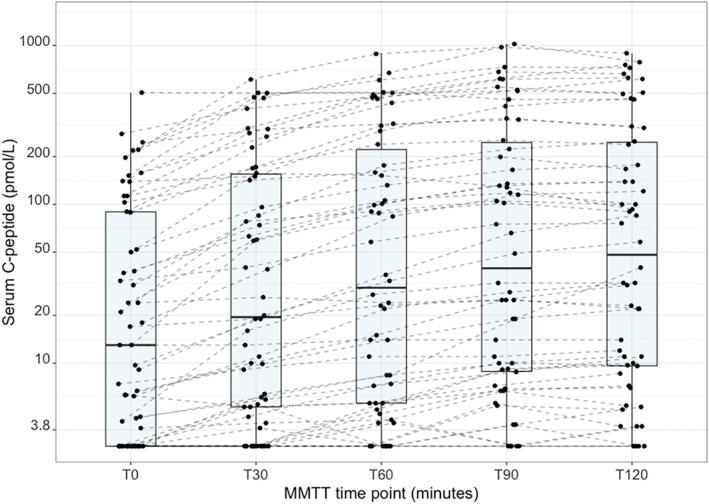
We included 607 type 1 diabetes individuals with diabetes duration >5 years. C-peptide concentrations (ultrasensitive assay) were collected in the fasting state, and in a subpopulation after MMTT (T0, just prior to, T30-T60-T90-T120, 30-120 min after ingestion of mixed-meal) (n = 168). Fasting C-peptide concentrations (in n = 535) at Year 0 and Year 1 were compared. The clinical determinants associated with residual C-peptide secretion and the correspondence of C-peptide at MMTT T90 / T120 and total AUC were assessed.
RESULTS
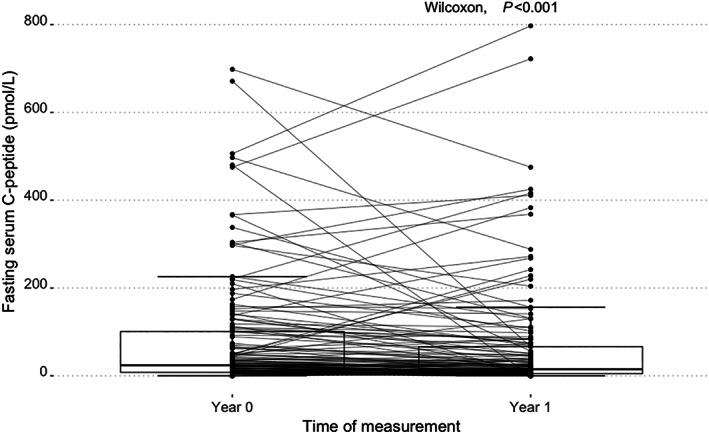
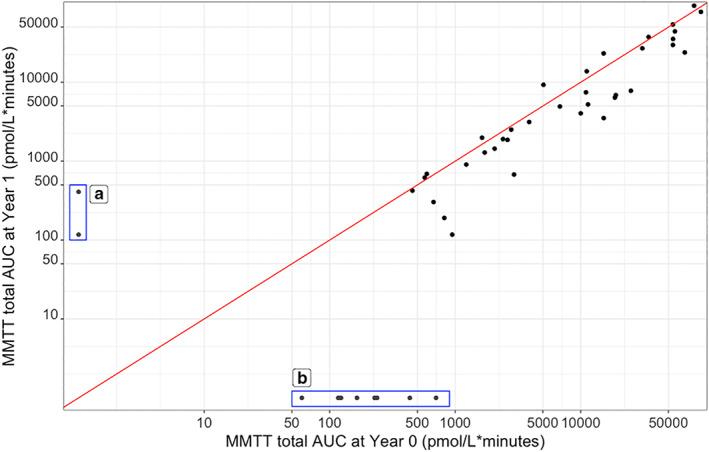
A total of 153 participants (25%) had detectable fasting serum C-peptide (i.e ≥ 3.8 pmol/L). Fasting C-peptide was significantly lower at Year 1 (p < 0.001, effect size = -0.16). Participants with higher fasting C-peptide had a higher age at diagnosis and shorter disease duration and were less frequently insulin pump users. Overall, 109 of 168 (65%) participants had both non-detectable fasting and post-meal serum C-peptide concentrations. The T90 and T120 C-peptide values at MMTT were concordant with total AUC. In 17 (10%) individuals, C-peptide was only detectable at MMTT and not in the fasting state.
CONCLUSIONS
Stimulated C-peptide was detectable in an additional 10% of individuals compared with fasting in individuals with >5 years of diabetes duration. T90 and T120 MMTT measurements showed good concordance with the MMTT total AUC. Overall, there was a decrease of C-peptide at 1-year follow-up.
目的
本研究旨在评估 C 肽随时间的稳定性,并比较 T90 或 T120 时空腹 C 肽和混合餐耐量试验(MMTT)后 C 肽反应与长病程 1 型糖尿病患者 C 肽曲线下面积(AUC)的关系。
方法
我们纳入了 607 例糖尿病病程>5 年的 1 型糖尿病患者。收集空腹时和 MMTT 后(T0,即在混合餐摄入前;T30-T60-T90-T120,摄入后 30-120min)的 C 肽浓度(超敏检测)(n=168)。比较了第 0 年和第 1 年的空腹 C 肽浓度(n=535)。评估了与残余 C 肽分泌相关的临床决定因素,以及 MMTT T90/T120 时和总 AUC 的 C 肽对应关系。
结果
共有 153 名(25%)参与者空腹血清 C 肽可检测(即≥3.8pmol/L)。第 1 年时空腹 C 肽明显降低(p<0.001,效应量=-0.16)。空腹 C 肽较高的参与者诊断时年龄较大,病程较短,且胰岛素泵使用率较低。总体而言,168 名参与者中有 109 名(65%)空腹和餐后血清 C 肽均不可检测。MMTT 时的 T90 和 T120 C 肽值与总 AUC 一致。17 名(10%)个体仅在 MMTT 时 C 肽可检测,而空腹时不可检测。
结论
与空腹时相比,在病程>5 年的个体中,在 MMTT 时可检测到 C 肽的个体增加了 10%。T90 和 T120 MMTT 测量与 MMTT 总 AUC 具有良好的一致性。总体而言,1 年后 C 肽下降。

 Zotero 插件