
早期乳腺癌疾病复发的风险评估:一项聚焦老年患者的血清代谢组学研究。
Risk assessment of disease recurrence in early breast cancer: A serum metabolomic study focused on elderly patients.
作者信息
Risi Emanuela, Lisanti Camilla, Vignoli Alessia, Biagioni Chiara, Paderi Agnese, Cappadona Silvia, Monte Francesca Del, Moretti Erica, Sanna Giuseppina, Livraghi Luca, Malorni Luca, Benelli Matteo, Puglisi Fabio, Luchinat Claudio, Tenori Leonardo, Biganzoli Laura
机构信息
Sandro Pitigliani Medical Oncology Department, Hospital of Prato, Prato, Italy.
Cro Aviano - National Cancer Institute - IRCCS, Medical Oncology and Cancer Prevention, Aviano, Italy.
出版信息
Transl Oncol. 2023 Jan;27:101585. doi: 10.1016/j.tranon.2022.101585. Epub 2022 Nov 17.
BACKGROUND
We previously showed that metabolomics predicts relapse in early breast cancer (eBC) patients, unselected by age. This study aims to identify a "metabolic signature" that differentiates eBC from advanced breast cancer (aBC) patients, and to investigate its potential prognostic role in an elderly population.
METHODS
Serum samples from elderly breast cancer (BC) patients enrolled in 3 onco-geriatric trials, were retrospectively analyzed via proton nuclear magnetic resonance (1H NMR) spectroscopy. Three nuclear magnetic resonance (NMR) spectra were acquired for each serum sample: NOESY1D, CPMG, Diffusion-edited. Random Forest (RF) models to predict BC relapse were built on NMR spectra, and resulting RF risk scores were evaluated by Kaplan-Meier curves.
RESULTS
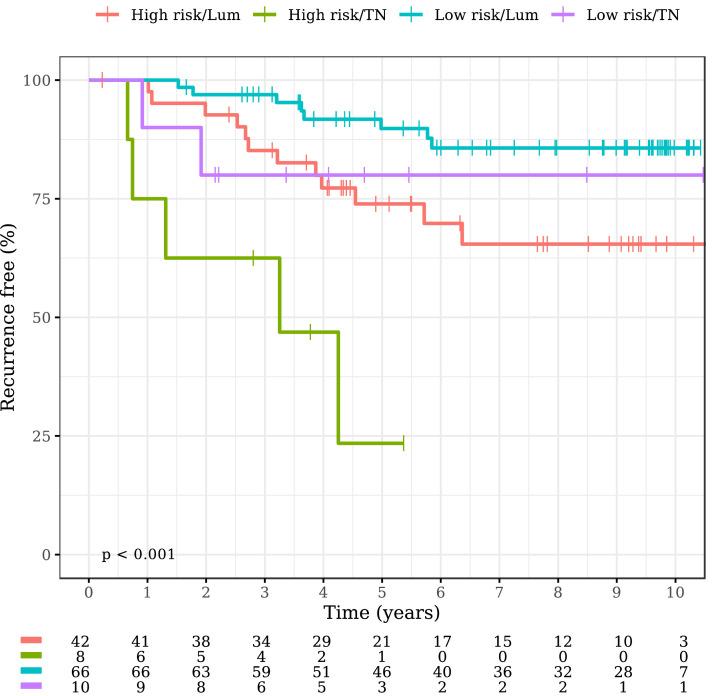
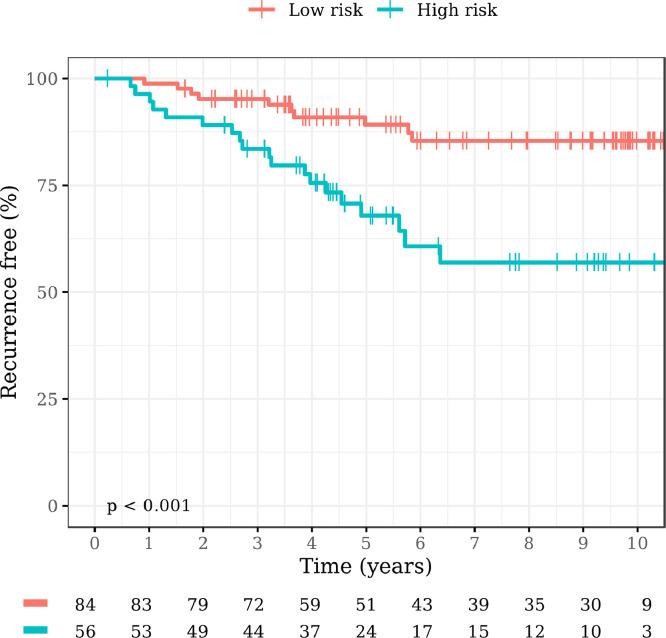
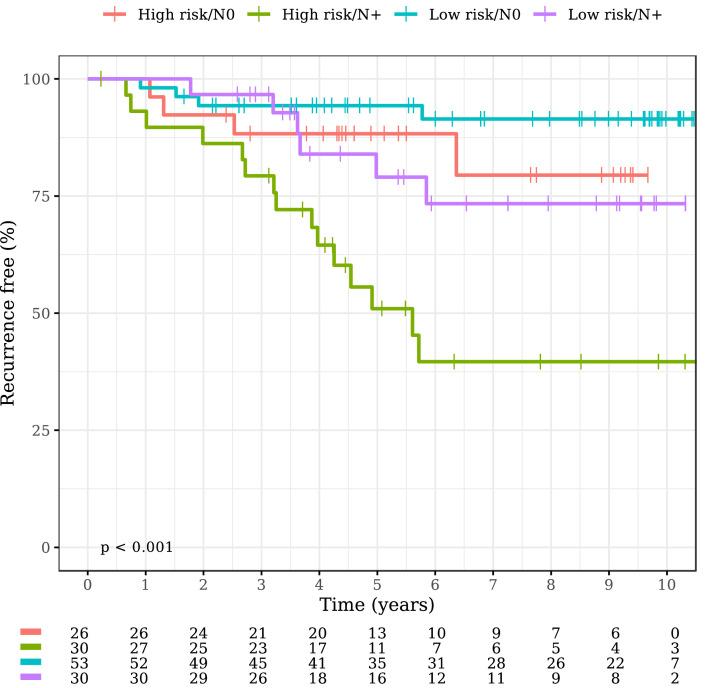
Serum samples from 140 eBC patients and 27 aBC were retrieved. In the eBC cohort, median age was 76 years; 77% of patients had luminal, 10% HER2-positive and 13% triple negative (TN) BC. Forty-two percent of patients had tumors >2 cm, 43% had positive axillary nodes. Using NOESY1D spectra, the RF classifier discriminated free-from-recurrence eBC from aBC with sensitivity, specificity and accuracy of 81%, 67% and 70% respectively. We tested the NOESY1D spectra of each eBC patient on the RF models already calculated. We found that patients classified as "high risk" had higher risk of disease recurrence (hazard ratio (HR) 3.42, 95% confidence interval (CI) 1.58-7.37) than patients at low-risk.
CONCLUSIONS
This analysis suggests that a "metabolic signature", identified employing NMR fingerprinting, is able to predict the risk of disease recurrence in elderly patients with eBC independently from standard clinicopathological features.
背景
我们之前的研究表明,代谢组学可预测早期乳腺癌(eBC)患者的复发情况,该研究未对年龄进行筛选。本研究旨在识别一种能区分eBC患者与晚期乳腺癌(aBC)患者的“代谢特征”,并研究其在老年人群中的潜在预后作用。
方法
对参与3项老年肿瘤试验的老年乳腺癌(BC)患者的血清样本进行回顾性分析,采用质子核磁共振(1H NMR)光谱法。每个血清样本采集三张核磁共振(NMR)光谱:1D NOESY、CPMG、扩散编辑谱。基于NMR光谱建立预测BC复发的随机森林(RF)模型,并通过Kaplan-Meier曲线评估所得的RF风险评分。
结果
收集了140例eBC患者和27例aBC患者的血清样本。在eBC队列中,中位年龄为76岁;77%的患者为管腔型,10%为HER2阳性,13%为三阴性(TN)乳腺癌。42%的患者肿瘤直径>2 cm,43%的患者腋窝淋巴结阳性。使用1D NOESY光谱,RF分类器区分无复发的eBC和aBC的灵敏度、特异性和准确率分别为81%、67%和70%。我们在已计算的RF模型上测试了每位eBC患者的1D NOESY光谱。我们发现,被归类为 “高风险” 的患者比低风险患者有更高的疾病复发风险(风险比(HR)3.42,95%置信区间(CI)1.58 - 7.37)。
结论
该分析表明,采用NMR指纹图谱识别的“代谢特征”能够独立于标准临床病理特征预测老年eBC患者的疾病复发风险。

 Zotero 插件