
衍生的中性粒细胞与淋巴细胞比值可预测 COVID-19 奥密克戎 BA.2 感染患者的预后。
The derived neutrophil to lymphocyte ratio can be the predictor of prognosis for COVID-19 Omicron BA.2 infected patients.
机构信息
Department of Anesthesiology and Perioperative Medicine, Shanghai Fourth People's Hospital, School of Medicine, Tongji University, Shanghai, China.
Shanghai Key Laboratory of Anesthesiology and Brain Functional Modulation, Shanghai, China.
出版信息
Front Immunol. 2022 Nov 2;13:1065345. doi: 10.3389/fimmu.2022.1065345. eCollection 2022.
BACKGROUND
Several systemic inflammatory biomarkers have been associated with poor overall survival (OS) and disease severity in patients with coronavirus disease 2019 (COVID-19). However, it remains unclear which markers are better for predicting prognosis, especially for COVID-19 Omicron BA.2 infected patients. The present study aimed to identify reliable predictors of prognosis of COVID-19 Omicron BA.2 from inflammatory indicators.
METHODS
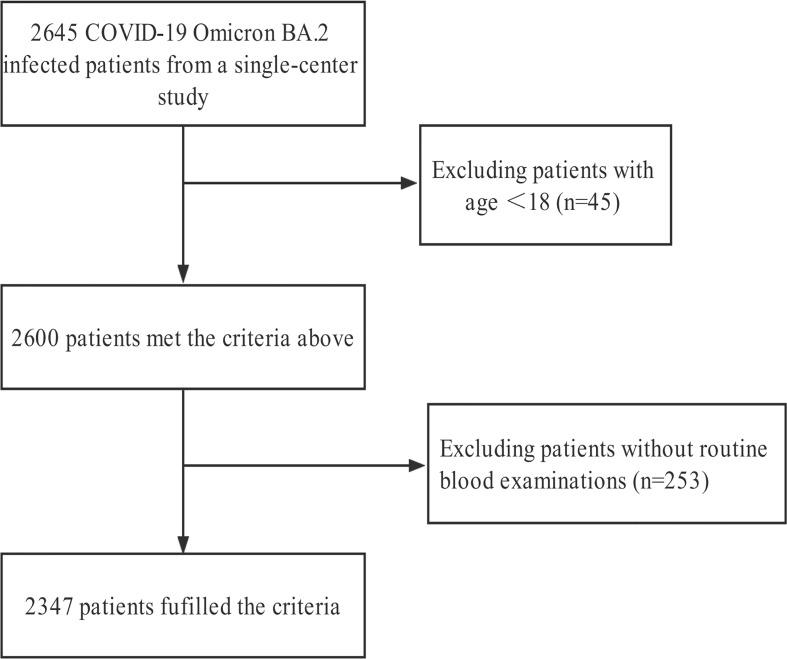
A cohort of 2645 COVID-19 Omicron BA.2 infected patients were retrospectively analyzed during the Omicron BA.2 surge in Shanghai between April 12, 2022, and June 17, 2022. The patients were admitted to the Shanghai Fourth People's Hospital, School of Medicine, Tongji University. Six systemic inflammatory indicators were included, and their cut-off points were calculated using maximally selected rank statistics. The analysis involved Kaplan-Meier curves, univariate and multivariate Cox proportional hazard models, and time-dependent receiver operating characteristic curves (time-ROC) for OS-associated inflammatory indicators.
RESULTS
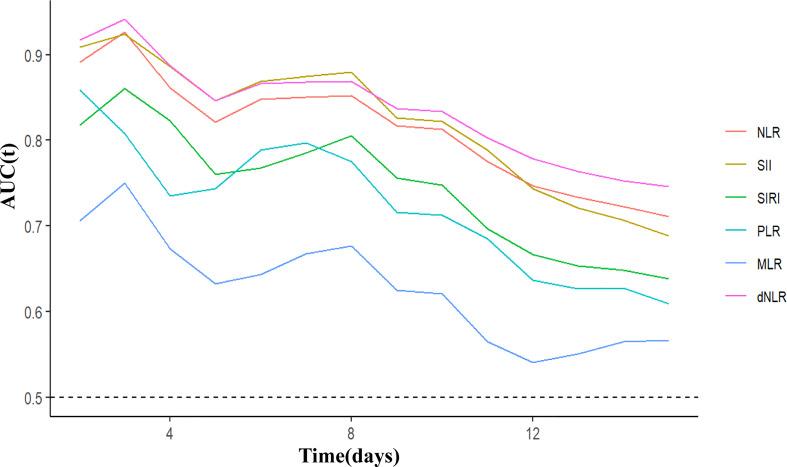
A total of 2347 COVID-19 Omicron BA.2 infected patients were included. All selected indicators proved to be independent predictors of OS in the multivariate analysis (all < 0.01). A high derived neutrophil to lymphocyte ratio (dNLR) was associated with a higher mortality risk of COVID-19 [hazard ratio, 4.272; 95% confidence interval (CI), 2.417-7.552]. The analyses of time-AUC and C-index showed that the dNLR (C-index: 0.844, 0.824, and 0.718 for the 5, 10, and 15 day, respectively) had the best predictive power for OS in COVID-19 Omicron BA.2 infected patients. Among different sub-groups, the dNLR was the best predictor for OS regardless of age (0.811 for patients aged ≥70 years), gender (C-index, 0.880 for men and 0.793 for women) and disease severity (C-index, 0.932 for non-severe patients and 0.658 for severe patients). However, the platelet to lymphocyte ratio was superior to the other indicators in patients aged <70 years.
CONCLUSIONS
The prognostic ability of the dNLR was higher than the other evaluated inflammatory indicators for all COVID-19 Omicron BA.2 infected patients.
背景
已有多项系统性炎症生物标志物与新型冠状病毒病 2019(COVID-19)患者的总体生存(OS)和疾病严重程度相关。然而,目前尚不清楚哪种标志物更适合预测预后,尤其是对于 COVID-19 奥密克戎 BA.2 感染患者。本研究旨在从炎症指标中确定 COVID-19 奥密克戎 BA.2 预后的可靠预测因子。
方法
回顾性分析了 2022 年 4 月 12 日至 6 月 17 日上海奥密克戎 BA.2 浪潮期间收治于上海交通大学医学院附属第四人民医院的 2645 例 COVID-19 奥密克戎 BA.2 感染患者。共纳入 6 项系统性炎症指标,采用最大选择秩统计计算其截断值。分析包括 Kaplan-Meier 曲线、单因素和多因素 Cox 比例风险模型以及 OS 相关炎症指标的时间依赖性受试者工作特征曲线(time-ROC)。
结果
共纳入 2347 例 COVID-19 奥密克戎 BA.2 感染患者。所有入选指标在多因素分析中均为 OS 的独立预测因子(均<0.01)。高衍生中性粒细胞与淋巴细胞比值(dNLR)与 COVID-19 较高的死亡率相关[风险比,4.272;95%置信区间(CI),2.417-7.552]。时间-AUC 和 C 指数分析表明,dNLR(C 指数:5、10 和 15 天时分别为 0.844、0.824 和 0.718)对 COVID-19 奥密克戎 BA.2 感染患者 OS 的预测能力最佳。在不同亚组中,dNLR 是 OS 的最佳预测因子,无论年龄(≥70 岁患者的 C 指数为 0.811)、性别(男性的 C 指数为 0.880,女性为 0.793)还是疾病严重程度(非重症患者的 C 指数为 0.932,重症患者为 0.658)。然而,血小板与淋巴细胞比值在<70 岁患者中的预测能力优于其他指标。
结论
dNLR 对所有 COVID-19 奥密克戎 BA.2 感染患者的预后能力均优于其他评估的炎症指标。


 Zotero 插件