
内质网应激作为未折叠蛋白反应和内质网自噬的触发因素在癌症生长和扩散中的作用
ER stress as a trigger of UPR and ER-phagy in cancer growth and spread.
作者信息
Cherubini Alessandro, Zito Ester
机构信息
Istituto di Ricerche Farmacologiche Mario Negri IRCCS, Milan, Italy.
Department of Biomolecular Sciences, University of Urbino Carlo Bo, Urbino, Italy.
出版信息
Front Oncol. 2022 Nov 3;12:997235. doi: 10.3389/fonc.2022.997235. eCollection 2022.
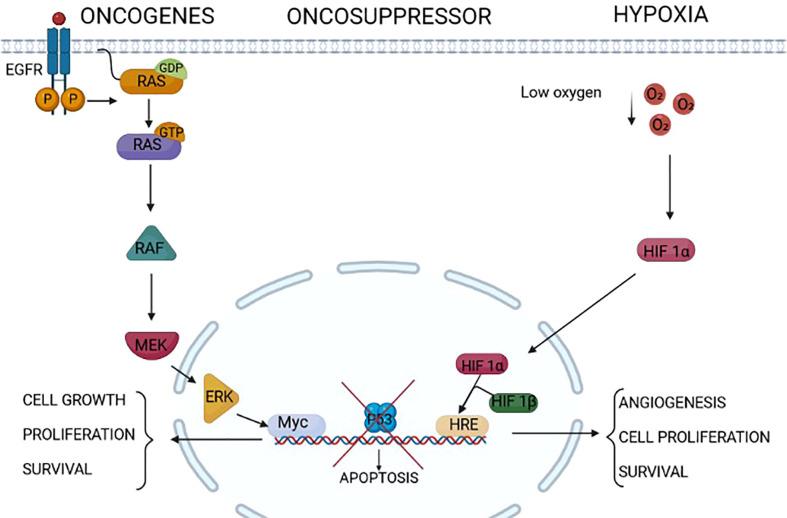
Tumors can survive environmental and metabolic stress by triggering homeostatic responses that re-establish the pre-stress status and permit them to grow and thrive. The endoplasmic reticulum (ER) is the organelle where proteins undergo post-translational modifications and are folded and exported to the secretory pathway. Its environment and activity are therefore fundamental for proteostasis, i.e., the plethora of mechanisms controlling protein formation, folding, degradation, and secretion, needed to assure protein balance and cellular health. In different tumor-related conditions, such as after the activation of oncogenes or under hypoxia and nutrient deprivation, the ER experiences stress, triggered by a high load of proteins to be folded compared to the limited folding capacity of the organelle. As a consequence, three ER membrane sensors and the related unfolded protein response (UPR) are activated. The UPR comprises a complex interconnection between signal transduction pathways that promote a homeostatic response that acts by increasing the amount of protein chaperones and of proteins involved in ER-associated protein degradation (ERAD) on one hand and attenuating protein translation on the other. ER-phagy, literally "eating" the ER, is part of another homeostatic response consisting of the clearance of non-functional ER portions including misfolded proteins. This response is also activated by a set of dedicated ER-phagy receptors after ER stimuli, which overlap the stimuli generating ER stress. Thus, the UPR and ER-phagy are two closely related homeostatic mechanisms that cooperate in re-establishing ER homeostasis. However, while the role of the UPR in favoring cancer growth and thriving by promoting angiogenesis, metastasis, chemotherapy resistance, and epithelial-to-mesenchymal transition is consolidated, that of ER-phagy is still in its infancy. This essay provides an overview of emerging concepts on ER stress, the UPR, and ER-phagy and their crosstalk in tumorigenesis. We also critically review new findings on their pharmacological targeting in cancer.
肿瘤可通过触发稳态反应来抵御环境和代谢应激,这些反应会重新建立应激前状态,使其得以生长和繁荣。内质网(ER)是蛋白质进行翻译后修饰、折叠并输出至分泌途径的细胞器。因此,内质网的环境和活性对于蛋白质稳态至关重要,即对于确保蛋白质平衡和细胞健康所需的控制蛋白质形成、折叠、降解和分泌的众多机制而言至关重要。在不同的肿瘤相关情况下,例如癌基因激活后、缺氧和营养剥夺时,由于与细胞器有限的折叠能力相比,需要折叠的蛋白质负载过高,内质网会经历应激。结果,三种内质网膜传感器和相关的未折叠蛋白反应(UPR)被激活。未折叠蛋白反应包括信号转导途径之间的复杂相互连接,这些途径促进一种稳态反应,一方面通过增加蛋白质伴侣和参与内质网相关蛋白降解(ERAD)的蛋白质的量来发挥作用,另一方面通过减弱蛋白质翻译来发挥作用。内质网自噬,字面意思是“吃掉”内质网,是另一种稳态反应的一部分,该反应包括清除包括错误折叠蛋白在内的无功能内质网部分。在受到内质网刺激后,一组专门的内质网自噬受体也会激活这种反应,这些刺激与产生内质网应激的刺激重叠。因此,未折叠蛋白反应和内质网自噬是两种密切相关的稳态机制,它们共同作用以重新建立内质网稳态。然而,虽然未折叠蛋白反应通过促进血管生成、转移、化疗耐药性和上皮-间质转化来促进癌症生长和繁荣的作用已得到证实,但内质网自噬的作用仍处于起步阶段。本文概述了内质网应激、未折叠蛋白反应和内质网自噬及其在肿瘤发生中的相互作用的新兴概念。我们还批判性地回顾了它们在癌症中药理学靶向的新发现。


 Zotero 插件