
感染严重急性呼吸综合征冠状病毒2(SARS-CoV-2)Delta或Omicron变种的孟加拉国患者的新冠病毒疾病(COVID-19)临床表现及抗体反应
Clinical Presentation of COVID-19 and Antibody Responses in Bangladeshi Patients Infected with the Delta or Omicron Variants of SARS-CoV-2.
作者信息
Ghosh Asish Kumar, Landt Olfert, Yeasmin Mahmuda, Sharif Mohiuddin, Ratul Rifat Hossain, Molla Maruf Ahmed, Nafisa Tasnim, Mosaddeque Mymuna Binte, Hosen Nur, Bulbul Md Rakibul Hassan, Mamunur Rashid, Islam Alimul, Shakil Shahjahan Siddike, Kaiser Marco, Amin Md Robed, Lytton Simon D
机构信息
Department of Virology, Dhaka Medical College Hospital, Dhaka 1000, Bangladesh.
TIB Molbiol GmbH, Eresburgstraße 22-23, 12103 Berlin, Germany.
出版信息
Vaccines (Basel). 2022 Nov 18;10(11):1959. doi: 10.3390/vaccines10111959.
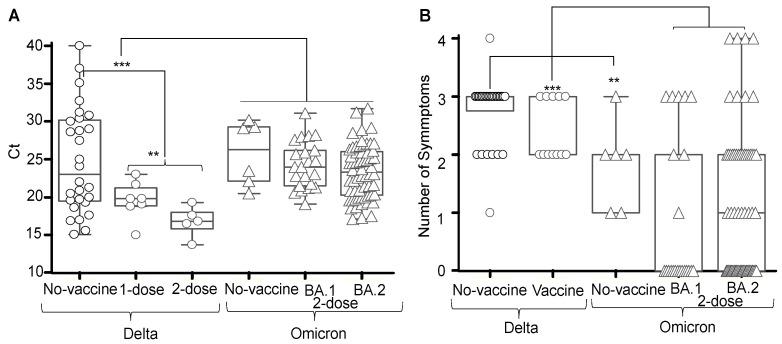
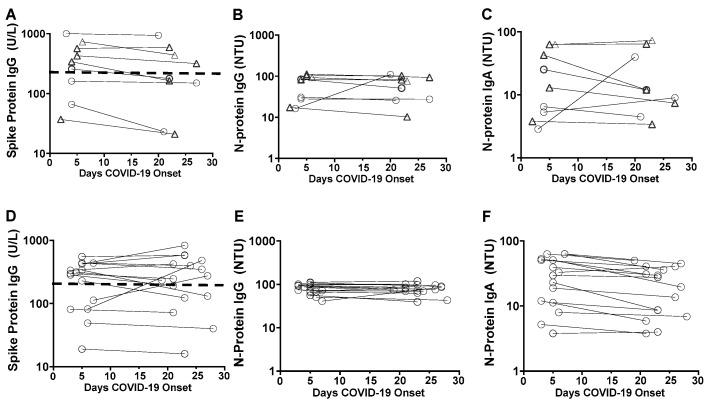
The clinical presentation of COVID-19 and the specific antibody responses associated with SARS-CoV-2 variants have not been investigated during the emergence of Omicron variants in Bangladesh. The Delta and Omicron variants were identified by post-PCR melting curve analysis of the spike (S) protein receptor binding domain amplicons. Anti-S-protein immunoglobulin-G anti-nucleocapsid (N)-protein immunoglobulin-G and immunoglobulin-A levels were measured by ELISA. The Delta variant was found in 40 out of 40 (100%) SARS-CoV-2 RT-PCR positive COVID-19 patients between 13 September and 23 October 2021 and Omicron variants in 90 out of 90 (100%) RT-PCR positive COVID-19 patients between 9 January and 10 February 2022. The Delta variant associated with hospitalization (74%, 80%, and 40%) and oxygen support (60%, 57%, and 40%) in the no vaccine, dose-1, and dose-2 vaccinated cases, respectively, whereas the Omicron COVID-19 required neither hospitalization nor oxygen support (0%, p < 0.0001). Fever, cough, and breathlessness were found at a significantly higher frequency among the Delta than Omicron variants (p < 0.001). The viral RNA levels of the Delta variant were higher than that of the Omicron variants (Ct median 19.9 versus 23.85; p < 0.02). Anti-spike protein immunoglobulin-G and anti-N-protein immunoglobulin-G within 1 week post onset of Delta variant COVID-19 symptoms indicate prior SARS-CoV-2 infection. The Delta variant and Omicron BA.1 and BA.2 breakthrough infections in the Dhaka region, at 240 days post onset of COVID-19 symptoms, negatively correlated with the time interval between the second vaccine dose and serum sampling. The findings of lower anti-spike protein immunoglobulin-G reactivity after booster vaccination than after the second vaccine dose suggest that the booster vaccine is not necessarily beneficial in young Bangladeshi adults having a history of repeated SARS-CoV-2 infections.
在孟加拉国出现奥密克戎变种期间,尚未对新冠病毒病(COVID-19)的临床表现以及与严重急性呼吸综合征冠状病毒2(SARS-CoV-2)变种相关的特异性抗体反应进行研究。通过对刺突(S)蛋白受体结合域扩增子进行聚合酶链反应(PCR)后熔解曲线分析来鉴定德尔塔和奥密克戎变种。采用酶联免疫吸附测定法(ELISA)检测抗S蛋白免疫球蛋白G、抗核衣壳(N)蛋白免疫球蛋白G和免疫球蛋白A水平。在2021年9月13日至10月23日期间,40例(100%)SARS-CoV-2逆转录聚合酶链反应(RT-PCR)阳性的COVID-19患者中均检测到德尔塔变种;在2022年1月9日至2月10日期间,90例(100%)RT-PCR阳性的COVID-19患者中均检测到奥密克戎变种。在未接种疫苗、接种一剂和接种两剂疫苗的病例中,德尔塔变种分别与住院(74%、80%和40%)和吸氧支持(60%、57%和40%)相关,而感染奥密克戎的COVID-19患者既不需要住院也不需要吸氧支持(0%,p<0.0001)。德尔塔变种患者出现发热、咳嗽和呼吸急促的频率显著高于奥密克戎变种(p<0.001)。德尔塔变种的病毒RNA水平高于奥密克戎变种(Ct中位数19.9对23.85;p<0.02)。在德尔塔变种COVID-19症状出现后1周内,抗刺突蛋白免疫球蛋白G和抗N蛋白免疫球蛋白G表明先前感染过SARS-CoV-2。在达卡地区,COVID-19症状出现240天后,德尔塔变种以及奥密克戎BA.1和BA.2突破性感染与第二剂疫苗接种和血清采样之间的时间间隔呈负相关。加强疫苗接种后抗刺突蛋白免疫球蛋白G反应性低于第二剂疫苗接种后的结果表明,加强疫苗对有多次SARS-CoV-2感染史的年轻孟加拉国成年人不一定有益。


 Zotero 插件