
基于社区的以健康素养为重点的宫颈癌防控干预措施在艾滋病毒感染者中的应用:一项随机试点试验。
Community-based health literacy focused intervention for cervical cancer control among Black women living with human immunodeficiency virus: A randomized pilot trial.
机构信息
The Johns Hopkins University School of Nursing, Baltimore, Maryland, USA.
The Johns Hopkins University Bloomberg School of Public Health, Baltimore, Maryland, USA.
出版信息
Health Expect. 2023 Feb;26(1):172-182. doi: 10.1111/hex.13644. Epub 2022 Nov 28.
BACKGROUND
Health literacy plays an essential role in how individuals process health information to make decisions about health behaviours including cancer screening. Research is scarce to address health literacy as a strategy to improve cancer screening participation among women living with human immunodeficiency virus (HIV), particularly Black women who, despite the heavy burden of cervical cancer, report consistently low screening rates.
AIM
To assess the feasibility, acceptability and preliminary efficacy of a health literacy-focused intervention called CHECC-uP-Community-based, HEalth literacy focused intervention for Cervical Cancer control-among women living with HIV.
METHODS
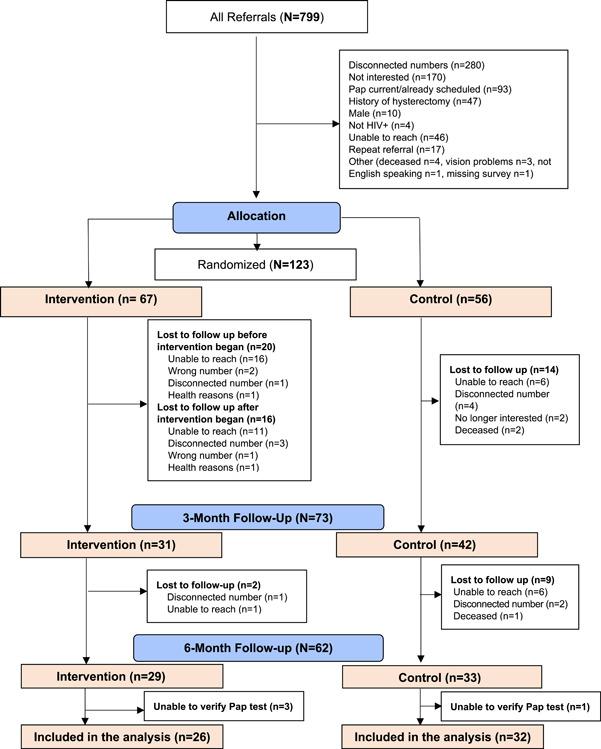
We conducted a community-based, single-blinded randomized pilot trial. A total of 123 eligible women were enrolled and randomized to one of two conditions, control (i.e., cervical cancer brochure) or intervention (cervical cancer brochure plus 30-60 min health literacy-focused education followed by monthly phone counselling and navigation assistance for 6 months). Study assessments were done at baseline, 3 and 6 months. The final analysis sample included 58 women who completed all data points and whose Papanicolaou (Pap) test status was confirmed by medical records.
RESULTS
All intervention participants who completed the programme would recommend the CHECC-uP to other women living with HIV. However, adherence in the experimental conditions was low (49.6% attrition rate including 20 women who dropped out before the intervention began) due, in large part, to phone disconnection. Those who had received the intervention had a significantly higher Pap test rate compared to women in the control group at 6 months (50% vs. 21.9%, p = .025). Participation in the intervention programme was associated with improved health literacy and other psychosocial outcomes at 3 months but the trend was attenuated at 6 months.
CONCLUSIONS
The CHECC-uP was highly acceptable and led to improved Pap testing rates among Black women living with HIV. Future research should consider addressing social determinants of health such as phone connectivity as part of designing a retention plan targeting low-income Black women living with HIV.
IMPLICATIONS
The findings should be incorporated into a future intervention framework to fulfil the unmet needs of Black women living with HIV to facilitate their decision-making about Pap test screening.
PATIENT OR PUBLIC CONTRIBUTION
Nineteen community members including women living with HIV along with HIV advocates and care providers participated in four focus groups to develop cervical cancer screening decision-relevant information and the health literacy intervention. Additionally, a community advisory board was involved to provide guidance in the general design and conduct of the study.
背景
健康素养在个体处理健康信息以做出健康行为决策方面发挥着重要作用,包括癌症筛查。针对健康素养作为提高艾滋病毒感染者(HIV)女性参与癌症筛查的策略的研究很少,尤其是黑人女性,尽管她们患有宫颈癌的负担沉重,但报告的筛查率却一直很低。
目的
评估一项以健康素养为重点的干预措施(称为 CHECC-uP-基于社区的、针对宫颈癌控制的健康素养重点干预)在 HIV 感染者中控制宫颈癌的可行性、可接受性和初步效果。
方法
我们进行了一项基于社区的、单盲随机试点试验。共有 123 名符合条件的女性入组并随机分为两组,对照组(即宫颈癌小册子)或干预组(宫颈癌小册子+30-60 分钟的健康素养重点教育,随后每月进行电话咨询和 6 个月的导航辅助)。在基线、3 个月和 6 个月时进行研究评估。最终分析样本包括完成所有数据点且巴氏涂片(Pap)检测状态经病历确认的 58 名女性。
结果
所有完成该项目的干预组参与者均会向其他 HIV 感染者推荐 CHECC-uP。然而,由于很大程度上是由于电话中断,实验组的依从性很低(包括 20 名在干预开始前退出的参与者在内,有 49.6%的失访率)。与对照组相比,接受干预的女性在 6 个月时的 Pap 检测率显著更高(50%比 21.9%,p=0.025)。在 3 个月时,参与干预方案与健康素养的提高和其他心理社会结果相关,但在 6 个月时这种趋势减弱。
结论
CHECC-uP 非常受欢迎,并提高了 HIV 感染者中黑人女性的 Pap 检测率。未来的研究应考虑解决健康的社会决定因素,如电话连接,作为针对低收入黑人 HIV 感染者的保留计划的一部分。
意义
研究结果应纳入未来的干预框架中,以满足 HIV 感染者中黑人女性对 Pap 检测筛查决策的未满足需求。
患者或公众贡献
包括 HIV 感染者在内的 19 名社区成员以及 HIV 倡导者和护理提供者参加了 4 次焦点小组,以制定与宫颈癌筛查决策相关的信息和健康素养干预措施。此外,社区咨询委员会参与其中,为研究的总体设计和实施提供指导。
 Zotero 插件