
蛋白质S-酰化对T细胞功能的调控。
Regulation of T cell function by protein S-acylation.
作者信息
West Savannah J, Boehning Darren, Akimzhanov Askar M
机构信息
Department of Biochemistry and Molecular Biology, McGovern Medical School, University of Texas Health Science Center at Houston, Houston, TX, United States.
MD Anderson Cancer Center and University of Texas Health Science at Houston Graduate School, Houston, TX, United States.
出版信息
Front Physiol. 2022 Nov 16;13:1040968. doi: 10.3389/fphys.2022.1040968. eCollection 2022.
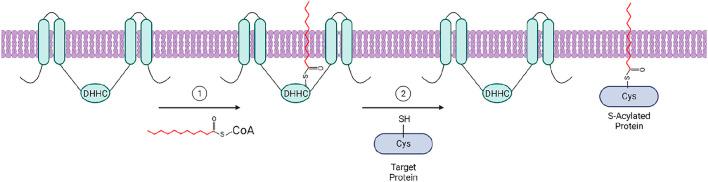
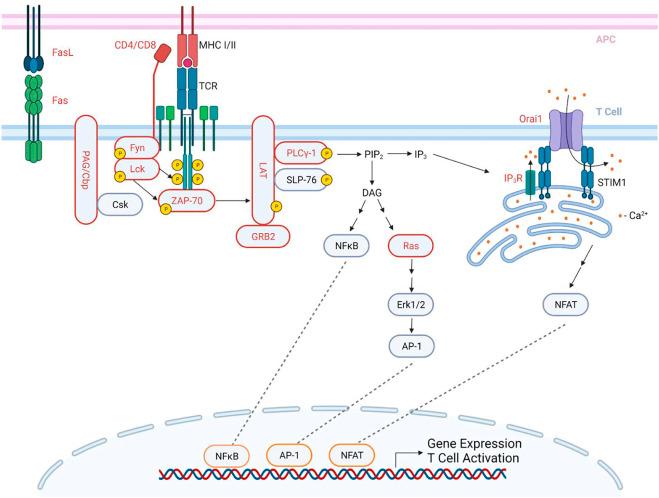
S-acylation, the reversible lipidation of free cysteine residues with long-chain fatty acids, is a highly dynamic post-translational protein modification that has recently emerged as an important regulator of the T cell function. The reversible nature of S-acylation sets this modification apart from other forms of protein lipidation and allows it to play a unique role in intracellular signal transduction. In recent years, a significant number of T cell proteins, including receptors, enzymes, ion channels, and adaptor proteins, were identified as S-acylated. It has been shown that S-acylation critically contributes to their function by regulating protein localization, stability and protein-protein interactions. Furthermore, it has been demonstrated that zDHHC protein acyltransferases, the family of enzymes mediating this modification, also play a prominent role in T cell activation and differentiation. In this review, we aim to highlight the diversity of proteins undergoing S-acylation in T cells, elucidate the mechanisms by which reversible lipidation can impact protein function, and introduce protein acyltransferases as a novel class of regulatory T cell proteins.
S-酰化作用是指游离半胱氨酸残基与长链脂肪酸发生的可逆脂化反应,是一种高度动态的翻译后蛋白质修饰,最近已成为T细胞功能的重要调节因子。S-酰化作用的可逆性使其与其他形式的蛋白质脂化作用有所不同,并使其能够在细胞内信号转导中发挥独特作用。近年来,大量T细胞蛋白,包括受体、酶、离子通道和衔接蛋白,被鉴定为发生了S-酰化。研究表明,S-酰化通过调节蛋白质定位、稳定性和蛋白质-蛋白质相互作用,对其功能起着至关重要的作用。此外,已经证明,介导这种修饰的酶家族——zDHHC蛋白酰基转移酶,在T细胞活化和分化中也起着重要作用。在这篇综述中,我们旨在强调T细胞中发生S-酰化的蛋白质的多样性,阐明可逆脂化影响蛋白质功能的机制,并介绍蛋白酰基转移酶作为一类新型的调节性T细胞蛋白。
 Zotero 插件