
控制钙库操纵性钙内流的调节机制。
Regulatory mechanisms controlling store-operated calcium entry.
作者信息
Kodakandla Goutham, Akimzhanov Askar M, Boehning Darren
机构信息
Department of Biomedical Sciences, Cooper Medical School of Rowan University, Camden, NJ, United States.
Department of Biochemistry and Molecular Biology, McGovern Medical School, Houston, TX, United States.
出版信息
Front Physiol. 2023 Dec 19;14:1330259. doi: 10.3389/fphys.2023.1330259. eCollection 2023.
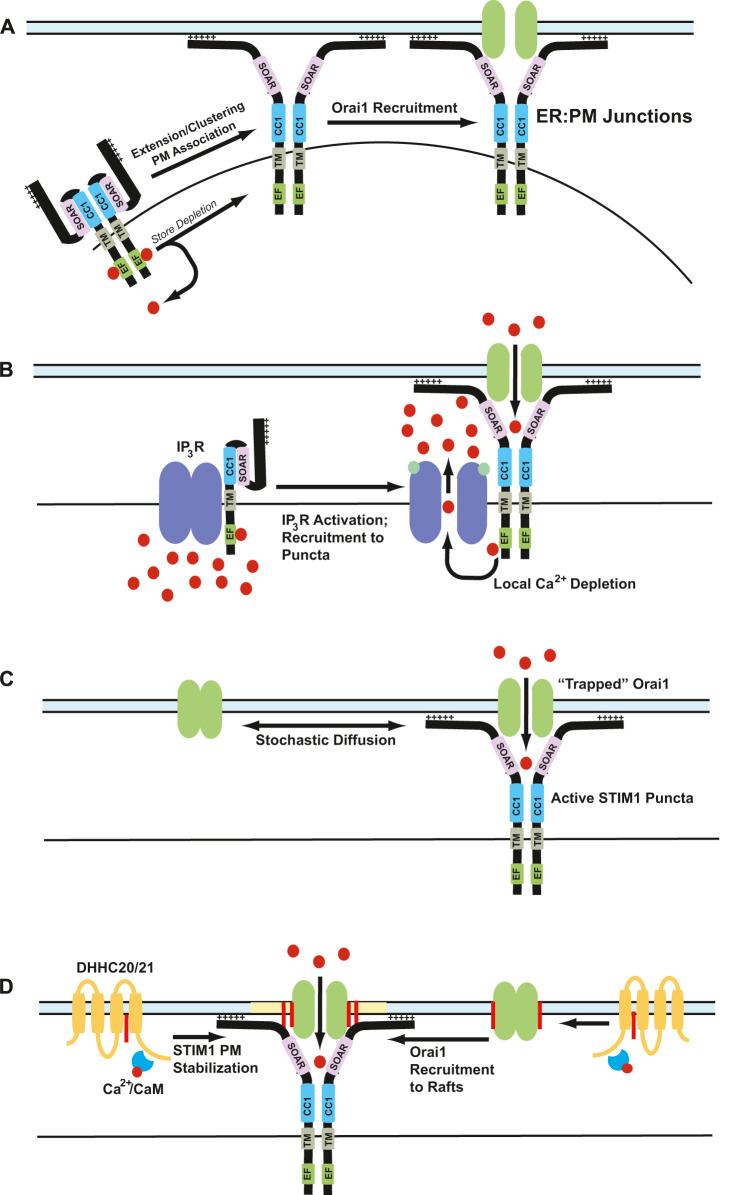
Calcium influx through plasma membrane ion channels is crucial for many events in cellular physiology. Cell surface stimuli lead to the production of inositol 1,4,5-trisphosphate (IP), which binds to IP receptors (IPR) in the endoplasmic reticulum (ER) to release calcium pools from the ER lumen. This leads to the depletion of ER calcium pools, which has been termed store depletion. Store depletion leads to the dissociation of calcium ions from the EF-hand motif of the ER calcium sensor Stromal Interaction Molecule 1 (STIM1). This leads to a conformational change in STIM1, which helps it to interact with the plasma membrane (PM) at ER:PM junctions. At these ER:PM junctions, STIM1 binds to and activates a calcium channel known as Orai1 to form calcium release-activated calcium (CRAC) channels. Activation of Orai1 leads to calcium influx, known as store-operated calcium entry (SOCE). In addition to Orai1 and STIM1, the homologs of Orai1 and STIM1, such as Orai2/3 and STIM2, also play a crucial role in calcium homeostasis. The influx of calcium through the Orai channel activates a calcium current that has been termed the CRAC current. CRAC channels form multimers and cluster together in large macromolecular assemblies termed "puncta". How CRAC channels form puncta has been contentious since their discovery. In this review, we will outline the history of SOCE, the molecular players involved in this process, as well as the models that have been proposed to explain this critical mechanism in cellular physiology.
通过质膜离子通道的钙内流对细胞生理学中的许多事件至关重要。细胞表面刺激导致肌醇1,4,5-三磷酸(IP)的产生,IP与内质网(ER)中的IP受体(IPR)结合,从内质网腔中释放钙库。这导致内质网钙库耗竭,这被称为储存耗竭。储存耗竭导致钙离子从内质网钙传感器基质相互作用分子1(STIM1)的EF手基序解离。这导致STIM1发生构象变化,有助于它在内质网与质膜(PM)的交界处与质膜相互作用。在这些内质网与质膜的交界处,STIM1结合并激活一种称为Orai1的钙通道,形成钙释放激活钙(CRAC)通道。Orai1的激活导致钙内流,即储存操纵性钙内流(SOCE)。除了Orai1和STIM1之外,Orai1和STIM1的同源物,如Orai2/3和STIM2,在钙稳态中也起着关键作用。通过Orai通道的钙内流激活了一种被称为CRAC电流的钙电流。CRAC通道形成多聚体并聚集在一起,形成称为“斑点”的大型大分子聚集体。自发现以来,CRAC通道如何形成斑点一直存在争议。在这篇综述中,我们将概述SOCE的历史、参与这一过程的分子成分,以及为解释细胞生理学中的这一关键机制而提出的模型。


 Zotero 插件