
氮杂-BODIPY的合成、它们对铜(II)的差异结合以及作为朗格汉斯β细胞荧光染料的生物成像结果。
Synthesis of Aza-BODIPYs, Their Differential Binding for Cu(II), and Results of Bioimaging as Fluorescent Dyes of Langerhans β-Cells.
作者信息
Pino Yaneth C, Aguilera Jorge A, García-González Víctor, Alatorre-Meda Manuel, Rodríguez-Velázquez Eustolia, Espinoza Karla A, Frayde-Gómez Héctor, Rivero Ignacio A
机构信息
Centro de Graduados e Investigación en Química, Tecnológico Nacional de México/Instituto Tecnológico de Tijuana, Blvd. Alberto Limón Padilla S/N, Tijuana, BC 22510, México.
Departamento de Bioquímica, Facultad de Medicina Mexicali, Universidad Autónoma de Baja California, Mexicali, BC 21100, México.
出版信息
ACS Omega. 2022 Nov 15;7(47):42752-42762. doi: 10.1021/acsomega.2c04151. eCollection 2022 Nov 29.
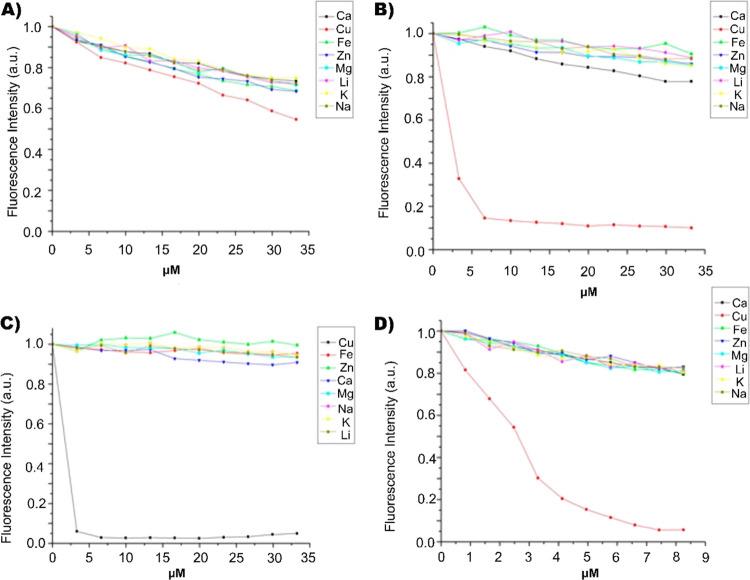
Cellular labeling through the use of dyes is of great interest to the biomedical sciences for the characterization of the location and distribution of biomolecules and also for the tracking of the course of biological processes in both health and illness. This paper reports the synthesis, characterization, and subsequent evaluation as metal sensors and cell staining probes of four aza-BODIPY compounds [herein referred to as ()]. Compounds () were found to display an outstanding selectivity for Cu(II) because their emission band at 720 nm was progressively quenched by this metal, presenting fluorescence quenching between 75 and 95%. On the other hand, cell imaging studies with pancreatic β-cells proved that aza-BODIPYs and showed selectivity for the cytoplasm, while and were selective for the cell membrane. Moreover, aza-BODIPY allowed to characterize in a clear way a lipotoxic condition mediated by saturated fatty acids, a critical phenomenon on β-cell damage associated with diabetes mellitus type II. Taken together, the presented results highlight the obtained aza-BODIPY compounds as selective sensing/staining probes with the potential to be used in the biomedical field.
通过使用染料进行细胞标记,对于生物医学科学来说极具吸引力,这有助于表征生物分子的位置和分布,也有助于追踪健康和疾病状态下生物过程的进程。本文报道了四种氮杂硼二吡咯化合物(以下简称“()”)作为金属传感器和细胞染色探针的合成、表征及后续评估。发现化合物()对Cu(II)表现出出色的选择性,因为它们在720 nm处的发射带会被这种金属逐渐淬灭,荧光淬灭程度在75%至95%之间。另一方面,对胰腺β细胞的细胞成像研究证明,氮杂硼二吡咯 和 对细胞质具有选择性,而 和 对细胞膜具有选择性。此外,氮杂硼二吡咯 能够清晰地表征由饱和脂肪酸介导的脂毒性状况,这是与II型糖尿病相关的β细胞损伤中的一个关键现象。综上所述,所呈现的结果突出了所获得的氮杂硼二吡咯化合物作为选择性传感/染色探针在生物医学领域的应用潜力。




 Zotero 插件