
用于检测铜(II)的超灵敏光学化学传感器。
Ultrasensitive Optical Chemosensor for Cu(II) Detection.
作者信息
Saleh Sayed M, Ali Reham, Alminderej Fahad, Ali Ibrahim A I
机构信息
Chemistry Department, Science College, Qassim University, Buraidah, Saudi Arabia.
Chemistry Branch, Department of Science and Mathematics, Faculty of Petroleum and Mining Engineering, Suez University, Suez, Egypt.
出版信息
Int J Anal Chem. 2019 Mar 26;2019:7381046. doi: 10.1155/2019/7381046. eCollection 2019.
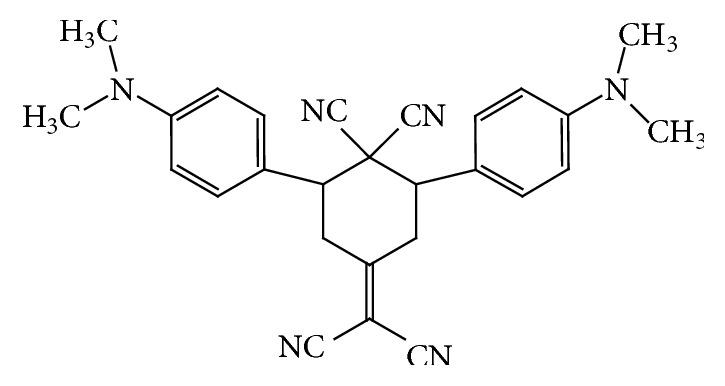
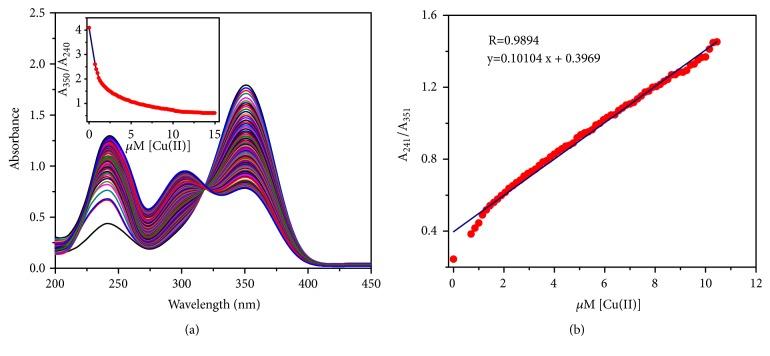
Herein, the main objective of this research is to design and synthesize a novel optical chemosensor, 2,6-Bis(4-dimethylaminophenyl)-4-(dicyanomethylene)-cyclohexane-1,1-dicarbo-nitrile (BDC), for detection of one of the most significant metal ions Cu(II). This novel fluorescent chemosensor exhibits unique optical properties with large Stokes shift (about 170 nm) approximately. The fluorescence and UV-vis absorption performance among the BDC probe and Cu(II) ions were examined in 1:9 (v/v) methanol-HEPES buffer (pH = 7.2) solution. Also, BDC displays high selectivity for Cu(II) concerning other cations. Moreover, this probe provides high selectivity and sensitivity based on their fluorescence properties and recognition abilities within a detection limit of the Cu(II) contents (LOD 2.3 x 10 M). The suggested mechanism of BDC sensor is attributed to the chelation process with Cu(II), to establish a 1:1 metal-ligand ratio complex with a binding constant (K = 7.16 x 10 M). The detection process is accompanied by quenching the main emission peak of the BDC at 571 nm. All the experimental data were collected to investigate the effects of several important parameters such as reversibility and the concentration limits. Besides, we study the interference of various metal ions on selectivity and detection capacity of this significant Cu (II) ion. This novel chemosensor shows ultrasensitive, fast tracing of Cu(II) in the physiological pH range (pH 7.2) and therefore may propose a novel promising method for the investigation of the biological functions of Cu(II) in living cells.
在此,本研究的主要目的是设计并合成一种新型光学化学传感器,即2,6-双(4-二甲基氨基苯基)-4-(二氰基亚甲基)-环己烷-1,1-二腈(BDC),用于检测最重要的金属离子之一铜(II)。这种新型荧光化学传感器具有独特的光学性质,斯托克斯位移约为170 nm。在1:9(v/v)甲醇-HEPES缓冲液(pH = 7.2)溶液中研究了BDC探针与铜(II)离子之间的荧光和紫外-可见吸收性能。此外,BDC对铜(II)的选择性高于其他阳离子。而且,该探针基于其荧光性质和识别能力,在铜(II)含量的检测限(LOD 2.3×10⁻⁶ M)内具有高选择性和灵敏度。BDC传感器的建议机制归因于与铜(II)的螯合过程,以形成1:1金属-配体比的配合物,结合常数(K = 7.16×10⁵ M⁻¹)。检测过程伴随着BDC在571 nm处的主要发射峰猝灭。收集所有实验数据以研究几个重要参数的影响,如可逆性和浓度极限。此外,我们研究了各种金属离子对这种重要的铜(II)离子的选择性和检测能力的干扰。这种新型化学传感器在生理pH范围(pH 7.2)内对铜(II)具有超灵敏、快速追踪能力,因此可能为研究活细胞中铜(II)的生物学功能提出一种新的有前景的方法。



 Zotero 插件