
一种新型的、极其灵敏的利用希夫碱的关断型光学传感器,用于快速检测 Cu(II)。
A New, Extremely Sensitive, Turn-Off Optical Sensor Utilizing Schiff Base for Fast Detection of Cu(II).
机构信息
Department of Chemistry, College of Science, Qassim University, Buraidah 51452, Saudi Arabia.
Laboratory of Structural Organic Chemistry-Synthesis and Physicochemical Studies (LR99ES14), Department of Chemistry, Faculty of Sciences of Tunis, University of Tunis El Manar, Tunis 2092, Tunisia.
出版信息
Biosensors (Basel). 2023 Mar 8;13(3):359. doi: 10.3390/bios13030359.
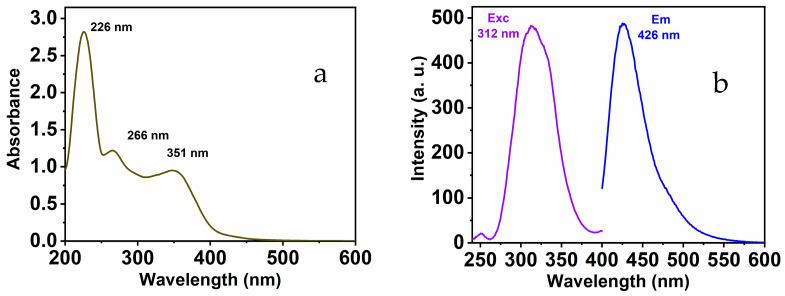
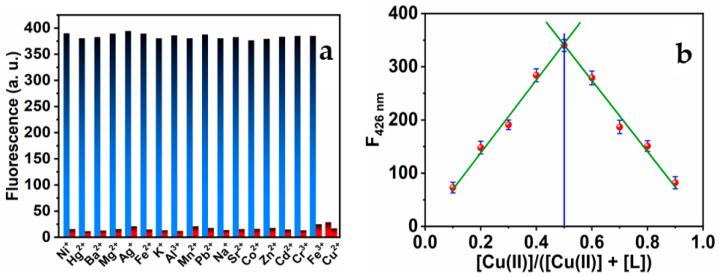
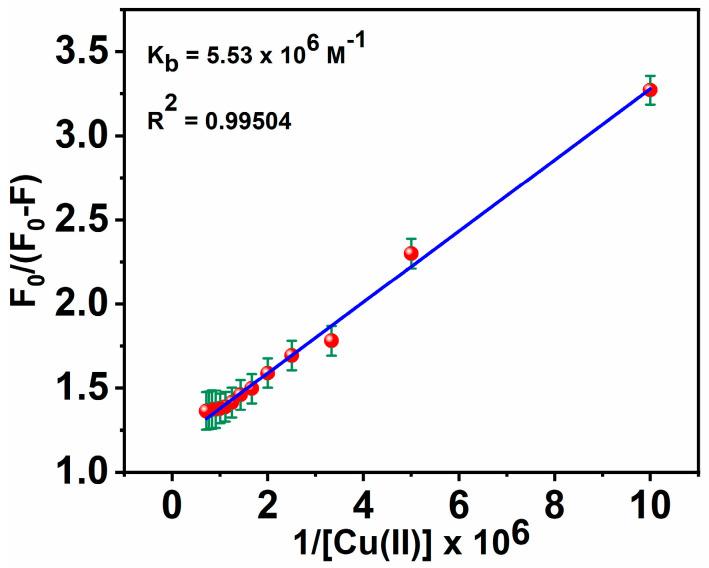
Throughout this research, a unique optical sensor for detecting one of the most dangerous heavy metal ions, Cu(II), was designed and developed. The (4-mercaptophenyl) iminomethylphenyl naphthalenyl carbamate (MNC) sensor probe was effectively prepared. The Schiff base of the sensor shows a "turn-off" state with excellent sensitivity to Cu(II) ions. This innovative fluorescent chemosensor possesses distinctive optical features with a substantial Stocks shift (about 114 nm). In addition, MNC has remarkable selectivity for Cu(II) relative to other cations. Density functional theory (DFT) and the time-dependent DFT (TDDFT) theoretical calculations were performed to examine Cu(II) chelation structures and associated electronic properties in solution, and the results indicate that the luminescence quenching in this complex is due to ICT. Chelation-quenched fluorescence is responsible for the internal charge transfer (ICT)-based selectivity of the MNC sensing molecule for Cu(II) ions. In a 1:9 (/) DMSO-HEPES buffer (20 mM, pH = 7.4) solution, Fluorescence and UV-Vis absorption of the MNC probe and Cu(II) ions were investigated. By utilizing a solution containing several metal ions, the interference of other metal ions was studied. This MNC molecule has outstanding selectivity and sensitivity, as well as a low LOD (1.45 nM). Consequently, these distinctive properties enable it to find the copper metal ions across an actual narrow dynamic range (0-1.2 M Cu(II)). The reversibility of the sensor was obtained by employing an EDTA as a powerful chelating agent.
在这项研究中,设计并开发了一种用于检测最危险的重金属离子之一 Cu(II) 的独特光学传感器。有效制备了(4-巯基苯基)亚氨基甲基苯基萘基氨基甲酸酯(MNC)传感器探针。传感器的席夫碱对 Cu(II) 离子具有出色的灵敏度和“关闭”状态。这种创新的荧光化学传感器具有独特的光学特性,斯托克斯位移(约 114nm)较大。此外,MNC 对 Cu(II) 具有显著的选择性,相对于其他阳离子。进行了密度泛函理论(DFT)和含时密度泛函理论(TDDFT)理论计算,以研究溶液中 Cu(II)螯合结构和相关电子性质,结果表明该络合物的发光猝灭是由于 ICT。螯合猝灭荧光是 MNC 传感分子对 Cu(II)离子具有基于内电荷转移(ICT)的选择性的原因。在 1:9(/)DMSO-HEPES 缓冲液(20mM,pH=7.4)溶液中,研究了 MNC 探针和 Cu(II)离子的荧光和紫外-可见吸收。通过使用含有几种金属离子的溶液研究了其他金属离子的干扰。该 MNC 分子具有出色的选择性和灵敏度,以及较低的 LOD(1.45 nM)。因此,这些独特的特性使其能够在实际的窄动态范围内(0-1.2M Cu(II))检测到铜金属离子。通过使用 EDTA 作为强螯合剂,可以获得传感器的可逆性。







 Zotero 插件