
一种用于检测铬离子的新型有机发色荧光光学传感器。
A novel organic chromo-fluorogenic optical sensor for detecting chromium ions.
作者信息
Saleh Sayed M, Ali Reham, Algreiby Azizah, Alfeneekh Bayader, Ali Ibrahim A I
机构信息
Department of Chemistry, College of Science, Qassim University, Buraidah, 51452, Saudi Arabia.
Chemistry Department, Faculty of Science, Suez Canal University, Ismailia, Egypt.
出版信息
Heliyon. 2024 Sep 7;10(17):e37480. doi: 10.1016/j.heliyon.2024.e37480. eCollection 2024 Sep 15.
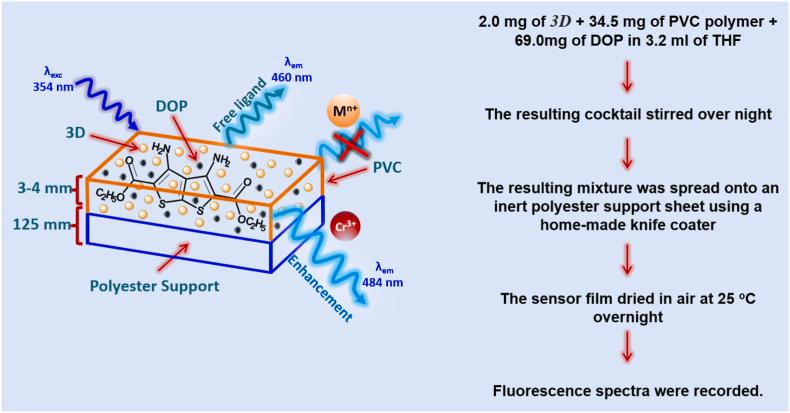
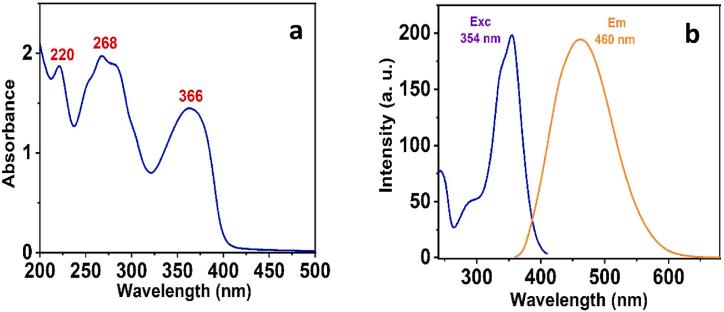
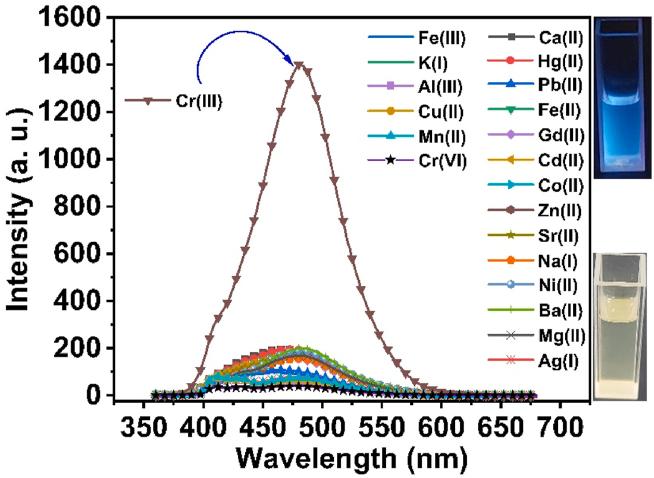
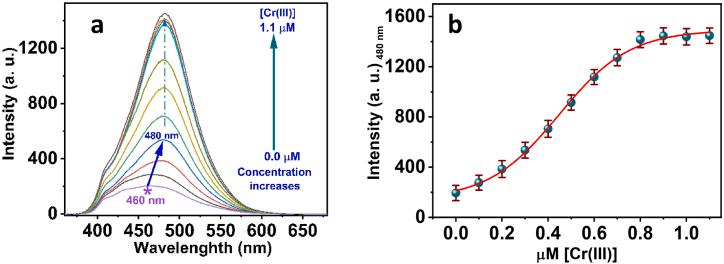
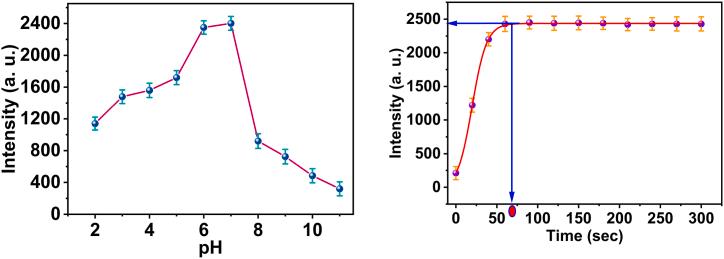
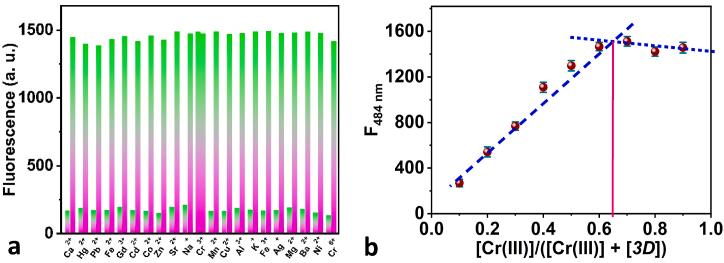
Sensing trivalent chromium ion (Cr(III)) is widely applied in different areas, such as clinical analysis, marine, environmental monitoring, or even chemical industry applications. Cr(III) has a significant role in the physiological process of human life. It is classified as an essential micronutrient for living organisms. Herein, we developed and designed a novel optical Cr(III) ions sensor film. The investigated sensor has a relatively small dynamic range of 1.24 × 10 to 0.5 μM. We report a highly sensitive optical sensor film for Cr(III) ions based on diethyl 3,4-diaminothieno[2,3-b]thiophene-2,5-dicarboxylate () probe. The optical characteristics of the chemical probe exhibit substantial emission at 460 nm under 354 nm excitation. Besides, the interaction of the Cr(III) ions with involves a complex formation with a 2:1 (metal: ligand) ratio, which is convoyed by the main peak enhancement that centered at 460 nm of 3D, and the main peak is red-shifted to 480 nm. The easily discernible fluorescence enhancement effect is a defining characteristic of the complexation reaction between the 3D probe and Cr(III). On the basis of the substantial fluorescence mechanism caused by the formation of a (Cr(III)-3D complex, which inhibits the photo-induced electron transfer (PET) process, the devised optical sensor was proposed. This film exhibits exceptional sensitivity and selectivity due to its notable fluorescence properties, stock shift of less than 106 nm, and detection capabilities at a significantly low detection limit of 0.37 × 10 μM. The detection procedure is executed by utilizing a physiological pH medium (pH = 7.4) with a relative standard deviation RSDr (1 %, n = 3). In addition, the 3D sensor demonstrates a high degree of affinity for Cr(III), as determined by the calculation of its binding constant to be 1.40 × 10. We present an impressive optical sensor that is constructed upon a three-dimensional molecule.
三价铬离子(Cr(III))传感在临床分析、海洋、环境监测乃至化工等不同领域有着广泛应用。Cr(III)在人类生命的生理过程中发挥着重要作用。它被归类为生物体必需的微量营养素。在此,我们开发并设计了一种新型光学Cr(III)离子传感薄膜。所研究的传感器动态范围相对较小,为1.24×10至0.5 μM。我们报道了一种基于3,4 - 二氨基噻吩并[2,3 - b]噻吩 - 2,5 - 二羧酸二乙酯()探针的高灵敏度Cr(III)离子光学传感薄膜。该化学探针的光学特性在354 nm激发下于460 nm处有显著发射。此外,Cr(III)离子与的相互作用涉及形成金属与配体比例为2:1的配合物,这通过三维光谱中以460 nm为中心的主峰增强体现,且主峰红移至480 nm。易于辨别且明显的荧光增强效应是3D探针与Cr(III)之间络合反应的一个决定性特征。基于由(Cr(III) - 3D)配合物形成引起的显著荧光机制,该机制抑制了光致电子转移(PET)过程,我们设计了这种光学传感器。由于其显著的荧光特性、小于106 nm的斯托克斯位移以及低至0.37×10 μM的极低检测限检测能力,该薄膜表现出卓越的灵敏度和选择性。检测过程在生理pH介质(pH = 7.4)中进行,相对标准偏差RSDr为1%(n = 3)。此外,通过计算其结合常数为1.40×10可知,3D传感器对Cr(III)表现出高度亲和力。我们展示了一种基于三维分子构建的令人印象深刻的光学传感器。





 Zotero 插件