
利用预测性流行病学多模型预警系统支持新冠疫情决策制定。
Supporting COVID-19 policy-making with a predictive epidemiological multi-model warning system.
作者信息
Bicher Martin, Zuba Martin, Rainer Lukas, Bachner Florian, Rippinger Claire, Ostermann Herwig, Popper Nikolas, Thurner Stefan, Klimek Peter
机构信息
Institute of Information Systems Engineering, TU Wien, Favoritenstraße 8-11, A-1040, Vienna, Austria.
dwh simulation services, dwh GmbH, Neustiftgasse 57-59, A-1070, Vienna, Austria.
出版信息
Commun Med (Lond). 2022 Dec 8;2(1):157. doi: 10.1038/s43856-022-00219-z.
BACKGROUND
In response to the SARS-CoV-2 pandemic, the Austrian governmental crisis unit commissioned a forecast consortium with regularly projections of case numbers and demand for hospital beds. The goal was to assess how likely Austrian ICUs would become overburdened with COVID-19 patients in the upcoming weeks.
METHODS
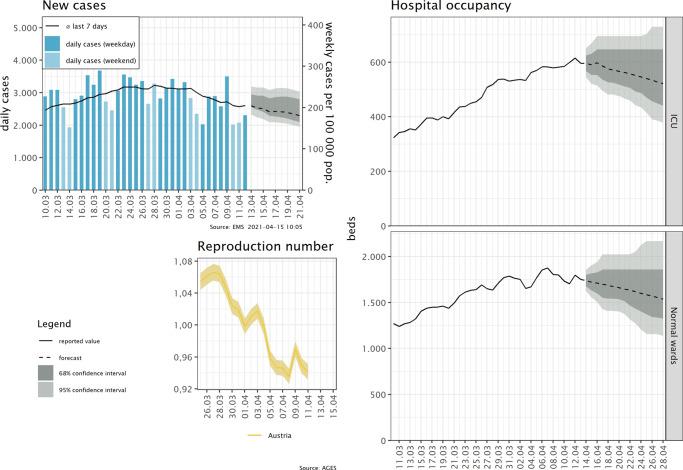
We consolidated the output of three epidemiological models (ranging from agent-based micro simulation to parsimonious compartmental models) and published weekly short-term forecasts for the number of confirmed cases as well as estimates and upper bounds for the required hospital beds.
RESULTS
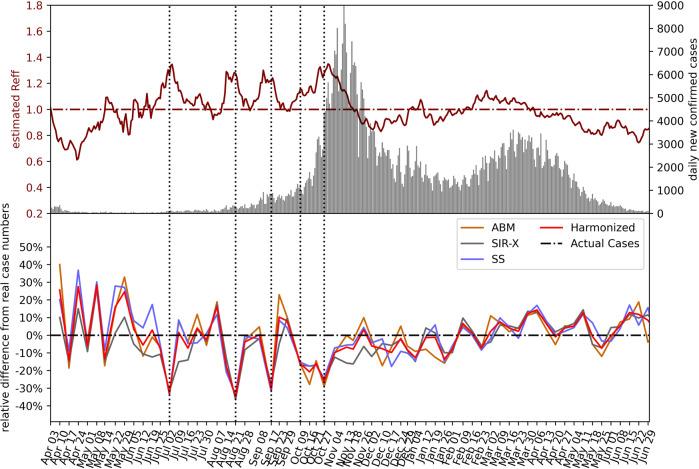
We report on three key contributions by which our forecasting and reporting system has helped shaping Austria's policy to navigate the crisis, namely (i) when and where case numbers and bed occupancy are expected to peak during multiple waves, (ii) whether to ease or strengthen non-pharmaceutical intervention in response to changing incidences, and (iii) how to provide hospital managers guidance to plan health-care capacities.
CONCLUSIONS
Complex mathematical epidemiological models play an important role in guiding governmental responses during pandemic crises, in particular when they are used as a monitoring system to detect epidemiological change points.
背景
为应对严重急性呼吸综合征冠状病毒2(SARS-CoV-2)大流行,奥地利政府危机应对小组委托一个预测团队定期对病例数和医院床位需求进行预测。目的是评估在接下来的几周内,奥地利的重症监护病房(ICU)因新型冠状病毒肺炎(COVID-19)患者而不堪重负的可能性有多大。
方法
我们整合了三种流行病学模型的输出结果(从基于主体的微观模拟模型到简约的 compartmental 模型),并每周发布确诊病例数的短期预测以及所需医院床位的估计值和上限。
结果
我们报告了我们的预测和报告系统对奥地利应对危机政策形成的三项关键贡献,即(i)在多波疫情期间病例数和床位占用率预计何时何地达到峰值,(ii)根据发病率变化,是放松还是加强非药物干预措施,以及(iii)如何为医院管理人员提供规划医疗保健能力的指导。
结论
复杂的数学流行病学模型在指导大流行危机期间的政府应对措施方面发挥着重要作用,特别是当它们被用作检测流行病学变化点的监测系统时。


 Zotero 插件