
口腔健康与全身非传染性疾病关联证据的伞式综述。
An umbrella review of the evidence linking oral health and systemic noncommunicable diseases.
机构信息
Clinical Research Unit, Centro de Investigação Interdisciplinar Egas Moniz (CiiEM), Egas Moniz-Cooperativa de Ensino Superior, CRL, Almada, Portugal.
Evidence-Based Hub, Centro de Investigação Interdisciplinar Egas Moniz (CiiEM), Egas Moniz-Cooperativa de Ensino Superior, CRL, Almada, Portugal.
出版信息
Nat Commun. 2022 Dec 9;13(1):7614. doi: 10.1038/s41467-022-35337-8.
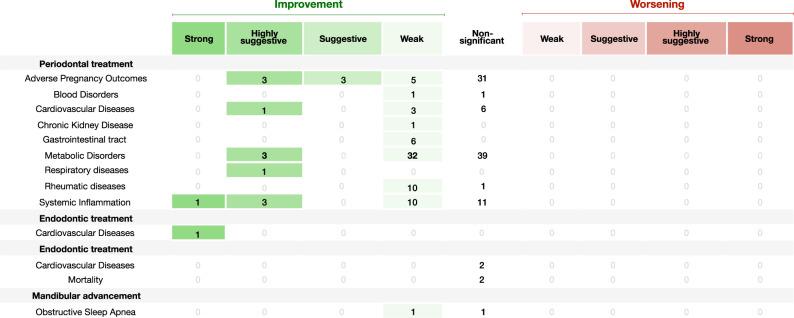
Oral diseases are highly prevalent worldwide. Recent studies have been supporting a potential bidirectional association of oral diseases with systemic noncommunicable diseases (NCDs). Available evidence supports that people with NCDs have a greater prevalence of oral diseases particularly those with limited ability of oral self-care. Regarding the reverse relationship, the lines of evidence pointing out NCDs as putative risk factors for oral diseases have increased significantly but not with a consistent agreement. This umbrella review of meta-analyses appraises the strength and validity of the evidence for the association between oral health and systemic health (registered at PROSPERO, ID: CRD42022300740). An extensive search included systematic reviews that have provided meta-analytic estimates on the association of oral diseases with NCDs. The overall strength of evidence was found to be unfavorable and with methodological inconsistencies. Twenty-eight NCDs were strongly associated with oral diseases. Among those NCDs are five types of cancer, diabetes mellitus, cardiovascular diseases, depression, neurodegenerative conditions, rheumatic diseases, inflammatory bowel disease, gastric helicobacter pylori, obesity, and asthma. According to fail-safe number statistics, the evidence levels are unlikely to change in the future, indicating a fairly robust consistency.
口腔疾病在全球范围内普遍存在。最近的研究支持口腔疾病与全身非传染性疾病(NCDs)之间存在潜在的双向关联。现有证据表明,患有 NCD 的人患口腔疾病的患病率更高,特别是那些口腔自我护理能力有限的人。关于相反的关系,指出 NCDs 是口腔疾病潜在危险因素的证据明显增加,但并未达成一致意见。这项元分析的伞式审查评估了口腔健康与全身健康之间关联的证据的强度和有效性(在 PROSPERO 注册,ID:CRD42022300740)。广泛的搜索包括提供了关于口腔疾病与 NCD 之间关联的 meta 分析估计的系统评价。发现证据的总体强度不利,且存在方法学上的不一致性。28 种 NCDs 与口腔疾病密切相关。其中 NCD 包括五种癌症、糖尿病、心血管疾病、抑郁症、神经退行性疾病、风湿性疾病、炎症性肠病、胃幽门螺杆菌、肥胖症和哮喘。根据失效安全数统计,未来证据水平不太可能改变,表明一致性相当稳健。


 Zotero 插件