
阿基仑赛和Tisagenlecleucel 作为二线或更后线治疗复发或难治弥漫性大 B 细胞淋巴瘤的成本效益分析。
Cost-effectiveness of Axicabtagene Ciloleucel and Tisagenlecleucel as Second-line or Later Therapy in Relapsed or Refractory Diffuse Large B-Cell Lymphoma.
机构信息
Department of Pharmaceutical and Health Economics, School of Pharmacy, University of Southern California, Los Angeles.
Leonard D. Schaeffer Center for Health Policy & Economics, University of Southern California, Los Angeles.
出版信息
JAMA Netw Open. 2022 Dec 1;5(12):e2245956. doi: 10.1001/jamanetworkopen.2022.45956.
IMPORTANCE
Chimeric antigen receptor (CAR) T cell therapies are approved as a third-line or later therapy for several hematological malignant neoplasms. Recently, randomized clinical trials have investigated their efficacy as a second-line treatment in high-risk relapsed or refractory diffuse large B-cell lymphoma (DLBCL) compared with salvage chemotherapy followed by hematopoietic stem cell transplantation (HSCT).
OBJECTIVE
To evaluate the cost-effectiveness of axicabtagene ciloleucel and tisagenlecleucel vs standard care (SC) as second-line or later therapy for relapsed or refractory DLBCL, from both US health care sector and societal perspectives at a cost-effectiveness threshold of $150 000 per quality-adjusted life-year (QALY).
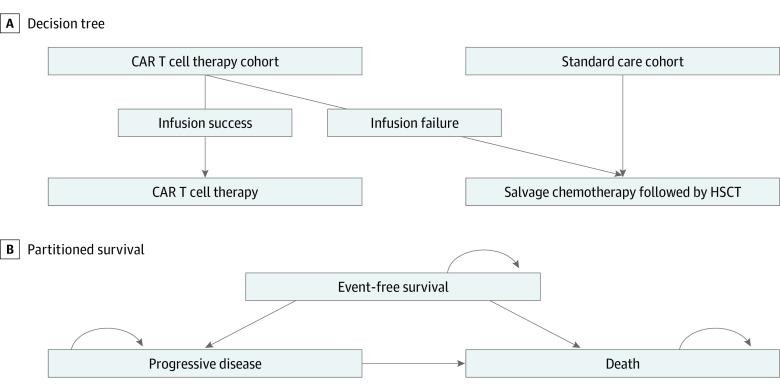
DESIGN, SETTING, AND PARTICIPANTS: This economic evaluation assessed cost-effectiveness using a partitioned survival model with 2021 US dollars and QALYs over a lifetime horizon. Model inputs were derived from 2 randomized clinical trials (ZUMA-7 and BELINDA) and published literature. In the trials, patients who did not respond to SC received CAR T cells (treatment switching or crossover), either outside the protocol (ZUMA-7) or as part of the protocol (BELINDA). A separate scenario analysis compared second-line axicabtagene ciloleucel with SC alone without treatment crossover to CAR T cell therapy. Data analysis was performed from December 18, 2021, to September 13, 2022.
EXPOSURES
CAR T cell therapy (axicabtagene ciloleucel and tisagenlecleucel) compared with salvage chemotherapy followed by HSCT.
MAIN OUTCOMES AND MEASURES
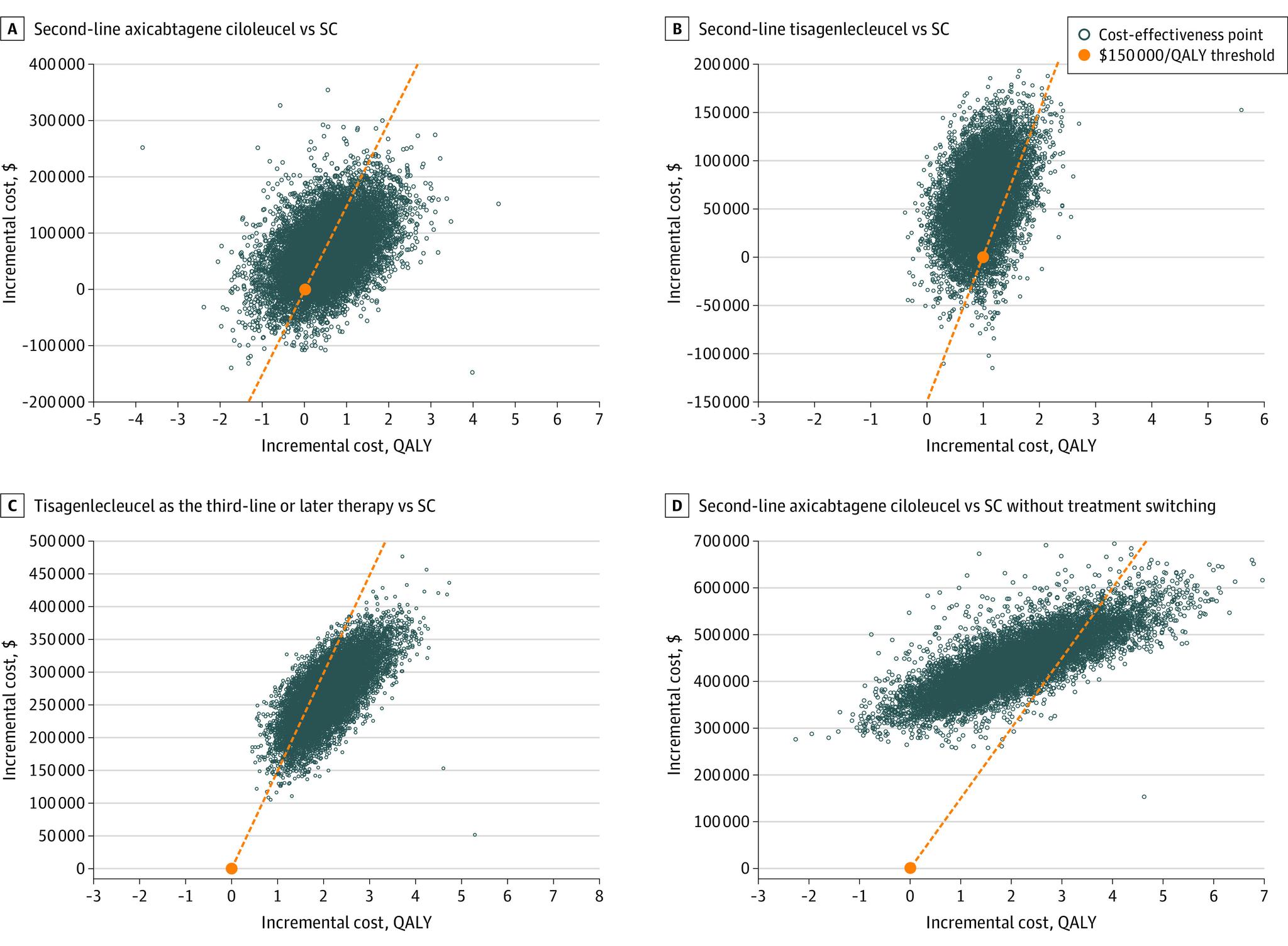
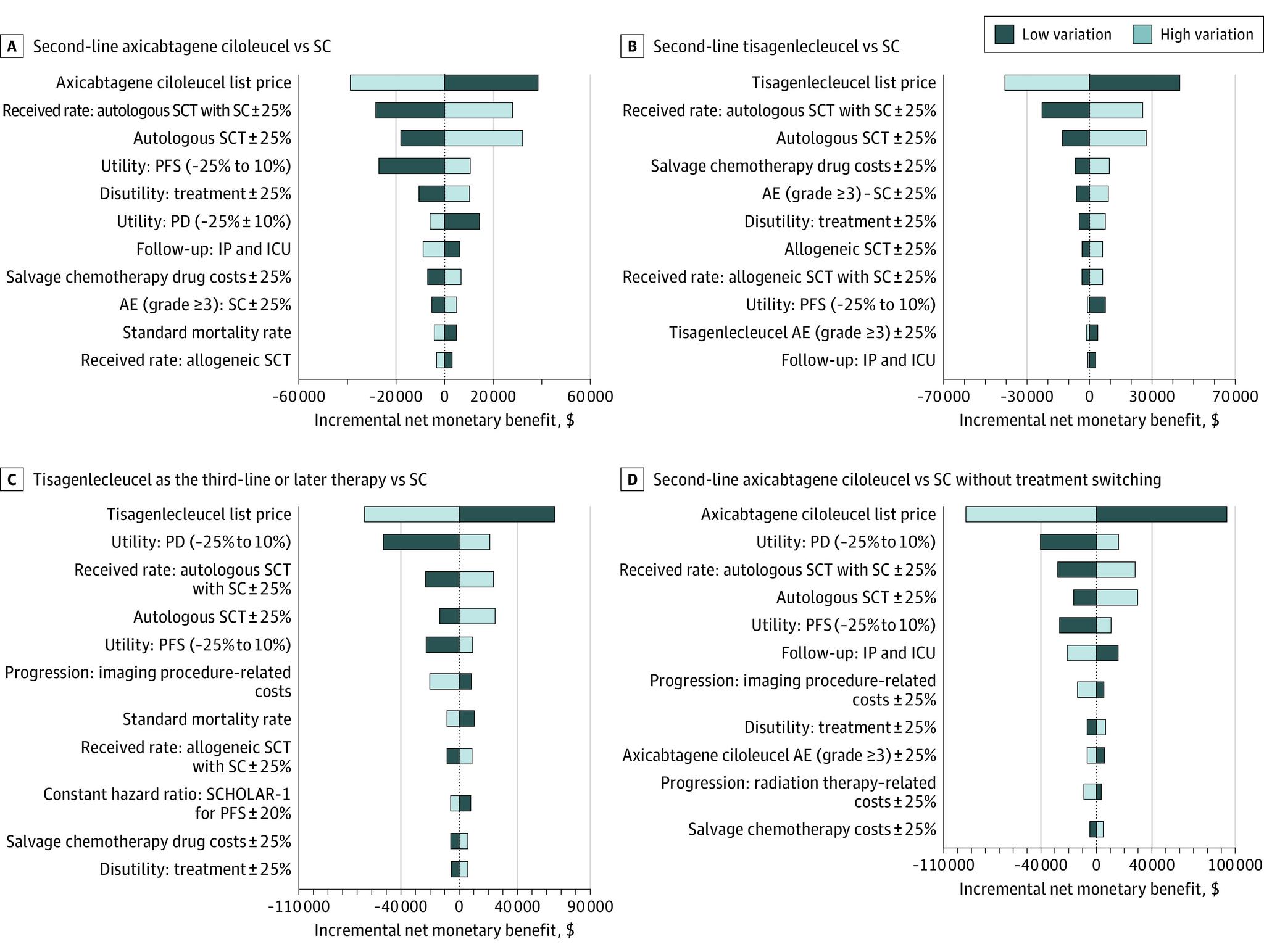
Costs and QALYs were used to derive incremental cost-effectiveness ratios (ICERs) for the health care sector and societal perspectives. Cost and QALYs were discounted at 3.0% annually. Univariate and multivariate probabilistic sensitivity analysis using 10 000 Monte Carlo simulations were applied to test model uncertainty on the ICER.
RESULTS
Second-line axicabtagene ciloleucel was associated with an ICER of $99 101 per QALY from the health care sector perspective and an ICER of $97 977 per QALY from the societal perspective, while second-line tisagenlecleucel was dominated by SC (incremental costs of $37 803 from the health care sector and $39 480 from the societal perspective with decremental QALY of -0.02). Third-line or later tisagenlecleucel was associated with an ICER of $126 593 per QALY from the health care sector perspective and an ICER of $128 012 per QALY from the societal perspective. Based on the scenario analysis of no treatment switching, second-line axicabtagene ciloleucel yielded an ICER of $216 790 per QALY from the health care sector perspective and an ICER of $218 907 per QALY from the societal perspective, compared with SC. When accounting for patients achieving prolonged progression-free survival who would not incur progression-related costs, in this scenario ICER changed to $125 962 per QALY from the health care sector perspective and $122 931 per QALY from the societal perspective. These results were most sensitive to increased list prices of CAR T cell therapy and QALY losses associated with axicabtagene ciloleucel and tisagenlecleucel.
CONCLUSIONS AND RELEVANCE
These findings suggest that second-line axicabtagene ciloleucel and third-line or later tisagenlecleucel were cost-effective in treating patients with relapsed or refractory DLBCL at the cost-effectiveness threshold of $150 000 per QALY. However, uncertainty remains regarding the best candidates who would experience value gains from receiving CAR T cell therapy.
重要性
嵌合抗原受体 (CAR) T 细胞疗法已被批准用于几种血液恶性肿瘤的三线或更后线治疗。最近,随机临床试验已经研究了它们在高危复发或难治性弥漫性大 B 细胞淋巴瘤 (DLBCL) 中的二线治疗效果,与挽救化疗后造血干细胞移植 (HSCT) 相比。
目的
从美国医疗保健部门和社会角度,以每质量调整生命年 (QALY) 150000 美元的成本效益阈值,评估 axicabtagene ciloleucel 和 tisagenlecleucel 与标准护理 (SC) 作为复发或难治性 DLBCL 的二线或更后线治疗的成本效益。
设计、设置和参与者:本经济评估使用带有 2021 年美元和终生 QALY 的分区生存模型评估成本效益。模型输入来自两项随机临床试验 (ZUMA-7 和 BELINDA) 和已发表的文献。在试验中,未对 SC 有反应的患者接受了 CAR T 细胞治疗(治疗转换或交叉),无论是在方案之外 (ZUMA-7) 还是作为方案的一部分 (BELINDA)。一项单独的情景分析比较了二线 axicabtagene ciloleucel 与无治疗交叉的 SC 单独治疗与 CAR T 细胞治疗。数据分析于 2021 年 12 月 18 日至 2022 年 9 月 13 日进行。
暴露
CAR T 细胞治疗(axicabtagene ciloleucel 和 tisagenlecleucel)与挽救化疗后 HSCT 相比。
主要结果和措施
使用增量成本效益比 (ICER) 来衡量卫生保健部门和社会视角的成本和 QALYs。成本和 QALYs 每年贴现 3.0%。应用了 10000 次蒙特卡罗模拟的单变量和多变量概率敏感性分析,以测试 ICER 的模型不确定性。
结果
二线 axicabtagene ciloleucel 的增量成本效益比为每 QALY 99101 美元,来自卫生保健部门的视角,每 QALY 97977 美元,来自社会的视角,而二线 tisagenlecleucel 被 SC 主导(卫生保健部门的增量成本为 37803 美元,社会的增量成本为 39480 美元,QALY 减少了 0.02)。三线或更后线 tisagenlecleucel 的增量成本效益比为每 QALY 126593 美元,来自卫生保健部门的视角,每 QALY 128012 美元,来自社会的视角。基于无治疗转换的情景分析,二线 axicabtagene ciloleucel 的增量成本效益比为每 QALY 216790 美元,来自卫生保健部门的视角,每 QALY 218907 美元,来自社会的视角,与 SC 相比。当考虑到那些没有进展相关成本的患者实现了延长无进展生存期时,在这种情况下,ICER 从卫生保健部门的角度变为每 QALY 125962 美元,从社会的角度变为每 QALY 122931 美元。这些结果对 CAR T 细胞治疗的涨价和 axicabtagene ciloleucel 和 tisagenlecleucel 相关的 QALY 损失最为敏感。
结论和相关性
这些发现表明,二线 axicabtagene ciloleucel 和三线或更后线 tisagenlecleucel 在治疗复发或难治性 DLBCL 患者方面在每 QALY 150000 美元的成本效益阈值上是有效的。然而,对于谁将从接受 CAR T 细胞治疗中获得价值收益的最佳患者,仍存在不确定性。
 Zotero 插件