
治疗B细胞恶性肿瘤新型药物的现状:接下来会有什么进展?
Current Status of Novel Agents for the Treatment of B Cell Malignancies: What's Coming Next?
作者信息
Tannoury Mariana, Garnier Delphine, Susin Santos A, Bauvois Brigitte
机构信息
Centre de Recherche des Cordeliers, Sorbonne Université, Université Paris Cité, Inserm, Cell Death and Drug Resistance in Lymphoproliferative Disorders Team, F-75006 Paris, France.
出版信息
Cancers (Basel). 2022 Dec 7;14(24):6026. doi: 10.3390/cancers14246026.
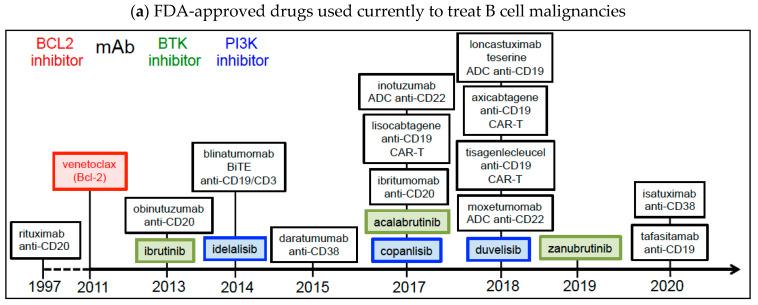
Resistance to death is one of the hallmarks of human B cell malignancies and often contributes to the lack of a lasting response to today's commonly used treatments. Drug discovery approaches designed to activate the death machinery have generated a large number of inhibitors of anti-apoptotic proteins from the B-cell lymphoma/leukemia 2 family and the B-cell receptor (BCR) signaling pathway. Orally administered small-molecule inhibitors of Bcl-2 protein and BCR partners (e.g., Bruton's tyrosine kinase and phosphatidylinositol-3 kinase) have already been included (as monotherapies or combination therapies) in the standard of care for selected B cell malignancies. Agonistic monoclonal antibodies and their derivatives (antibody-drug conjugates, antibody-radioisotope conjugates, bispecific T cell engagers, and chimeric antigen receptor-modified T cells) targeting tumor-associated antigens (TAAs, such as CD19, CD20, CD22, and CD38) are indicated for treatment (as monotherapies or combination therapies) of patients with B cell tumors. However, given that some patients are either refractory to current therapies or relapse after treatment, novel therapeutic strategies are needed. Here, we review current strategies for managing B cell malignancies, with a focus on the ongoing clinical development of more effective, selective drugs targeting these molecules, as well as other TAAs and signaling proteins. The observed impact of metabolic reprogramming on B cell pathophysiology highlights the promise of targeting metabolic checkpoints in the treatment of these disorders.
对死亡的抵抗是人类B细胞恶性肿瘤的特征之一,常常导致对当今常用治疗方法缺乏持久反应。旨在激活死亡机制的药物发现方法已经产生了大量来自B细胞淋巴瘤/白血病2家族和B细胞受体(BCR)信号通路的抗凋亡蛋白抑制剂。口服的Bcl-2蛋白和BCR相关蛋白(如布鲁顿酪氨酸激酶和磷脂酰肌醇-3激酶)的小分子抑制剂已经被纳入(作为单一疗法或联合疗法)某些B细胞恶性肿瘤的治疗标准中。靶向肿瘤相关抗原(TAAs,如CD19、CD20、CD22和CD38)的激动性单克隆抗体及其衍生物(抗体-药物偶联物、抗体-放射性同位素偶联物、双特异性T细胞衔接器和嵌合抗原受体修饰的T细胞)被用于治疗(作为单一疗法或联合疗法)B细胞肿瘤患者。然而,鉴于一些患者对当前治疗方法耐药或治疗后复发,需要新的治疗策略。在这里,我们综述了当前治疗B细胞恶性肿瘤的策略,重点关注针对这些分子以及其他TAAs和信号蛋白的更有效、更具选择性的药物的临床开发进展。代谢重编程对B细胞病理生理学的影响凸显了靶向代谢检查点治疗这些疾病的前景。


 Zotero 插件