
游离DNA在癌症治疗决策中的作用。
The Role of Cell-Free DNA in Cancer Treatment Decision Making.
作者信息
Telekes András, Horváth Anna
机构信息
Omnimed-Etosz, Ltd., 81 Széher Rd., 1021 Budapest, Hungary.
Semmelweis University, 26. Üllői Rd., 1085 Budapest, Hungary.
出版信息
Cancers (Basel). 2022 Dec 12;14(24):6115. doi: 10.3390/cancers14246115.
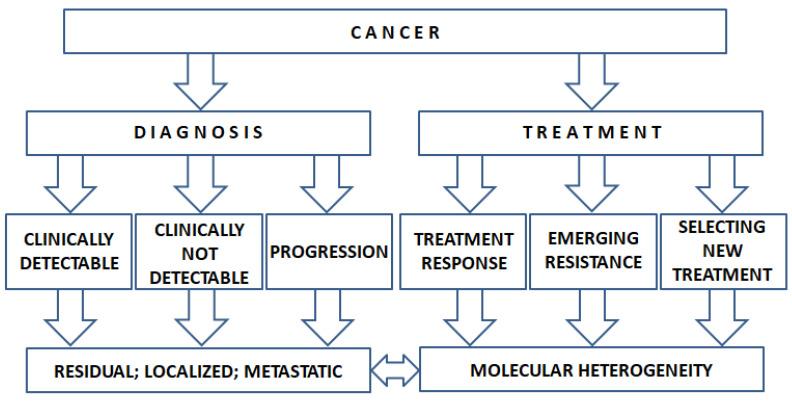
The aim of this review is to evaluate the present status of the use of cell-free DNA and its fraction of circulating tumor DNA (ctDNA) because this year July 2022, an ESMO guideline was published regarding the application of ctDNA in patient care. This review is for clinical oncologists to explain the concept, the terms used, the pros and cons of ctDNA; thus, the technical aspects of the different platforms are not reviewed in detail, but we try to help in navigating the current knowledge in liquid biopsy. Since the validated and adequately sensitive ctDNA assays have utility in identifying actionable mutations to direct targeted therapy, ctDNA may be used for this soon in routine clinical practice and in other different areas as well. The cfDNA fragments can be obtained by liquid biopsy and can be used for diagnosis, prognosis, and selecting among treatment options in cancer patients. A great proportion of cfDNA comes from normal cells of the body or from food uptake. Only a small part (<1%) of it is related to tumors, originating from primary tumors, metastatic sites, or circulating tumor cells (CTCs). Soon the data obtained from ctDNA may routinely be used for finding minimal residual disease, detecting relapse, and determining the sites of metastases. It might also be used for deciding appropriate therapy, and/or emerging resistance to the therapy and the data analysis of ctDNA may be combined with imaging or other markers. However, to achieve this goal, further clinical validations are inevitable. As a result, clinicians should be aware of the limitations of the assays. Of course, several open questions are still under research and because of it cfDNA and ctDNA testing are not part of routine care yet.
本综述的目的是评估游离DNA及其循环肿瘤DNA(ctDNA)部分的使用现状,因为在2022年7月,欧洲肿瘤内科学会(ESMO)发布了一份关于ctDNA在患者护理中应用的指南。本综述旨在向临床肿瘤学家解释ctDNA的概念、所用术语、优缺点;因此,不同平台的技术方面不再详细阐述,但我们试图帮助梳理液体活检方面的现有知识。由于经过验证且具有足够敏感性的ctDNA检测在识别可指导靶向治疗的可操作突变方面具有实用性,ctDNA可能很快会在常规临床实践以及其他不同领域中得到应用。游离DNA片段可通过液体活检获得,可用于癌症患者的诊断、预后评估以及治疗方案的选择。很大一部分游离DNA来自身体的正常细胞或食物摄入。其中只有一小部分(<1%)与肿瘤相关,来源于原发性肿瘤、转移部位或循环肿瘤细胞(CTC)。很快,从ctDNA获得的数据可能会常规用于发现微小残留病灶、检测复发以及确定转移部位。它还可能用于确定合适的治疗方案,和/或检测对治疗产生的新耐药性,并且ctDNA的数据分析可与影像学或其他标志物相结合。然而,要实现这一目标,进一步的临床验证是必不可少的。因此,临床医生应了解检测方法的局限性。当然,仍有几个悬而未决的问题正在研究中,正因为如此,游离DNA和ctDNA检测尚未成为常规护理的一部分。
 Zotero 插件