
头颈癌患者及其家属的流行病学、临床和基因组概况
Epidemiological, Clinical, and Genomic Profile in Head and Neck Cancer Patients and Their Families.
作者信息
Chulam Thiago Celestino, Bertonha Fernanda Bernardi, Villacis Rolando André Rios, Filho João Gonçalves, Kowalski Luiz Paulo, Rogatto Silvia Regina
机构信息
Department of Head and Neck Surgery and Otorhinolaryngology, A.C. Camargo Cancer Center, São Paulo 01509-001, SP, Brazil.
Department of Pediatrics, Faculdade de Medicina da Universidade de São Paulo (FMUSP), São Paulo 01246-903, SP, Brazil.
出版信息
Biomedicines. 2022 Dec 17;10(12):3278. doi: 10.3390/biomedicines10123278.
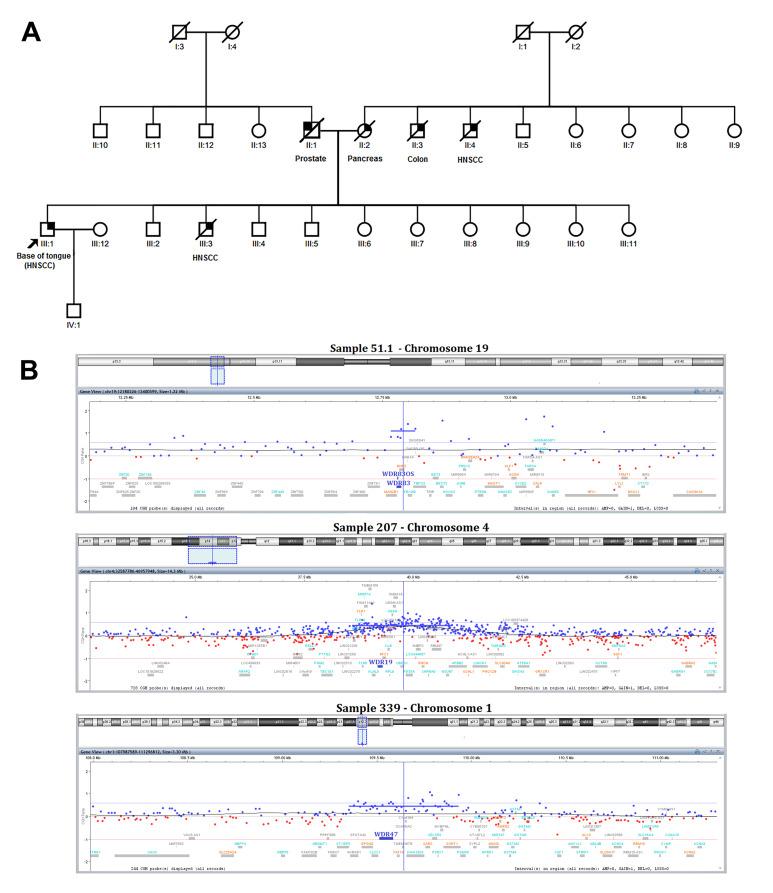
Inherited cancer predisposition genes are described as risk factors in head and neck cancer (HNC) families. To explore the clinical and epidemiological data and their association with a family history of cancer, we recruited 74 patients and 164 relatives affected by cancer. The germline copy number alterations were evaluated in 18 patients using array comparative genomic hybridization. Two or more first-degree relatives with HNC, tobacco-associated tumor sites (lung, esophagus, and pancreas), or other related tumors (breast, colon, kidney, bladder, cervix, stomach carcinomas, and melanoma) were reported in 74 families. Ten index patients had no exposure to any known risk factors. Family members presented tumors of 19 topographies (30 head and neck, 26 breast, 21 colon). In first-degree relatives, siblings were frequently affected by cancer ( = 58, 13 had HNC). Breast cancer ( = 21), HNC ( = 19), and uterine carcinoma ( = 15) were commonly found in first-degree relatives and HNC in second-degree relatives ( = 11). Nineteen germline genomic imbalances were detected in 13 patients; three presented gains of WRD genes. The number of HNC patients, the degree of kinship, and the tumor types detected in each relative support the role of heredity in these families. Germline alterations may potentially contribute to cancer development.
遗传性癌症易感基因被描述为头颈癌(HNC)家族中的风险因素。为了探究临床和流行病学数据及其与癌症家族史的关联,我们招募了74例患者和164名受癌症影响的亲属。使用阵列比较基因组杂交技术对18例患者的生殖系拷贝数改变进行了评估。在74个家族中,报告有两名或更多患有HNC、烟草相关肿瘤部位(肺癌、食管癌和胰腺癌)或其他相关肿瘤(乳腺癌、结肠癌、肾癌、膀胱癌、宫颈癌、胃癌和黑色素瘤)的一级亲属。10例索引患者未接触任何已知风险因素。家庭成员出现了19种不同部位的肿瘤(30例头颈癌、26例乳腺癌、21例结肠癌)。在一级亲属中,兄弟姐妹经常患癌症(=58,13例患有HNC)。一级亲属中常见乳腺癌(=21)、HNC(=19)和子宫癌(=15),二级亲属中常见HNC(=11)。在13例患者中检测到19种生殖系基因组失衡;3例出现WRD基因增益。HNC患者的数量、亲属关系程度以及在每个亲属中检测到的肿瘤类型支持了遗传因素在这些家族中的作用。生殖系改变可能潜在地促进癌症发展。
 Zotero 插件