
单细胞测序恶性腹水揭示上皮性卵巢癌进展过程中肿瘤微环境的转录组重构。
Single-Cell Sequencing of Malignant Ascites Reveals Transcriptomic Remodeling of the Tumor Microenvironment during the Progression of Epithelial Ovarian Cancer.
机构信息
School of Life Sciences and Technology, Harbin Institute of Technology, Harbin 150000, China.
Department of Biostatistics, School of Public Health, Harbin Medical University, Harbin 150000, China.
出版信息
Genes (Basel). 2022 Dec 2;13(12):2276. doi: 10.3390/genes13122276.
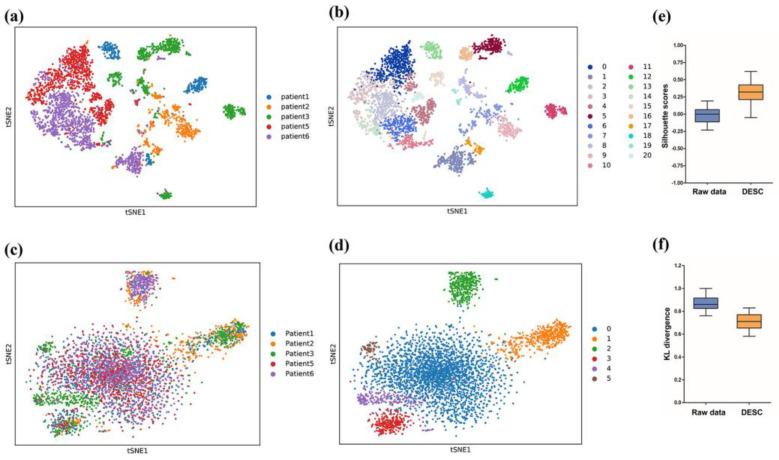
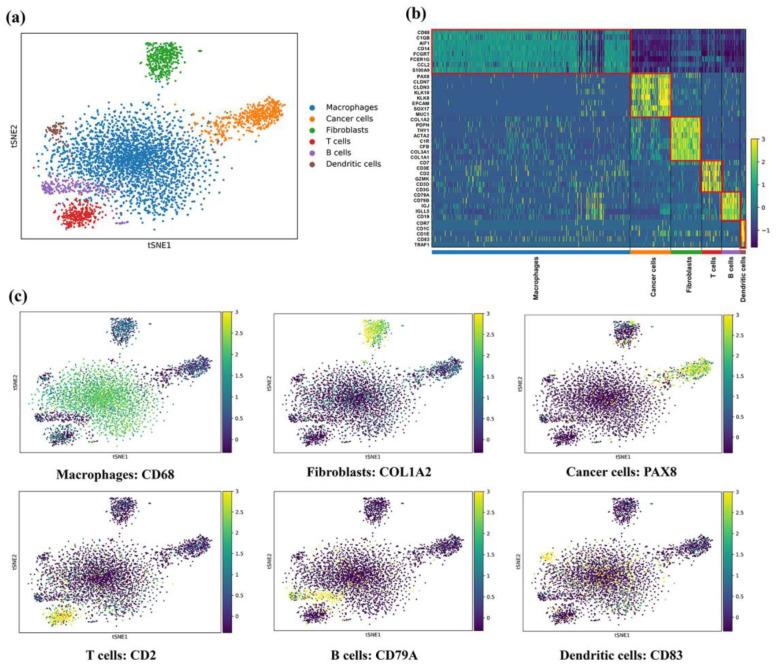
Epithelial ovarian cancer (EOC) is the main cause of mortality among gynecological malignancies worldwide. Although patients with EOC undergo aggregate treatment, the prognosis is often poor. Peritoneal malignant ascites is a distinguishable clinical feature in EOC patients and plays a pivotal role in tumor progression and recurrence. The mechanisms of the tumor microenvironment (TME) in ascites in the regulation of tumor progression need to be explored. We comprehensively analyzed the transcriptomes of 4680 single cells from five EOC patients (three diagnostic samples and two recurrent samples) derived from Gene Expression Omnibus (GEO) databases. Batch effects between different samples were removed using an unsupervised deep embedding single-cell cluster algorithm. Subcluster analysis identified the different phenotypes of cells. The transition of a malignant cell state was confirmed using pseudotime analysis. The landscape of TME in malignant ascites was profiled during EOC progression. The transformation of epithelial cancer cells into mesenchymal cells was observed to lead to the emergence of related anti-chemotherapy and immune escape phenotypes. We found the activation of multiple biological pathways with the transition of tumor-associated macrophages and fibroblasts, and we identified the infiltration of CD4CD25 T regulatory cells in recurrent samples. The cell adhesion molecules mediated by integrin might be associated with the formation of the tumorsphere. Our study provides novel insights into the remodeling of the TME heterogeneity in malignant ascites during EOC progression, which provides evidence for identifying novel therapeutic targets and promotes the development of ovarian cancer treatment.
上皮性卵巢癌(EOC)是全球妇科恶性肿瘤死亡的主要原因。尽管 EOC 患者接受了综合治疗,但预后往往较差。腹膜恶性腹水是 EOC 患者的一个明显临床特征,在肿瘤进展和复发中起关键作用。肿瘤微环境(TME)在腹水调节肿瘤进展中的机制仍需探索。我们综合分析了来自基因表达综合数据库(GEO)的五名 EOC 患者(三名诊断样本和两名复发性样本)的 4680 个单细胞转录组。使用无监督深度嵌入单细胞聚类算法去除不同样本之间的批次效应。亚群分析确定了细胞的不同表型。通过伪时间分析证实恶性细胞状态的转变。在 EOC 进展过程中对恶性腹水的 TME 进行了描绘。观察到上皮癌细胞向间充质细胞的转化导致相关抗化疗和免疫逃逸表型的出现。我们发现随着肿瘤相关巨噬细胞和成纤维细胞的转变,多个生物学途径被激活,并且在复发性样本中鉴定到 CD4CD25T 调节性细胞的浸润。整合素介导的细胞黏附分子可能与肿瘤球的形成有关。我们的研究为 EOC 进展过程中恶性腹水中 TME 异质性的重塑提供了新的见解,为鉴定新的治疗靶点提供了证据,并促进了卵巢癌治疗的发展。



 Zotero 插件