
一项系统评价,旨在探究老年人进行双重任务训练后平衡改善和跌倒减少的理论基础。
A Systematic Review Exploring the Theories Underlying the Improvement of Balance and Reduction in Falls Following Dual-Task Training among Older Adults.
机构信息
Department of Rehabilitation Sciences, The Hong Kong Polytechnic University, Kowloon, Hong Kong 999077, China.
出版信息
Int J Environ Res Public Health. 2022 Dec 15;19(24):16890. doi: 10.3390/ijerph192416890.
BACKGROUND
Balance impairment causes frequent falls in older adults, and preventing falls remains challenging. Dual-task (DT) training reduces falls by improving balance, but the precise theory is not fully understood. This review aims to explore the theories underlying the effectiveness of DT in improving balance and reducing falls in older adults.
METHODS
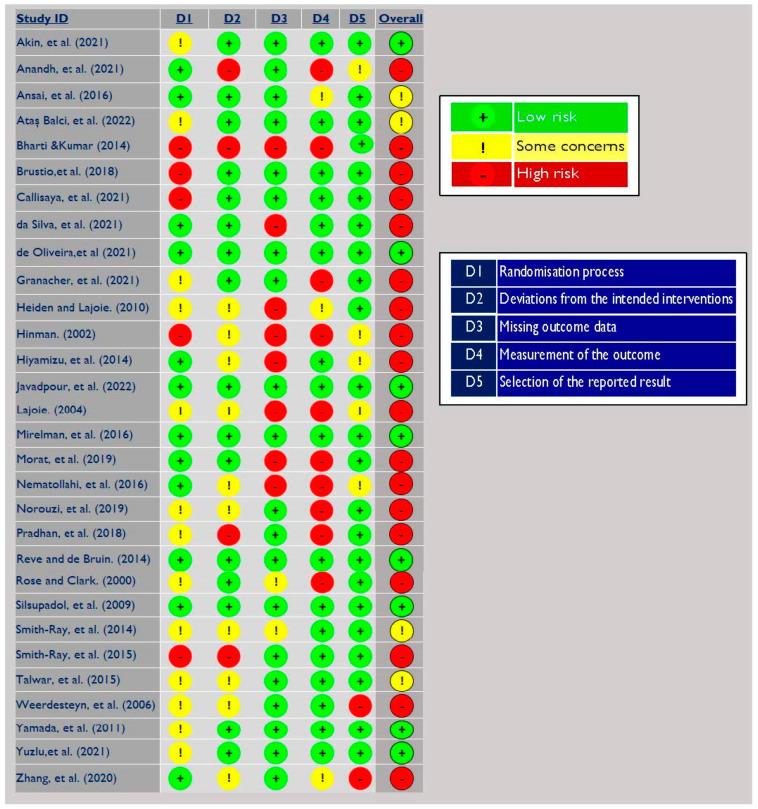
Eleven electronic databases were searched from database inception to June 2022. Two reviewers independently performed study screening and data extraction. The risk of bias (RoB) in the included studies was assessed using the Cochrane Collaboration RoB 2 tool.
RESULTS
The searches yielded 1478 citations, of which 30 studies met the inclusion criteria and were included in the review. Twenty-two of the 30 included studies utilized the motor-cognitive type of DT for training, while six used motor-motor and two utilized cognitive-cognitive DT. The included studies reported 20 different theories to explain the effectiveness of DT for improving balance and reducing falls in older adults. The predominant theory identified in the included studies was attention theory ( = 14). Overall, 26 studies reported improved balance and five studies found a reduction in fall incidence following DT training. Balance and falls improved significantly in 15 motor-cognitive DT intervention studies.
CONCLUSION
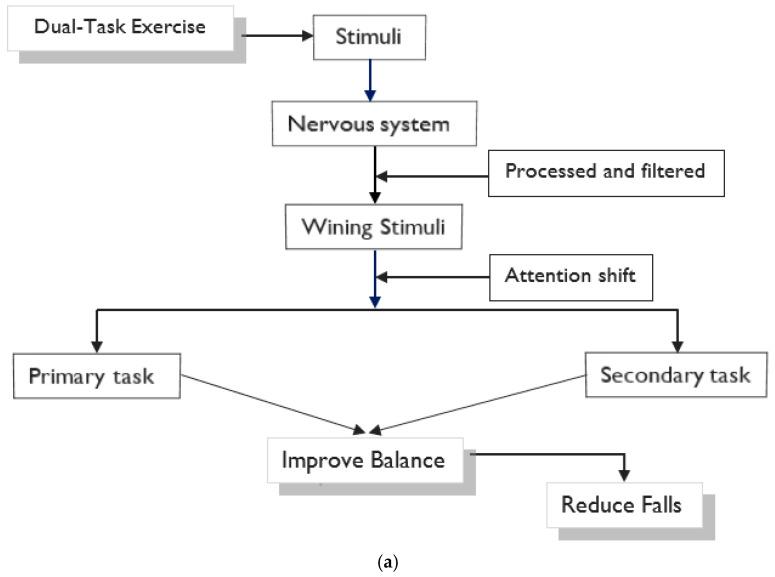
Attention shifting between two tasks is reported to occur following DT training. Motor-cognitive DT training improves balance and reduces fall incidence in older adults by shifting attention based on the difficulty and priority of a task from the motor to the cognitive task.
背景
平衡障碍导致老年人经常跌倒,预防跌倒仍然具有挑战性。双重任务(DT)训练通过改善平衡来减少跌倒,但确切的理论尚未完全理解。本综述旨在探讨 DT 在改善老年人平衡和减少跌倒方面有效性的理论基础。
方法
从数据库建立到 2022 年 6 月,我们对 11 个电子数据库进行了检索。两位审查员独立进行了研究筛选和数据提取。使用 Cochrane 协作 RoB 2 工具评估纳入研究的偏倚风险(RoB)。
结果
检索产生了 1478 条引文,其中 30 项研究符合纳入标准并包含在综述中。30 项纳入研究中的 22 项采用了运动认知型 DT 进行训练,6 项采用了运动运动型 DT,2 项采用了认知认知型 DT。纳入的研究报告了 20 种不同的理论来解释 DT 改善老年人平衡和减少跌倒的有效性。纳入研究中最主要的理论是注意力理论(=14)。总体而言,26 项研究报告了平衡的改善,5 项研究发现 DT 训练后跌倒发生率降低。15 项运动认知型 DT 干预研究中平衡和跌倒显著改善。
结论
报告称,在进行 DT 训练后,两个任务之间的注意力转移会发生。运动认知型 DT 训练通过将注意力从运动任务转移到认知任务,根据任务的难度和优先级进行转移,从而改善老年人的平衡并减少跌倒发生率。

 Zotero 插件