
多因素质量和安全分析:无需处方即可在网上药店购买的抗菌药物:多阶段观察、内容分析和产品评估研究。
Multifactor Quality and Safety Analysis of Antimicrobial Drugs Sold by Online Pharmacies That Do Not Require a Prescription: Multiphase Observational, Content Analysis, and Product Evaluation Study.
机构信息
Global Health Program, Department of Anthropology, University of California, San Diego, La Jolla, CA, United States.
Global Health Policy and Data Institute, San Diego, CA, United States.
出版信息
JMIR Public Health Surveill. 2022 Dec 23;8(12):e41834. doi: 10.2196/41834.
BACKGROUND
Antimicrobial resistance is a significant global public health threat. However, the impact of sourcing potentially substandard and falsified antibiotics via the internet remains understudied, particularly in the context of access to and quality of common antibiotics. In response, this study conducted a multifactor quality and safety analysis of antibiotics sold and purchased via online pharmacies that did not require a prescription.
OBJECTIVE
The aim of this paper is to identify and characterize "no prescription" online pharmacies selling 5 common antibiotics and to assess the quality characteristics of samples through controlled test buys.
METHODS
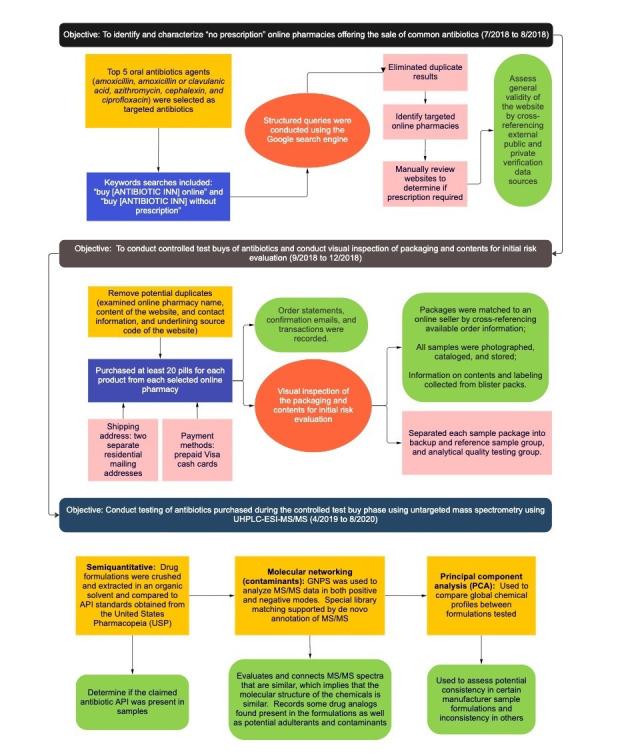
We first used structured search queries associated with the international nonproprietary names of amoxicillin, azithromycin, amoxicillin and clavulanic acid, cephalexin, and ciprofloxacin to detect and characterize online pharmacies offering the sale of antibiotics without a prescription. Next, we conducted controlled test buys of antibiotics and conducted a visual inspection of packaging and contents for risk evaluation. Antibiotics were then analyzed using untargeted mass spectrometry (MS). MS data were used to determine if the claimed active pharmaceutical ingredient was present, and molecular networking was used to analyze MS data to detect drug analogs as well as possible adulterants and contaminants.
RESULTS
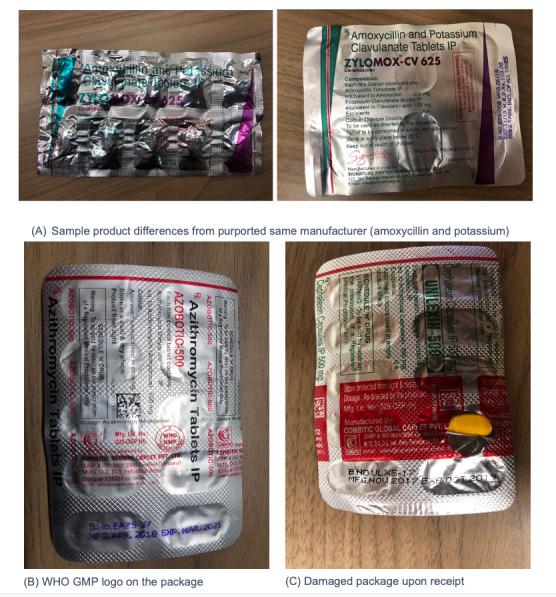
A total of 109 unique websites were identified that actively advertised direct-to-consumer sale of antibiotics without a prescription. From these websites, we successfully placed 27 orders, received 11 packages, and collected 1373 antibiotic product samples. Visual inspection resulted in all product packaging consisting of pill packs or blister packs and some concerning indicators of potential poor quality, falsification, and improper dispensing. Though all samples had the presence of stated active pharmaceutical ingredient, molecular networking revealed a number of drug analogs of unknown identity, as well as known impurities and contaminants.
CONCLUSIONS
Our study used a multifactor approach, including web surveillance, test purchasing, and analytical chemistry, to assess risk factors associated with purchasing antibiotics online. Results provide evidence of possible safety risks, including substandard packaging and shipment, falsification of product information and markings, detection of undeclared chemicals, high variability of quality across samples, and payment for orders being defrauded. Beyond immediate patient safety risks, these falsified and substandard products could exacerbate the ongoing public health threat of antimicrobial resistance by circulating substandard product to patients.
背景
抗菌药物耐药性是一个重大的全球公共卫生威胁。然而,通过互联网获取潜在劣药和假药的影响仍研究不足,尤其是在获取和常见抗生素质量方面。有鉴于此,本研究对无需处方即可购买的网上药店销售和购买的抗生素进行了多因素质量和安全性分析。
目的
本文旨在识别和描述销售 5 种常见抗生素且无需处方的“无处方”网上药店,并通过受控测试购买来评估样本的质量特征。
方法
我们首先使用与阿莫西林、阿奇霉素、阿莫西林克拉维酸、头孢氨苄和环丙沙星的国际非专利名称相关的结构化搜索查询来检测和描述提供无需处方销售抗生素的网上药店。接下来,我们进行了抗生素的受控测试购买,并对包装和内容进行了目视检查,以进行风险评估。然后使用非靶向质谱(MS)分析抗生素。MS 数据用于确定是否存在所声称的活性药物成分,并且分子网络用于分析 MS 数据以检测药物类似物以及可能的掺杂物和污染物。
结果
共确定了 109 个独特的网站,这些网站积极宣传直接面向消费者销售无需处方的抗生素。我们从这些网站成功下达了 27 个订单,收到了 11 个包裹,并收集了 1373 个抗生素产品样本。目视检查导致所有产品包装均为药丸包装或泡罩包装,且存在一些令人担忧的潜在劣质、伪造和不当配药的迹象。尽管所有样本均含有所声明的活性药物成分,但分子网络揭示了一些未知身份的药物类似物,以及已知的杂质和污染物。
结论
我们的研究使用多因素方法,包括网络监测、测试购买和分析化学,评估了在线购买抗生素的相关风险因素。结果提供了可能存在安全风险的证据,包括劣质包装和运输、产品信息和标记伪造、检测到未申报的化学物质、样本质量的高度变异性以及订单付款欺诈。除了直接的患者安全风险外,这些伪造和劣质产品可能会通过向患者流通劣质产品来加剧抗菌药物耐药性这一持续存在的公共卫生威胁。
 Zotero 插件