
从非小细胞肺癌和小细胞肺癌患者中分离出的循环肿瘤细胞的表型特征
Phenotypic Characterization of Circulating Tumor Cells Isolated from Non-Small and Small Cell Lung Cancer Patients.
作者信息
Roumeliotou Argyro, Pantazaka Evangelia, Xagara Anastasia, Dimitrakopoulos Foteinos-Ioannis, Koutras Angelos, Christopoulou Athina, Kourelis Theodoros, Aljarba Nada H, Alkahtani Saad, Koinis Filippos, Kotsakis Athanasios, Kallergi Galatea
机构信息
Laboratory of Biochemistry/Metastatic Signaling, Section of Genetics, Cell Biology and Development, Department of Biology, University of Patras, 26504 Patras, Greece.
Laboratory of Oncology, Faculty of Medicine, School of Health Sciences, University of Thessaly, 41500 Larissa, Greece.
出版信息
Cancers (Basel). 2022 Dec 28;15(1):171. doi: 10.3390/cancers15010171.
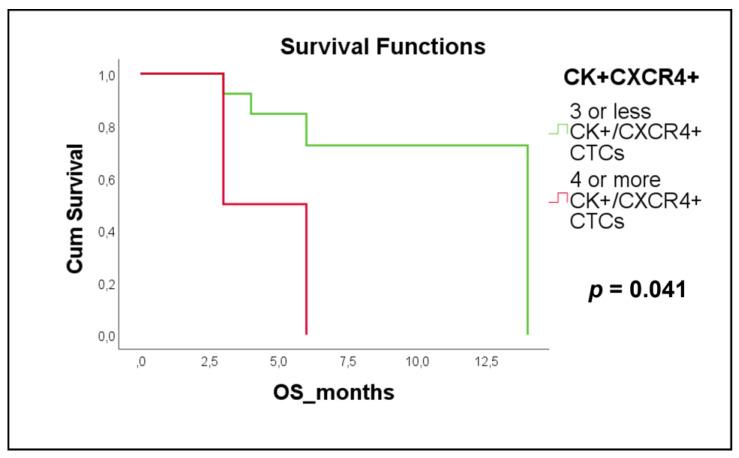
In the present study, we evaluated the expression of JUNB and CXCR4 in circulating tumor cells (CTCs) of lung cancer patients and investigated whether these proteins have prognostic clinical relevance. Peripheral blood from 30 patients with non-small-cell lung cancer (NSCLC) was filtered using ISET membranes, and cytospins from 37 patients with small-cell lung cancer (SCLC) were analyzed using confocal and VyCAP microscopy. Both JUNB and CXCR4 were expressed in the vast majority of lung cancer patients. Interestingly, the phenotypic patterns differed between NSCLC and SCLC patients; the (CK+/JUNB+/CXCR4+) phenotype was present in 50% of NSCLC vs. 71% of SCLC patients. Similarly, the (CK+/JUNB+/CXCR4−) was present in 44% vs. 71%, the (CK+/JUNB−/CXCR4+) in 6% vs. 71%, and the (CK+/JUNB−/CXCR4−) phenotype in 38% vs. 84%. In NSCLC, the presence of ≥1 CTCs with the (CK+/JUNB+/CXCR4+) phenotype was associated with worse progression-free survival (PFS) (p = 0.007, HR = 5.21) while ≥2 with poorer overall survival (OS) (p < 0.001, HR = 2.16). In extensive stage SCLC patients, the presence of ≥4 CXCR4-positive CTCs was associated with shorter OS (p = 0.041, HR = 5.01). Consequently, JUNB and CXCR4 were expressed in CTCs from lung cancer patients, and associated with patients’ survival, underlying their key role in tumor progression.
在本研究中,我们评估了肺癌患者循环肿瘤细胞(CTC)中JUNB和CXCR4的表达,并研究了这些蛋白是否具有预后临床相关性。使用ISET膜过滤30例非小细胞肺癌(NSCLC)患者的外周血,并使用共聚焦显微镜和VyCAP显微镜分析37例小细胞肺癌(SCLC)患者的细胞涂片。绝大多数肺癌患者中JUNB和CXCR4均有表达。有趣的是,NSCLC和SCLC患者的表型模式有所不同;(CK+/JUNB+/CXCR4+)表型在50%的NSCLC患者中出现,而在71%的SCLC患者中出现。同样,(CK+/JUNB+/CXCR4−)表型在NSCLC患者中占44%,在SCLC患者中占71%;(CK+/JUNB−/CXCR4+)表型在NSCLC患者中占6%,在SCLC患者中占71%;(CK+/JUNB−/CXCR4−)表型在NSCLC患者中占38%,在SCLC患者中占84%。在NSCLC中,存在≥1个具有(CK+/JUNB+/CXCR4+)表型的CTC与无进展生存期(PFS)较差相关(p = 0.007,HR = 5.21),而≥2个则与总生存期(OS)较差相关(p < 0.001,HR = 2.16)。在广泛期SCLC患者中,存在≥4个CXCR4阳性CTC与较短的OS相关(p = 0.041,HR = 5.01)。因此,JUNB和CXCR4在肺癌患者的CTC中表达,并与患者的生存相关,表明它们在肿瘤进展中起关键作用。


 Zotero 插件