
虚弱与冬季环境温度的关联:一项基于人群的研究结果。
Associations between Frailty and Ambient Temperature in Winter: Findings from a Population-Based Study.
机构信息
Department of Medical Statistic, School of Public Health, Sun Yat-sen University, Guangzhou 510275, China.
出版信息
Int J Environ Res Public Health. 2022 Dec 28;20(1):513. doi: 10.3390/ijerph20010513.
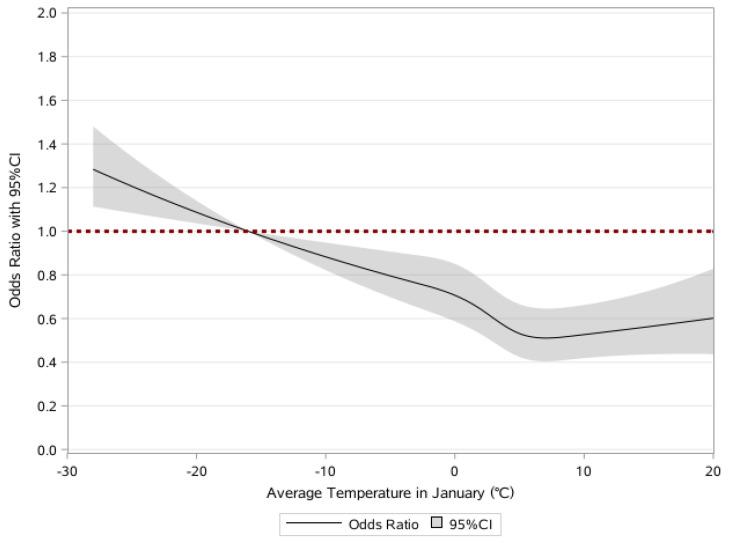
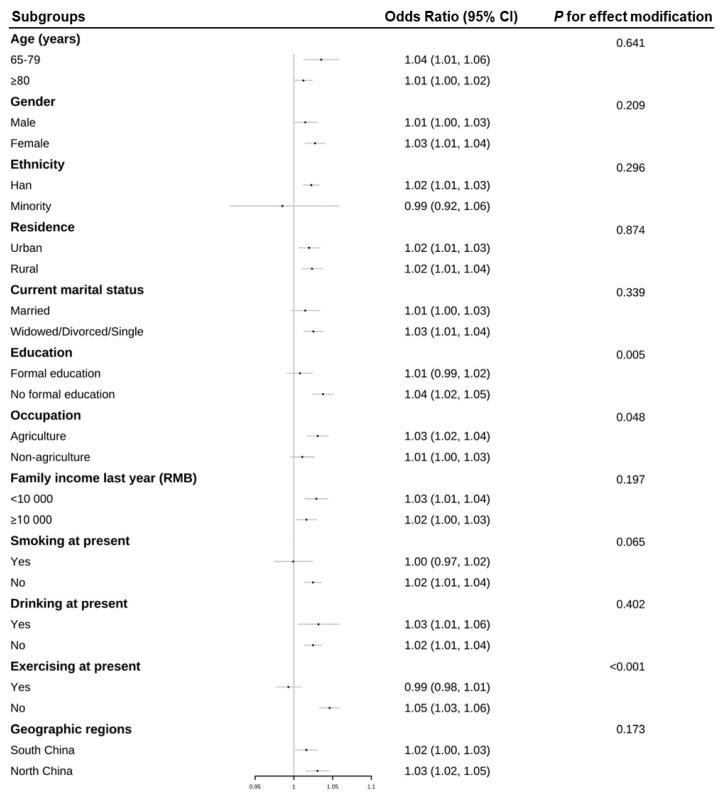
Frailty is an accumulation of deficits characterized by reduced resistance to stressors and increased vulnerability to adverse outcomes. However, there is little known about the effect of ambient temperature in winter on frailty among older adults, a population segment with the highest frailty prevalence. Thus, the objective of this study is to investigate the associations between frailty and ambient temperature in winter among older adults. This study was based on the Chinese Longitudinal Healthy Longevity Survey (CLHLS) of older adults aged ≥65 years from the 2005, 2008, 2011, and 2014 waves. The 39-item accumulation of frailty index (FI) was used to assess the frailty status of the participants. The FI was categorized into three groups as follows: robust (FI ≤ 0.10), prefrail (FI > 0.10 to <0.25), and frail (FI ≥ 0.25). Generalized linear mixed models (GLMMs) were conducted to explore the associations between frailty and ambient temperature in winter. A generalized estimating equation (GEE) modification was applied in the sensitivity analysis. A total of 9421 participants were included with a mean age of 82.81 (SD: 11.32) years. Compared with respondents living in the highest quartile (≥7.5 °C) of average temperature in January, those in the lowest quartile (<−1.9 °C) had higher odds of prefrailty (OR = 1.35, 95% CI 1.17−1.57) and frailty (OR = 1.61, 95%CI 1.32−1.95). The associations were stronger among the low-education groups, agricultural workers before retirement, and non-current exercisers. Additionally, results from the GEE model reported consistent findings. Lower levels of ambient temperature in winter were associated with higher likelihoods of prefrailty and frailty. The findings on vulnerability characteristics could help improve public health practices to tailor cold temperature health education and warning information.
衰弱是一种积累的缺陷,其特征是对压力源的抵抗力降低,对不良后果的脆弱性增加。然而,对于冬季环境温度对老年人衰弱的影响知之甚少,老年人是衰弱患病率最高的人群。因此,本研究旨在探讨老年人冬季衰弱与环境温度之间的关系。本研究基于中国老年人纵向健康长寿调查(CLHLS),共纳入了来自 2005 年、2008 年、2011 年和 2014 年的≥65 岁老年人。采用 39 项衰弱累积指数(FI)来评估参与者的衰弱状况。FI 分为三组:健壮(FI≤0.10)、衰弱前期(FI>0.10 至<0.25)和衰弱(FI≥0.25)。采用广义线性混合模型(GLMM)探讨衰弱与冬季环境温度之间的关系。在敏感性分析中应用广义估计方程(GEE)修正。共纳入 9421 名参与者,平均年龄为 82.81(SD:11.32)岁。与居住在 1 月平均温度最高四分位数(≥7.5°C)的受访者相比,居住在最低四分位数(<−1.9°C)的受访者衰弱前期(OR=1.35,95%CI 1.17−1.57)和衰弱(OR=1.61,95%CI 1.32−1.95)的可能性更高。在低教育程度、退休前农业劳动者和非当前锻炼者中,这种关联更为强烈。此外,GEE 模型的结果报告了一致的发现。冬季环境温度较低与衰弱前期和衰弱的可能性增加有关。这些脆弱性特征的发现有助于改善公共卫生实践,以定制寒冷天气健康教育和预警信息。

 Zotero 插件