
慢性炎症性脱髓鞘性多发性神经根神经病中的代谢紊乱与肠道微生物群失调
Metabolic disorder and intestinal microflora dysbiosis in chronic inflammatory demyelinating polyradiculoneuropathy.
作者信息
Fu Jiafang, Shan Jingli, Cui Yazhou, Yan Chuanzhu, Wang Qinzhou, Han Jinxiang, Cao Guangxiang
机构信息
Biomedical Sciences College & Shandong Medicinal Biotechnology Centre, First Affiliated Hospital of Shandong First Medical University, Shandong First Medical University & Shandong Academy of Medical Sciences, Jinan, 250117, China.
Key Lab for Rare & Uncommon Diseases of Shandong Province, Jinan, 250117, China.
出版信息
Cell Biosci. 2023 Jan 11;13(1):6. doi: 10.1186/s13578-023-00956-1.
OBJECTIVE
Chronic inflammatory demyelinating polyradiculoneuropathy (CIDP) is a rare acquired immune-mediated neuropathy. Although microbial infection is potentially a contributing factor, a causative link between CIDP and microbial infection remains unclear. There is also no definitive biomarker for CIDP diagnostics and therapies. The present study aimed to characterize the serum metabolic profile and gut microbiome structure in CIDP.
METHODS
Targeted metabolomics profiling of serum, using liquid chromatography-mass spectrometry, and metagenomics sequencing of stool samples from a cohort of CIDP and non-CIDP subjects were performed to evaluate serum metabolic profiles and gut microbiome structure in CIDP subjects relative to healthy controls.
RESULTS
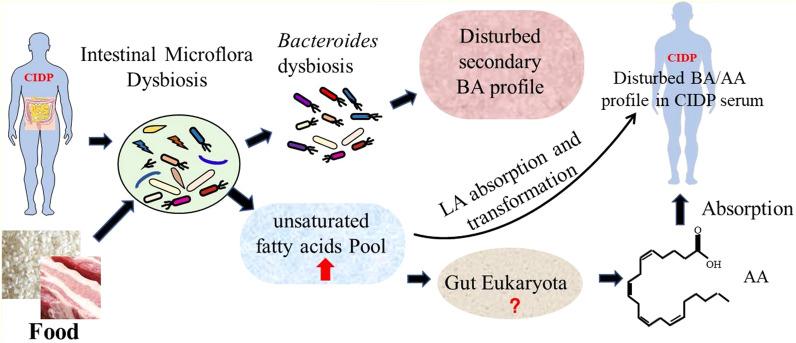
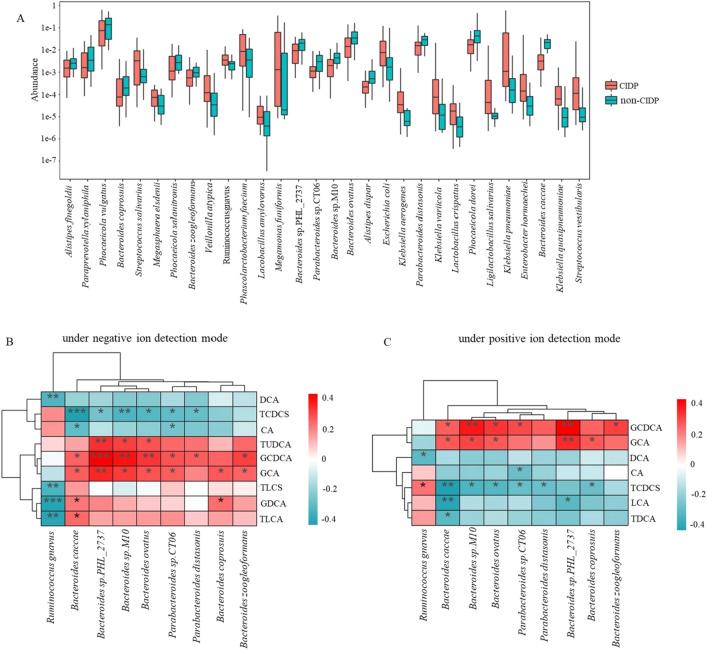
Metabolome data revealed that the bile acids profile was perturbed in CIDP with bile acids and arachidonic acid enriched significantly in CIDP versus non-CIDP controls. Metagenome data revealed that opportunistic pathogens, such as Klebsiella pneumonia and Megamonas funiformis, and genes involved in bacterial infection were notably more abundant in CIDP subjects, while gut microbes related to biotransformation of secondary bile acids were abnormal in CIDP versus non-CIDP subjects. Correlation analysis revealed that changes in secondary bile acids were associated with altered gut microbes, including Bacteroides ovatus, Bacteroides caccae, and Ruminococcus gnavus.
CONCLUSION
Bile acids and arachidonic acid metabolism were disturbed in CIDP subjects and might be affected by the dysbiosis of gut microbial flora. These findings suggest that the combination of bile acids and arachidonic acid could be used as a CIDP biomarker and that modulation of gut microbiota might impact the clinical course of CIDP.
目的
慢性炎症性脱髓鞘性多发性神经根神经病(CIDP)是一种罕见的获得性免疫介导性神经病。尽管微生物感染可能是一个促成因素,但CIDP与微生物感染之间的因果关系仍不清楚。CIDP的诊断和治疗也没有明确的生物标志物。本研究旨在描述CIDP患者的血清代谢谱和肠道微生物群结构。
方法
采用液相色谱-质谱联用技术对血清进行靶向代谢组学分析,并对一组CIDP患者和非CIDP患者的粪便样本进行宏基因组测序,以评估CIDP患者相对于健康对照的血清代谢谱和肠道微生物群结构。
结果
代谢组学数据显示,CIDP患者的胆汁酸谱发生了改变,与非CIDP对照组相比,CIDP患者的胆汁酸和花生四烯酸显著富集。宏基因组数据显示,机会性病原体,如肺炎克雷伯菌和梭形巨单胞菌,以及参与细菌感染的基因在CIDP患者中明显更为丰富,而与次级胆汁酸生物转化相关的肠道微生物在CIDP患者与非CIDP患者中存在异常。相关性分析显示,次级胆汁酸的变化与肠道微生物的改变有关,包括卵形拟杆菌、粪便拟杆菌和纤细瘤胃球菌。
结论
CIDP患者的胆汁酸和花生四烯酸代谢受到干扰,可能受肠道微生物群失调的影响。这些发现表明,胆汁酸和花生四烯酸的组合可作为CIDP的生物标志物,调节肠道微生物群可能会影响CIDP的临床病程。


 Zotero 插件