
随时间变化的氧供应条件下肿瘤球体的生长和适应机制。
Growth and adaptation mechanisms of tumour spheroids with time-dependent oxygen availability.
机构信息
Mathematical Sciences, Queensland University of Technology, Brisbane, Queensland, Australia.
Frazer Institute, The University of Queensland, Brisbane, Queensland, Australia.
出版信息
PLoS Comput Biol. 2023 Jan 12;19(1):e1010833. doi: 10.1371/journal.pcbi.1010833. eCollection 2023 Jan.
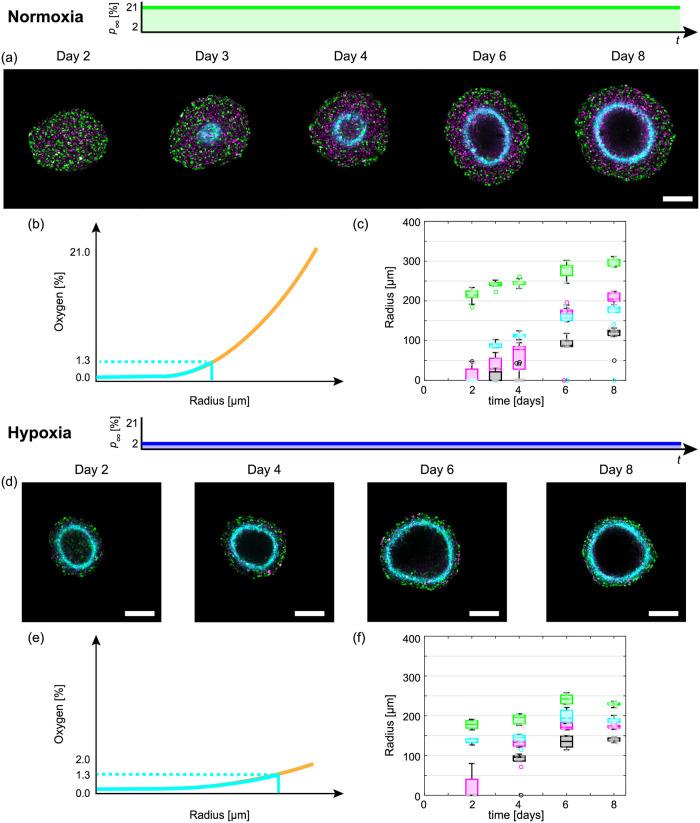
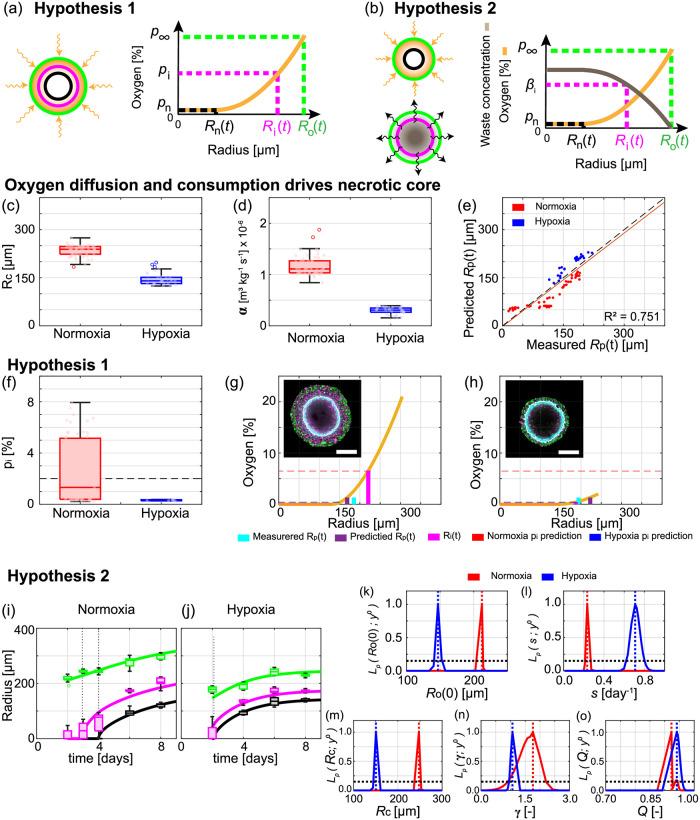
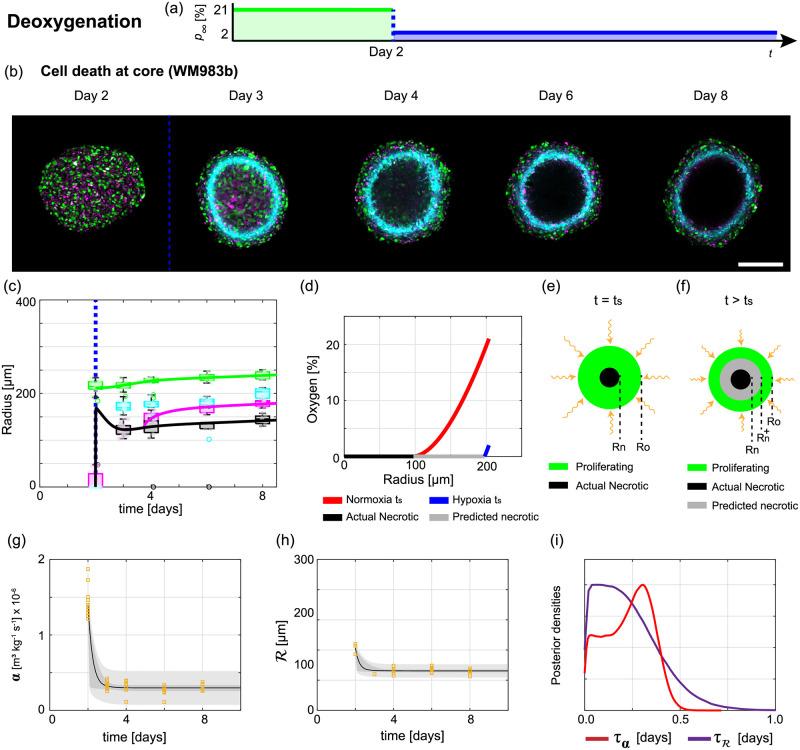
Tumours are subject to external environmental variability. However, in vitro tumour spheroid experiments, used to understand cancer progression and develop cancer therapies, have been routinely performed for the past fifty years in constant external environments. Furthermore, spheroids are typically grown in ambient atmospheric oxygen (normoxia), whereas most in vivo tumours exist in hypoxic environments. Therefore, there are clear discrepancies between in vitro and in vivo conditions. We explore these discrepancies by combining tools from experimental biology, mathematical modelling, and statistical uncertainty quantification. Focusing on oxygen variability to develop our framework, we reveal key biological mechanisms governing tumour spheroid growth. Growing spheroids in time-dependent conditions, we identify and quantify novel biological adaptation mechanisms, including unexpected necrotic core removal, and transient reversal of the tumour spheroid growth phases.
肿瘤受到外部环境变化的影响。然而,在过去的五十年中,为了了解癌症的进展并开发癌症疗法,人们一直在常规地进行体外肿瘤球体实验,这些实验都是在恒定的外部环境中进行的。此外,球体通常在大气氧(常氧)中生长,而大多数体内肿瘤存在于缺氧环境中。因此,体外和体内条件之间存在明显差异。我们通过结合实验生物学、数学建模和统计不确定性量化的工具来探索这些差异。我们专注于氧变异性来开发我们的框架,揭示了控制肿瘤球体生长的关键生物学机制。通过在时变条件下培养球体,我们确定并量化了新的生物学适应机制,包括意外的坏死核心去除和肿瘤球体生长阶段的短暂逆转。


 Zotero 插件