
基于侧位头影测量片准确估计骨龄的深度聚焦方法。
Deep focus approach for accurate bone age estimation from lateral cephalogram.
作者信息
Seo Hyejun, Hwang JaeJoon, Jung Yun-Hoa, Lee Eungyung, Nam Ok Hyung, Shin Jonghyun
机构信息
Department of Pediatric Dentistry, School of Dentistry, Pusan National University, Yangsan, South Korea.
Department of Dentistry, Ulsan University Hospital, Ulsan, South Korea.
出版信息
J Dent Sci. 2023 Jan;18(1):34-43. doi: 10.1016/j.jds.2022.07.018. Epub 2022 Aug 20.
BACKGROUND/PURPOSE: Bone age is a useful indicator of children's growth and development. Recently, the rapid development of deep-learning technique has shown promising results in estimating bone age. This study aimed to devise a deep-learning approach for accurate bone-age estimation by focusing on the cervical vertebrae on lateral cephalograms of growing children using image segmentation.
MATERIALS AND METHODS
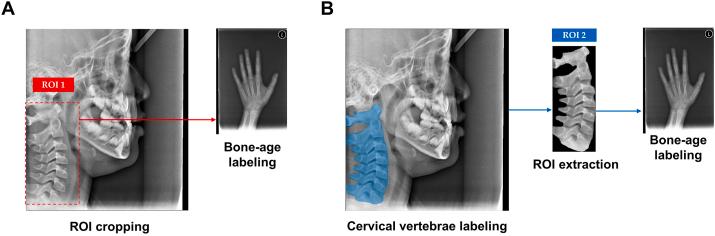
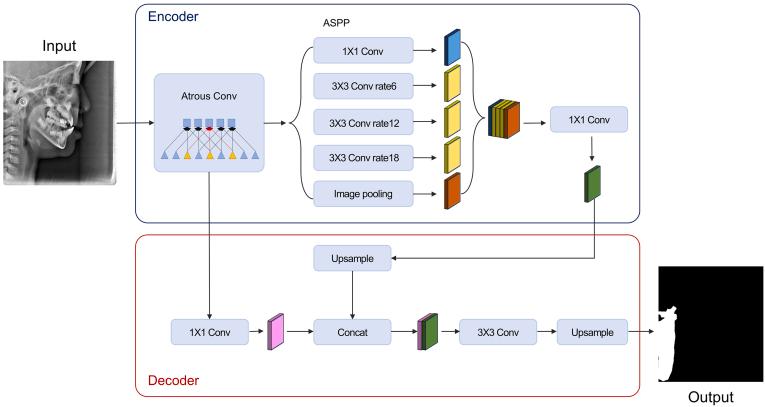
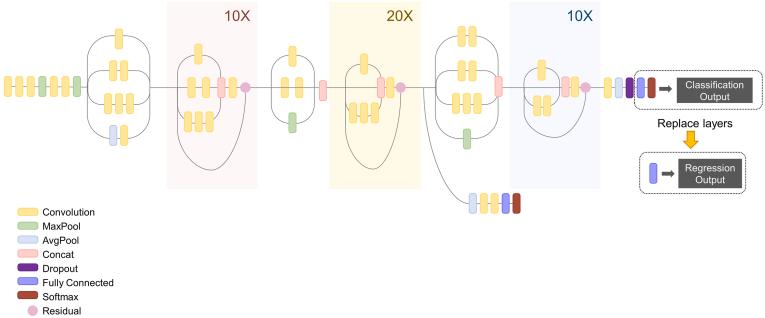
We included 900 participants, aged 4-18 years, who underwent lateral cephalogram and hand-wrist radiograph on the same day. First, cervical vertebrae segmentation was performed from the lateral cephalogram using DeepLabv3+ architecture. Second, after extracting the region of interest from the segmented image for preprocessing, bone age was estimated through transfer learning using a regression model based on Inception-ResNet-v2 architecture. The dataset was divided into train:test sets in a ratio of 4:1; five-fold cross-validation was performed at each step.
RESULTS
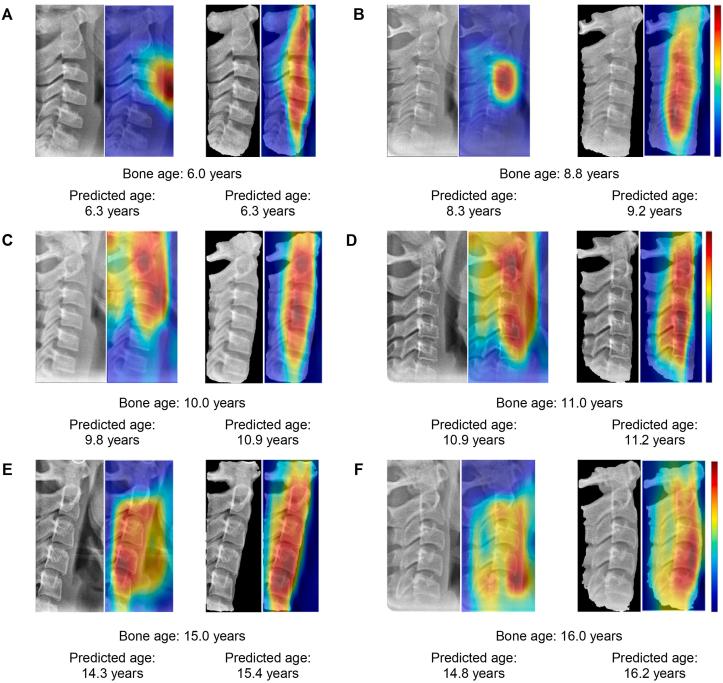
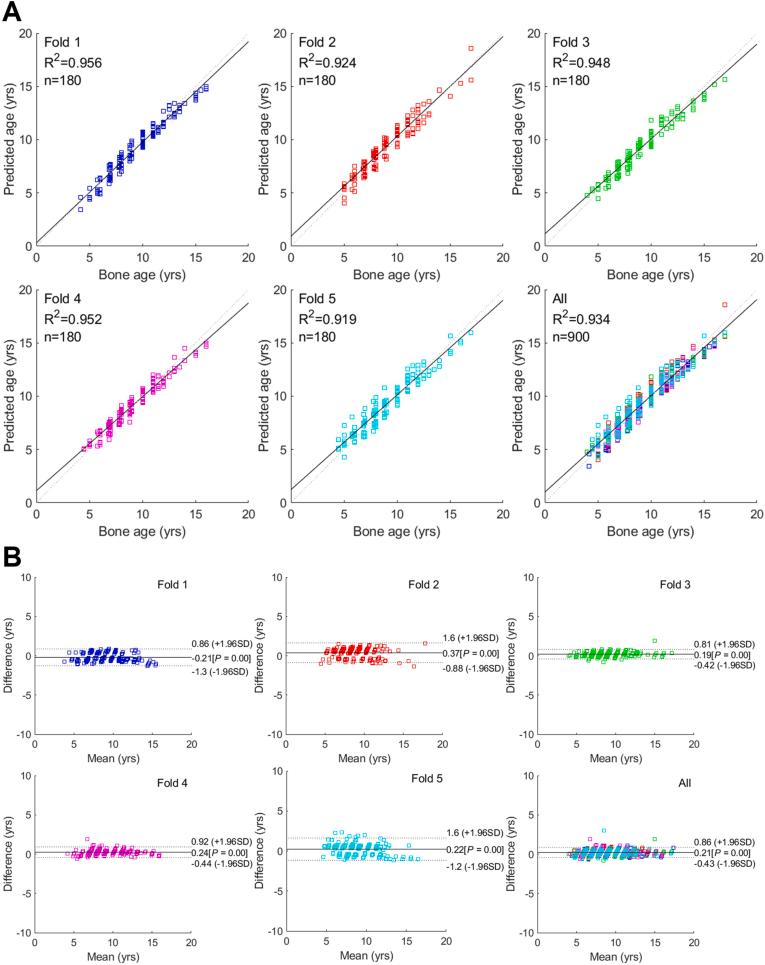
The segmentation model possessed average accuracy, intersection over union, and mean boundary F1 scores of 0.956, 0.913, and 0.895, respectively, for the segmentation of cervical vertebrae from lateral cephalogram. The regression model for estimating bone age from segmented cervical vertebrae images yielded average mean absolute error and root mean squared error values of 0.300 and 0.390 years, respectively. The coefficient of determination of the proposed method for the actual and estimated bone age was 0.983. Our method visualized important regions on cervical vertebral images to make a prediction using the gradient-weighted regression activation map technique.
CONCLUSION
Results showed that our proposed method can estimate bone age by lateral cephalogram with sufficiently high accuracy.
背景/目的:骨龄是儿童生长发育的一个有用指标。近年来,深度学习技术的快速发展在骨龄估计方面显示出了有前景的结果。本研究旨在通过使用图像分割技术,聚焦于生长中儿童的头颅侧位片上的颈椎,设计一种用于准确骨龄估计的深度学习方法。
材料与方法
我们纳入了900名年龄在4至18岁之间的参与者,他们在同一天接受了头颅侧位片和手腕部X线片检查。首先,使用DeepLabv3+架构从头颅侧位片中进行颈椎分割。其次,在从分割图像中提取感兴趣区域进行预处理后,通过基于Inception-ResNet-v2架构的回归模型,利用迁移学习来估计骨龄。数据集按照4:1的比例划分为训练集:测试集;在每个步骤中进行五折交叉验证。
结果
对于从头颅侧位片中分割颈椎,分割模型的平均准确率、交并比和平均边界F1分数分别为0.956、0.913和0.895。从分割后的颈椎图像估计骨龄的回归模型的平均平均绝对误差和均方根误差值分别为0.300岁和0.390岁。所提出方法的实际骨龄与估计骨龄的决定系数为0.983。我们的方法使用梯度加权回归激活图技术在颈椎图像上可视化重要区域以进行预测。
结论
结果表明,我们提出的方法能够通过头颅侧位片以足够高的准确率估计骨龄。

 Zotero 插件