
PD-1抑制剂与PD-L1抑制剂在广泛期小细胞肺癌中的疗效和安全性比较:一项回顾性比较队列研究。
Efficacy and safety comparison of PD-1 inhibitors PD-L1 inhibitors in extensive-stage small-cell lung cancer: a retrospective comparative cohort study.
作者信息
Yang Guanghui, Sun Hongfu, Sun Nini, Huang Wei, Wang Zhongtang, Zhang Huawei, Liu Chengxin
机构信息
Cheeloo College of Medicine, Shandong University, Jinan, China.
Department of Oncology, Qilu Hospital (Qingdao), Cheeloo College of Medicine, Shandong University, Qingdao, China.
出版信息
J Thorac Dis. 2022 Dec;14(12):4925-4937. doi: 10.21037/jtd-22-1682.
BACKGROUND
Evidence from clinical research and meta-analyses have suggested that programmed cell death 1 (PD-1) inhibitors and programmed cell death ligand 1 (PD-L1) inhibitors plus chemotherapy could achieve a significant survival benefit for extensive-stage small-cell lung cancer (ES-SCLC) patients. However clinical researches concerned about the comparation between the PD-1 and PD-L1 inhibitors were relatively lacking.
METHODS
We collected the data of ES-SCLC patients treated with PD-1 inhibitors or PD-L1 inhibitors. The primary endpoints were overall survival (OS) and progression-free survival (PFS). Secondary endpoint included adverse events (AEs).
RESULTS
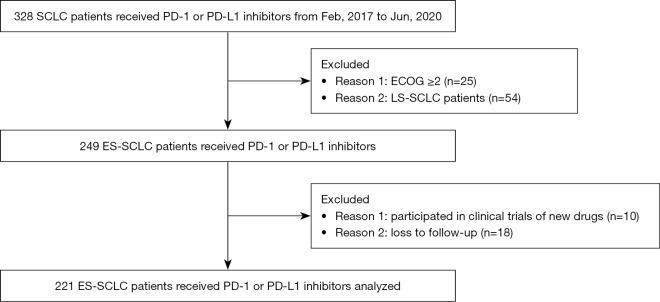
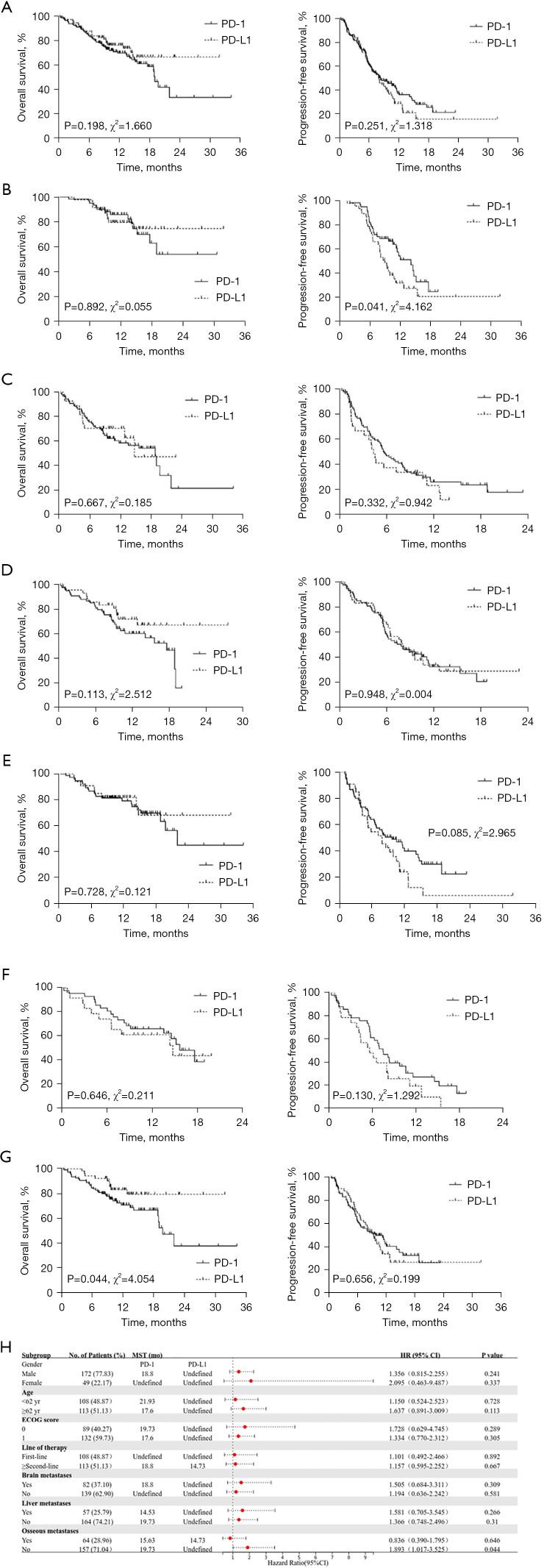
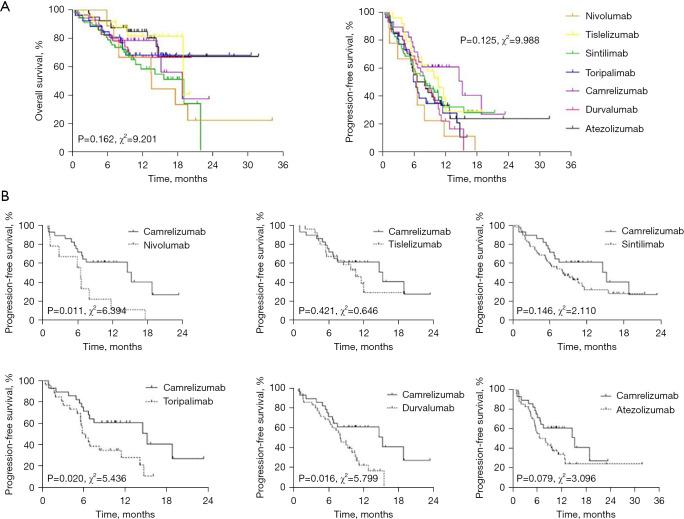
The data of 221 ES-SCLC patients treated with PD-1 (n=146) or PD-L1 inhibitors (n=75) between February 2017 and June 2020 were retrospectively collected. The median OS (mOS) and median PFS (mPFS) were 19.07 and 8.27 months, respectively, in patients treated with PD-1 inhibitors. In the PD-L1 group, mOS has not been reached, and mPFS was 7.95 months. No significant differences were observed between the 2 groups in OS [hazard ratio (HR), 1.472; 95% confidence interval (CI), 0.847-2.220; P=0.198] and PFS (HR, 0.816; 95% CI, 0.577-1.155; P=0.251). The rates of patients showed AEs of any grade treated with PD-1 or PD-L1 were 67.12% and 64.00%, with no significant difference (P=0.642, χ=0.216), ≥3 grade AEs occurred in 42 (28.76%) and 16 (21.33%) patients treated with PD-1 and PD-L1 inhibitors separately, also no significant difference (P=0.234, χ=1.415) was observed. According to subgroup analysis, camrelizumab revealed a longer mPFS (15.17 months) compared with other immune-checkpoint inhibitors (ICIs). PD-1 and PD-L1 inhibitors revealed comparable efficacy in ES-SCLC patients with brain metastases, with no significant differences in OS (HR, 1.505; 95% CI, 0.684-3.311; P=0.309) and PFS (HR, 0.649; 95% CI, 0.356-1.182; P=0.157).
CONCLUSIONS
PD-1 and PD-L1 inhibitors might achieved comparable survival benefit and safety in ES-SCLC patients. A longer PFS was observed in patients treated with PD-1 inhibitors in the first-line treatment, and the PD-1 inhibitor camrelizumab might have achieved a better PFS compared with other ICIs.
背景
临床研究和荟萃分析的证据表明,程序性细胞死亡蛋白1(PD-1)抑制剂和程序性细胞死亡配体1(PD-L1)抑制剂联合化疗可为广泛期小细胞肺癌(ES-SCLC)患者带来显著的生存获益。然而,关于PD-1和PD-L1抑制剂之间比较的临床研究相对较少。
方法
我们收集了接受PD-1抑制剂或PD-L1抑制剂治疗的ES-SCLC患者的数据。主要终点为总生存期(OS)和无进展生存期(PFS)。次要终点包括不良事件(AE)。
结果
回顾性收集了2017年2月至2020年6月期间接受PD-1抑制剂(n=146)或PD-L1抑制剂(n=75)治疗的221例ES-SCLC患者的数据。接受PD-1抑制剂治疗的患者,中位OS(mOS)和中位PFS(mPFS)分别为19.07个月和8.27个月。在PD-L1组中,mOS尚未达到,mPFS为7.95个月。两组在OS(风险比[HR],1.472;95%置信区间[CI],0.847-2.220;P=0.198)和PFS(HR,0.816;95%CI,0.577-1.155;P=0.251)方面未观察到显著差异。接受PD-1或PD-L1治疗的患者中,任何级别的AE发生率分别为67.12%和64.00%,无显著差异(P=0.642,χ=0.216),接受PD-1和PD-L1抑制剂治疗的患者中,≥3级AE分别发生在42例(28.76%)和16例(21.33%)患者中,也未观察到显著差异(P=0.234,χ=1.415)。根据亚组分析,与其他免疫检查点抑制剂(ICI)相比,卡瑞利珠单抗显示出更长的mPFS(15.17个月)。PD-1和PD-L1抑制剂在伴有脑转移的ES-SCLC患者中显示出相当的疗效,在OS(HR,1.505;95%CI,0.684-3.311;P=0.309)和PFS(HR,0.649;95%CI,0.356-1.182;P=0.15)方面无显著差异。
结论
PD-1和PD-L1抑制剂在ES-SCLC患者中可能实现相当的生存获益和安全性。在一线治疗中,接受PD-1抑制剂治疗的患者观察到更长的PFS,与其他ICI相比,PD-1抑制剂卡瑞利珠单抗可能具有更好的PFS。

 Zotero 插件