
程序性死亡受体1配体(PD-L1)抑制剂联合化疗与单纯化疗一线治疗广泛期小细胞肺癌的疗效和安全性:一项回顾性真实世界研究
Efficacy and Safety of PD-L1 Inhibitors plus Chemotherapy versus Chemotherapy Alone in First-Line Treatment of Extensive-Stage Small-Cell Lung Cancer: A Retrospective Real-World Study.
作者信息
Qu Jingjing, Kalyani Farhin Shaheed, Shen Qian, Yang Guangdie, Cheng Tianli, Liu Li, Zhou Jianya, Zhou Jianying
机构信息
Department of Respiratory Disease, Thoracic Disease Center, The First Affiliated Hospital, Zhejiang University School of Medicine, Hangzhou, Zhejiang 310003, China.
The Clinical Research Center for Respiratory Diseases of Zhejiang Province, Hangzhou, Zhejiang 310003, China.
出版信息
J Oncol. 2022 Sep 26;2022:3645489. doi: 10.1155/2022/3645489. eCollection 2022.
BACKGROUND
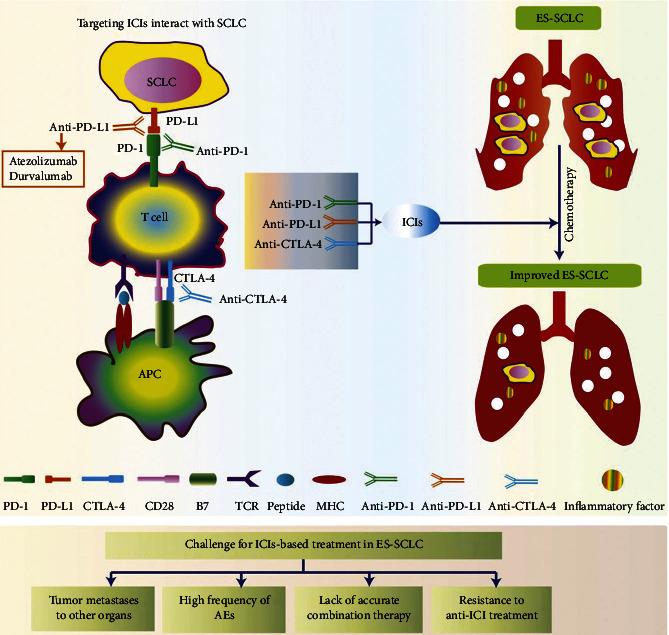
Most patients with small-cell lung cancer (SCLC) have extensive-stage (ES) disease with a poor prognosis. Immunotherapy has shown good therapeutic effects in the treatment of ES-SCLC. We performed a real-world retrospective study to evaluate the safety and efficacy of PD-L1 inhibitors plus chemotherapy in patients with ES-SCLC.
METHOD
A total of 224 patients diagnosed with ES-SCLC between March 2017 and April 2021 were included, of which 115 received only etoposide-platinum (EP) chemotherapy,and 109 received programmed cell-death ligand 1 (PD-L1) inhibitors and EP.
RESULTS
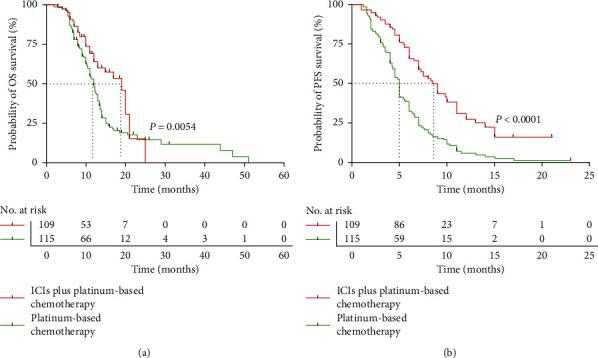
Immune checkpoint inhibitors (ICIs) plus platinum were associated with a significant improvement in overall survival (OS), with a hazard ratio (HR) of 0.60 (95% CI, 0.42-0.85; =0.0054); median OS was 19 months in the ICIs plus EP group vs. 12 months in the EP group. The median progression-free survival (PFS) was 8.5 and 5.0 months, respectively (HR for disease progression or death, 0.42; 95% CI, 0.31-0.57; < 0.0001). Male patients <65 years old, Stage IV, PS 0-1, without liver and brain metastasis had a better OS in the ICIs plus EP group than the EP group. The PFS and OS in the durvalumab plus chemotherapy group were insignificantly longer than that of the atezolizumab plus chemotherapy group. Any adverse effects (AEs) of grade 3 or 4 occurred in 50 patients (45.9%) in the ICIs plus EP group and 48 patients (41.7%) in the EP alone group. The most common immune-related AEs (irAEs) were immune hypothyroidism events (17.1%, 7/41), immune dermatitis (9.8%, 4/41), and immune pneumonia (9.8%, 4/41) in the durvalumab plus platinum-etoposide group. Immune liver insufficiency (10.3%, 7/68) and immune hypothyroidism (8.8%, 6/68) were the most common irAEs in the atezolizumab plus platinum-etoposide group.
CONCLUSION
This study shows that adding PD-L1 inhibitors to chemotherapy can significantly improve PFS and OS in patients with ES-SCLC and demonstrates its safety without additional AEs.
背景
大多数小细胞肺癌(SCLC)患者患有广泛期(ES)疾病,预后较差。免疫疗法在ES-SCLC的治疗中显示出良好的治疗效果。我们进行了一项真实世界的回顾性研究,以评估PD-L1抑制剂联合化疗在ES-SCLC患者中的安全性和疗效。
方法
纳入2017年3月至2021年4月期间诊断为ES-SCLC的224例患者,其中115例仅接受依托泊苷-铂(EP)化疗,109例接受程序性细胞死亡配体1(PD-L1)抑制剂和EP治疗。
结果
免疫检查点抑制剂(ICIs)联合铂类治疗可显著改善总生存期(OS),风险比(HR)为0.60(95%CI,0.42-0.85;P=0.0054);ICIs联合EP组的中位OS为19个月,而EP组为12个月。中位无进展生存期(PFS)分别为8.5个月和5.0个月(疾病进展或死亡的HR为0.42;95%CI,0.31-0.57;P<0.0001)。年龄<65岁、IV期、PS 0-1、无肝脑转移的男性患者,ICIs联合EP组的OS优于EP组。度伐利尤单抗联合化疗组的PFS和OS比阿替利珠单抗联合化疗组略长,但差异无统计学意义。ICIs联合EP组有50例患者(45.9%)发生3级或4级不良反应(AEs),单纯EP组有48例患者(41.7%)发生。度伐利尤单抗联合铂类-依托泊苷组最常见的免疫相关AEs(irAEs)为免疫性甲状腺功能减退事件(17.1%,7/41)、免疫性皮炎(9.8%,4/41)和免疫性肺炎(9.8%,4/41)。阿替利珠单抗联合铂类-依托泊苷组最常见的irAEs为免疫性肝功能不全(10.3%,7/68)和免疫性甲状腺功能减退(8.8%,6/68)。
结论
本研究表明,在化疗中添加PD-L1抑制剂可显著改善ES-SCLC患者的PFS和OS,并证明其安全性,且无额外的AEs。


 Zotero 插件