
广泛期小细胞肺癌引入化疗免疫治疗的真实世界影响:一项多中心分析。
Real-world impact of the introduction of chemo-immunotherapy in extended small cell lung cancer: a multicentric analysis.
机构信息
Medical Oncology 2, Veneto Institute of Oncology IOV - IRCCS, Padova, Italy.
Department of Oncology, Azienda ULSS 8 Berica, San Bortolo General Hospital, Vicenza, Italy.
出版信息
Front Immunol. 2024 Jan 22;15:1353889. doi: 10.3389/fimmu.2024.1353889. eCollection 2024.
BACKGROUND
Recent clinical trials demonstrated longer survival in extended small cell lung cancer (SCLC) patients treated with immunotherapy in addition to chemotherapy. However, the magnitude of benefit is modest and the impact in real-world setting has to be fully established.
METHODS
We collected clinical data and radiological imaging of patients affected by extended or relapsing SCLC and consecutively treated according to clinical practice between 2016 and 2023. As primary end-point, we compared pre-defined outcome indicators before and after the introduction of chemo-immunotherapy (May 2020): 6-month and 12-month progression free survival (PFS) rate, 12-month and 18-month overall survival (OS). Among those who were treated after May 2020, patients who did not receive immunotherapy according to treating physician's choice were included in the analysis to minimize clinical selection bias.
RESULTS
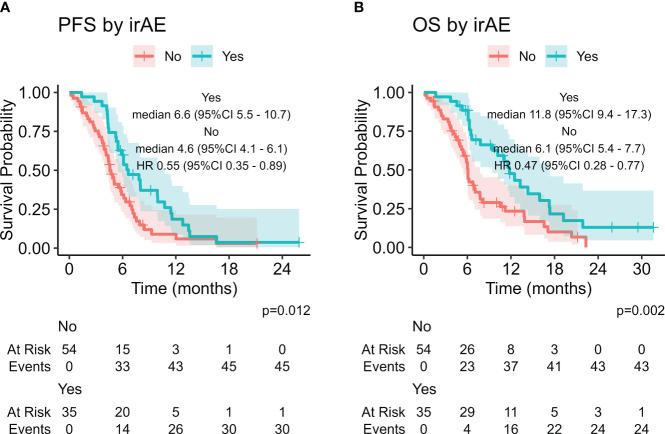
The analysis included 214 patients: 132 (61.7%) were treated in an Academic cancer center and 82 (38.3%) in two community hospitals; 104 were treated before May 2020. Median PFS of the overall study population was 4.8 months (95% confidence interval [95% CI]: 4.4-5.4), median OS was 7.1 months (95% CI: 6.3-7.7). Estimated PFS and OS were significantly longer in patients treated after May 2020 with hazard ratio (HR) for PFS and OS of 0.61 (95% CI: 0.46-0.81, p < 0.001) and 0.70 (95% CI: 0.52-0.93, p = 0.015), respectively. 6-month PFS rate increased from 27% to 40% (p = 0.04) while 12-months PFS raised from 1% to 11% (p = 0.003). 12-month and 18-month OS rate increased from 15% to 28% (p = 0.03) and from 2.1% to 12% (p = 0.009), respectively. After May 2020 the median number of hospitalization days per patient decreased significantly and the incidence of severe AEs was similar. Among patients treated with chemo-immunotherapy, the onset of immune-related AEs was associated with improved PFS and OS (HR 0.55, 95% CI: 0.35-0.89, p = 0.012 and HR 0.47, 95%CI 0.28-0.77, p = 0.002, respectively).
CONCLUSIONS
The real-world analysis shows a meaningful improvement of outcome indicators after the introduction of chemo-immunotherapy, with reduction of the duration of hospitalization, thus supporting the use of chemo-immunotherapy and the need for further biomarker research.
背景
最近的临床试验表明,在化疗基础上联合免疫治疗可延长广泛期小细胞肺癌(SCLC)患者的生存。然而,获益的幅度有限,其在真实世界环境中的影响仍有待全面评估。
方法
我们收集了 2016 年至 2023 年期间,根据临床实践连续治疗的广泛期或复发性 SCLC 患者的临床数据和影像学资料。主要终点为比较引入化疗免疫治疗前后(2020 年 5 月)的预定义结局指标:6 个月和 12 个月无进展生存率(PFS)、12 个月和 18 个月总生存率(OS)。在 2020 年 5 月后接受治疗的患者中,为了尽量减少临床选择偏倚,将根据治疗医生选择未接受免疫治疗的患者纳入分析。
结果
共纳入 214 例患者:132 例(61.7%)在学术癌症中心治疗,82 例(38.3%)在两家社区医院治疗;104 例患者在 2020 年 5 月前治疗。总体研究人群的中位 PFS 为 4.8 个月(95%CI:4.4-5.4),中位 OS 为 7.1 个月(95%CI:6.3-7.7)。与 2020 年 5 月前治疗的患者相比,2020 年 5 月后治疗的患者 PFS 和 OS 显著延长,风险比(HR)分别为 0.61(95%CI:0.46-0.81,p<0.001)和 0.70(95%CI:0.52-0.93,p=0.015)。6 个月 PFS 率从 27%增加至 40%(p=0.04),12 个月 PFS 率从 1%增加至 11%(p=0.003)。12 个月和 18 个月 OS 率从 15%增加至 28%(p=0.03)和从 2.1%增加至 12%(p=0.009)。2020 年 5 月后,每位患者的平均住院天数显著减少,严重不良事件发生率相似。在接受化疗免疫治疗的患者中,免疫相关不良事件的发生与 PFS 和 OS 的改善相关(HR 0.55,95%CI:0.35-0.89,p=0.012;HR 0.47,95%CI:0.28-0.77,p=0.002)。
结论
真实世界分析显示,化疗免疫治疗的引入后,结局指标显著改善,住院时间缩短,这支持化疗免疫治疗的应用,并需要进一步的生物标志物研究。


 Zotero 插件