
在临床真实环境中,小细胞肺癌患者接受胸部放疗后与总生存、无进展生存和毒性相关的因素。
Factors associated with overall survival, progression-free survival and toxicity in patients with small cell lung cancer and thoracic irradiation in a clinical real-world setting.
机构信息
Department of Radiation Therapy, University Hospital Halle/Saale, Ernst-Grube-Str. 40, 06120, Halle, Germany.
出版信息
Radiat Oncol. 2023 Apr 18;18(1):70. doi: 10.1186/s13014-023-02252-1.
BACKGROUND
Small-cell lung cancer (SCLC) is a malignant tumor known for its poor prognosis. In addition to chemotherapy and immunotherapy irradiation plays a big role especially in inoperability. This study evaluated prognostic factors in patients with SCLC, receiving chemotherapy and thoracic irradiation, that may affect overall survival (OS), progression-free survival (PFS) and toxicity.
METHODS
Patients with limited disease (LD) SCLC (n = 57) and extensive disease (ED) SCLC (n = 69) who received thoracic radiotherapy were analyzed retrospectively. The prognostic factors sex, age, Karnofsky performance status (KPS), tumor-, nodal-stage and timepoint of start of irradiation in relation to the first cycle of chemotherapy were evaluated. Start of irradiation was stratified as early ([Formula: see text] 2 cycles of chemotherapy), late (3 or 4 cycles) and very late ([Formula: see text] 5 cycles). Results were analyzed by Cox univariate and multivariate as well as logistic regression analysis.
RESULTS
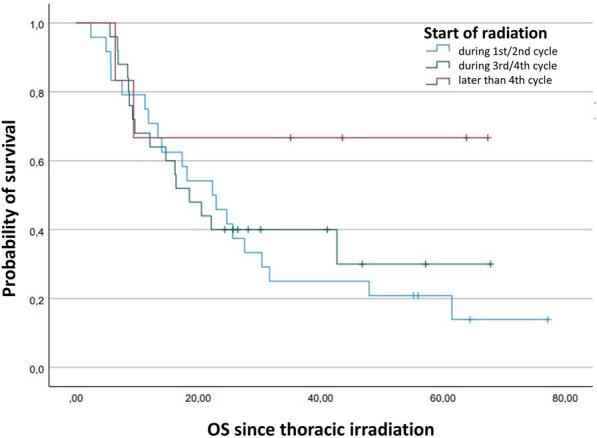
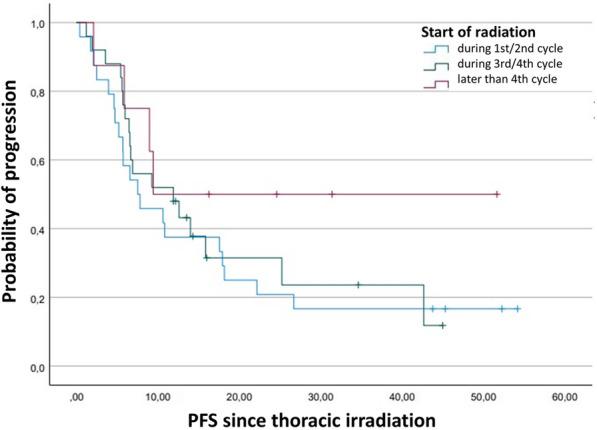
The median OS of LD-SCLC patients was 23.7 months in early, and 22.0 months in late start of irradiation. In very late start, median OS was not reached. PFS was 11.8, 15.2 and 47.9 months, respectively. In patients with ED-SCLC OS was 4.3 months in early, 13.0 months in late and 12.2 months in very late start of irradiation. PFS was 6.7, 13.0 and 12.2 months, respectively. Prognosis of patients with LD- or ED-SCLC receiving late or very late start of irradiation was significantly prolonged in OS and PFS compared to an early start (p < 0.05). KPS [Formula: see text] 80 shows a significant increase of OS and PFS in ED-SCLC. Female sex and smaller mean lung dose were associated with lower risk of toxicity.
CONCLUSION
Late or very late start of irradiation is a prognosis-enhancing factor in LD-SCLC and ED-SCLC for OS and PFS. KPS [Formula: see text] 80 increases prognosis of OS and PFS in ED-SCLC as well. Toxicity is less common in female sex and patients with low mean lung dose in LD-SCLC.
背景
小细胞肺癌(SCLC)是一种预后不良的恶性肿瘤。除了化疗,放疗在不能手术的情况下也起着重要作用。本研究评估了接受化疗和胸部放疗的 SCLC 患者的预后因素,这些因素可能影响总生存期(OS)、无进展生存期(PFS)和毒性。
方法
回顾性分析了 57 例局限期(LD)SCLC 和 69 例广泛期(ED)SCLC 患者。评估了性别、年龄、卡氏功能状态评分(KPS)、肿瘤、淋巴结分期以及与化疗第一周期相关的放疗开始时间等预后因素。放疗开始时间分为早期(化疗前 2 个周期)、晚期(化疗前 3 或 4 个周期)和极晚期(化疗前 5 个周期)。结果采用 Cox 单因素和多因素以及逻辑回归分析进行分析。
结果
LD-SCLC 患者早期放疗的中位 OS 为 23.7 个月,晚期放疗的中位 OS 为 22.0 个月。极晚期放疗的中位 OS 尚未达到。PFS 分别为 11.8、15.2 和 47.9 个月。ED-SCLC 患者的 OS 分别为早期的 4.3 个月、晚期的 13.0 个月和极晚期的 12.2 个月。PFS 分别为 6.7、13.0 和 12.2 个月。与早期相比,LD-SCLC 或 ED-SCLC 患者接受晚期或极晚期放疗的患者 OS 和 PFS 显著延长(p<0.05)。KPS≥80 可显著提高 ED-SCLC 的 OS 和 PFS。女性和较小的平均肺剂量与毒性风险降低相关。
结论
晚期或极晚期放疗是 LD-SCLC 和 ED-SCLC 患者 OS 和 PFS 的预后改善因素。KPS≥80 也能提高 ED-SCLC 的 OS 和 PFS 预后。女性和 LD-SCLC 中低平均肺剂量的患者毒性较少。



 Zotero 插件