
全新世的气候变化、人类健康和韧性
Climate change, human health, and resilience in the Holocene.
机构信息
Department of Biology, University of North Carolina Greensboro, Greensboro, NC 27412-5000.
Center for Bioarchaeological Research, School of Human Evolution and Social Change, Arizona State University, Tempe, AZ 85287-2402.
出版信息
Proc Natl Acad Sci U S A. 2023 Jan 24;120(4):e2209472120. doi: 10.1073/pnas.2209472120. Epub 2023 Jan 17.
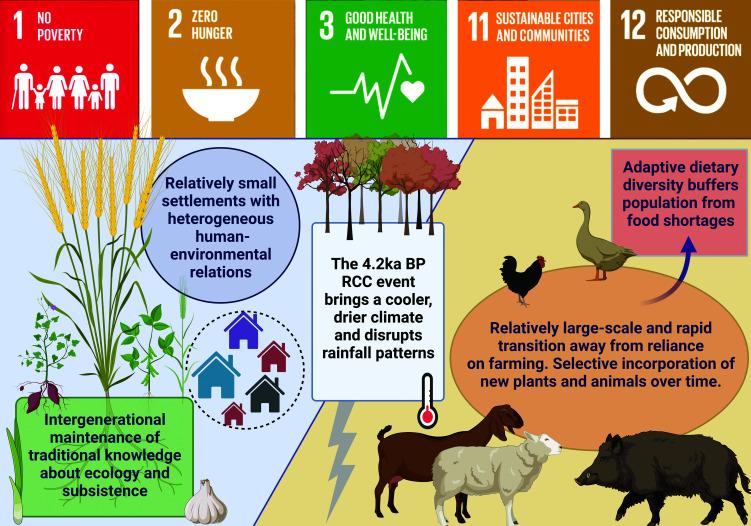
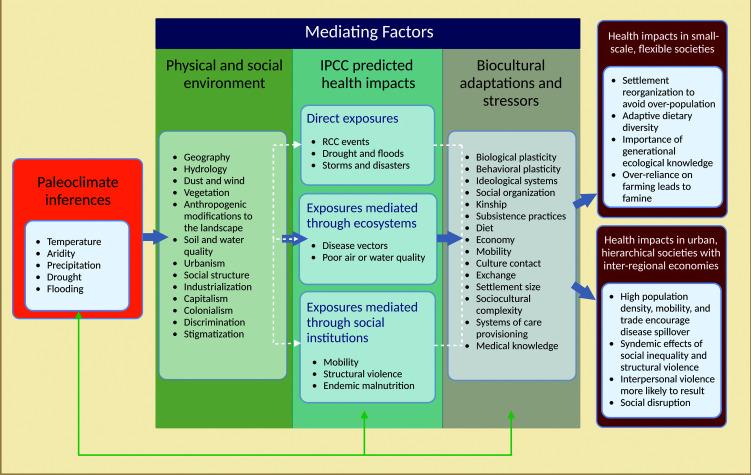
Climate change is an indisputable threat to human health, especially for societies already confronted with rising social inequality, political and economic uncertainty, and a cascade of concurrent environmental challenges. Archaeological data about past climate and environment provide an important source of evidence about the potential challenges humans face and the long-term outcomes of alternative short-term adaptive strategies. Evidence from well-dated archaeological human skeletons and mummified remains speaks directly to patterns of human health over time through changing circumstances. Here, we describe variation in human epidemiological patterns in the context of past rapid climate change (RCC) events and other periods of past environmental change. Case studies confirm that human communities responded to environmental changes in diverse ways depending on historical, sociocultural, and biological contingencies. Certain factors, such as social inequality and disproportionate access to resources in large, complex societies may influence the probability of major sociopolitical disruptions and reorganizations-commonly known as "collapse." This survey of Holocene human-environmental relations demonstrates how flexibility, variation, and maintenance of Indigenous knowledge can be mitigating factors in the face of environmental challenges. Although contemporary climate change is more rapid and of greater magnitude than the RCC events and other environmental changes we discuss here, these lessons from the past provide clarity about potential priorities for equitable, sustainable development and the constraints of modernity we must address.
气候变化是对人类健康的一个不容置疑的威胁,特别是对于那些已经面临社会不平等加剧、政治和经济不稳定以及一系列并发环境挑战的社会来说。关于过去气候和环境的考古数据为人类面临的潜在挑战以及替代短期适应策略的长期结果提供了重要的证据来源。来自有良好年代测定的考古人类骨骼和木乃伊化遗骸的证据通过不断变化的环境,直接反映了人类健康随时间变化的模式。在这里,我们描述了过去快速气候变化 (RCC) 事件和其他过去环境变化时期人类流行病学模式的变化。案例研究证实,人类社区根据历史、社会文化和生物偶然性以不同的方式对环境变化做出反应。某些因素,如社会不平等和在大型复杂社会中资源分配不均,可能会影响重大社会政治动荡和重组的可能性,通常被称为“崩溃”。本研究对全新世人类与环境关系的调查表明,在面临环境挑战时,灵活性、多样性和维护本土知识可以成为缓解因素。尽管当代气候变化比我们在这里讨论的 RCC 事件和其他环境变化更为迅速和剧烈,但这些来自过去的经验教训为公平、可持续发展的优先事项以及我们必须应对的现代性的限制提供了明确的认识。
 Zotero 插件