
在晚期脂肪肉瘤、实体瘤或淋巴瘤患者中进行的 Milademetan(一种 MDM2 抑制剂)的首次人体 I 期研究。
A First-in-Human Phase I Study of Milademetan, an MDM2 Inhibitor, in Patients With Advanced Liposarcoma, Solid Tumors, or Lymphomas.
机构信息
Memorial Sloan Kettering Cancer Center and Weill Cornell Medical Center, New York, NY.
Sarah Cannon Research Institute and Tennessee Oncology, PLLC, Nashville, TN.
出版信息
J Clin Oncol. 2023 Mar 20;41(9):1714-1724. doi: 10.1200/JCO.22.01285. Epub 2023 Jan 20.
PURPOSE
This study evaluated the safety, pharmacokinetics, pharmacodynamics, and preliminary efficacy of milademetan, a small-molecule murine double minute-2 (MDM2) inhibitor, in patients with advanced cancers.
PATIENTS AND METHODS
In this first-in-human phase I study, patients with advanced solid tumors or lymphomas received milademetan orally once daily as extended/continuous (days 1-21 or 1-28 every 28 days) or intermittent (days 1-7, or days 1-3 and 15-17 every 28 days) schedules. The primary objective was to determine the recommended phase II dose and schedule. Secondary objectives included tumor response according to standard evaluation criteria. Predefined analyses by tumor type were performed. Safety and efficacy analyses included all patients who received milademetan.
RESULTS
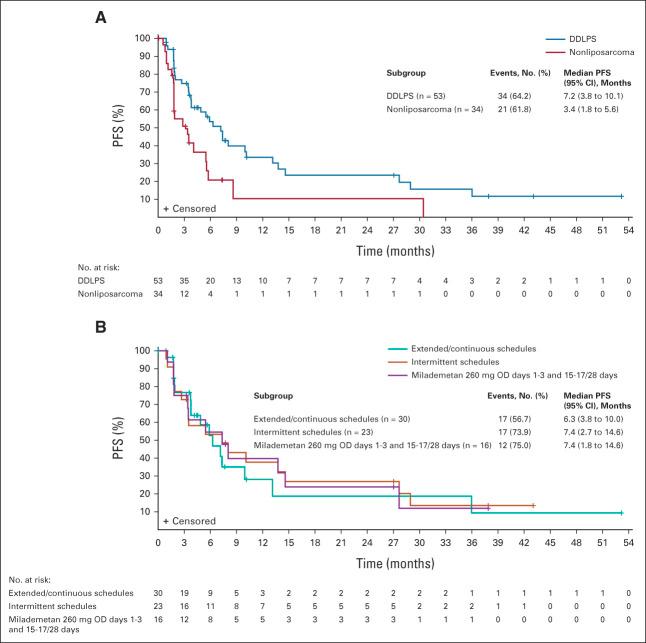
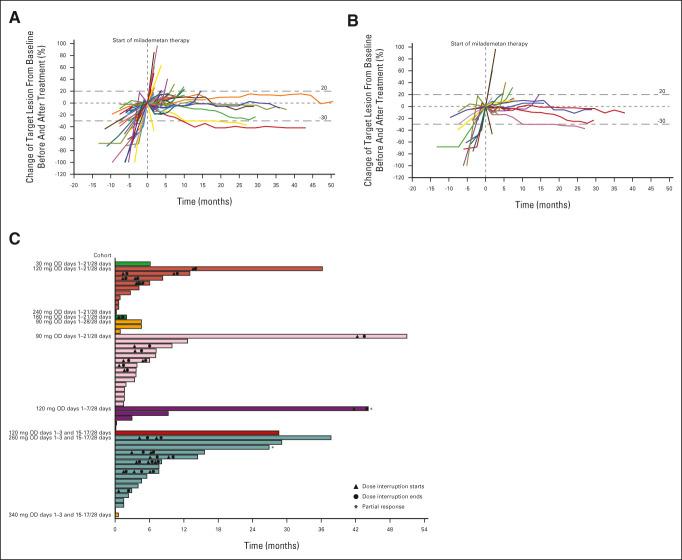
Between July 2013 and August 2018, 107 patients were enrolled and received milademetan. The most common grade 3/4 drug-related adverse events were thrombocytopenia (29.0%), neutropenia (15.0%), and anemia (13.1%). Respective rates at the recommended dose and schedule (260 mg once daily on days 1-3 and 15-17 every 28 days, ie, 3/14 days) were 15.0%, 5.0%, and 0%. Across all cohorts (N = 107), the disease control rate was 45.8% (95% CI, 36.1 to 55.7) and median progression-free survival was 4.0 months (95% CI, 3.4 to 5.7). In the subgroup with dedifferentiated liposarcomas, the disease control rate and median progression-free survival were 58.5% (95% CI, 44.1 to 71.9) and 7.2 months overall (n = 53), and 62.0% (95% CI, 35.4 to 84.8) and 7.4 months with the recommended intermittent schedule (n = 16), respectively.
CONCLUSION
An intermittent dosing schedule of 3/14 days of milademetan mitigates dose-limiting hematologic abnormalities while maintaining efficacy. Notable single-agent activity with milademetan in dedifferentiated liposarcomas has prompted a randomized phase III trial (MANTRA).
目的
本研究评估了小分子鼠双微体 2(MDM2)抑制剂米拉唑胺在晚期癌症患者中的安全性、药代动力学、药效学和初步疗效。
患者和方法
在这项首次人体 I 期研究中,患有晚期实体瘤或淋巴瘤的患者口服米拉唑胺,每日一次,连续/延长(第 1-21 天或每 28 天第 1-28 天)或间歇性(第 1-7 天,或第 1-3 天和第 15-17 天每 28 天)方案。主要目的是确定 II 期推荐剂量和方案。次要目标包括根据标准评估标准的肿瘤反应。对肿瘤类型进行了预设分析。安全性和疗效分析包括所有接受米拉唑胺治疗的患者。
结果
2013 年 7 月至 2018 年 8 月,共招募了 107 名患者接受米拉唑胺治疗。最常见的 3/4 级与药物相关的不良事件是血小板减少症(29.0%)、中性粒细胞减少症(15.0%)和贫血症(13.1%)。在推荐剂量和方案(每日 3 天和 15-17 天,即 3/14 天一次 260mg)下的相应发生率为 15.0%、5.0%和 0%。在所有队列(N=107)中,疾病控制率为 45.8%(95%CI,36.1 至 55.7),中位无进展生存期为 4.0 个月(95%CI,3.4 至 5.7)。在去分化脂肪肉瘤亚组中,疾病控制率和中位无进展生存期分别为 58.5%(95%CI,44.1 至 71.9)和总体 7.2 个月(n=53),以及 62.0%(95%CI,35.4 至 84.8)和推荐的间歇性方案 7.4 个月(n=16)。
结论
米拉唑胺的 3/14 天间歇性给药方案可减轻剂量限制的血液学异常,同时保持疗效。米拉唑胺在去分化脂肪肉瘤中具有显著的单药活性,这促使进行了一项随机 III 期试验(MANTRA)。

 Zotero 插件