
数字孪生在家用远程电机康复中的适用性研究。
Study on the Applicability of Digital Twins for Home Remote Motor Rehabilitation.
机构信息
Łukasiewicz Research Network-Industrial Research Institute for Automation and Measurements PIAP, 02-486 Warsaw, Poland.
Institute of Aeronautics and Applied Mechanics, Faculty of Power and Aeronautical Engineering, Warsaw University of Technology, 00-665 Warszawa, Poland.
出版信息
Sensors (Basel). 2023 Jan 12;23(2):911. doi: 10.3390/s23020911.
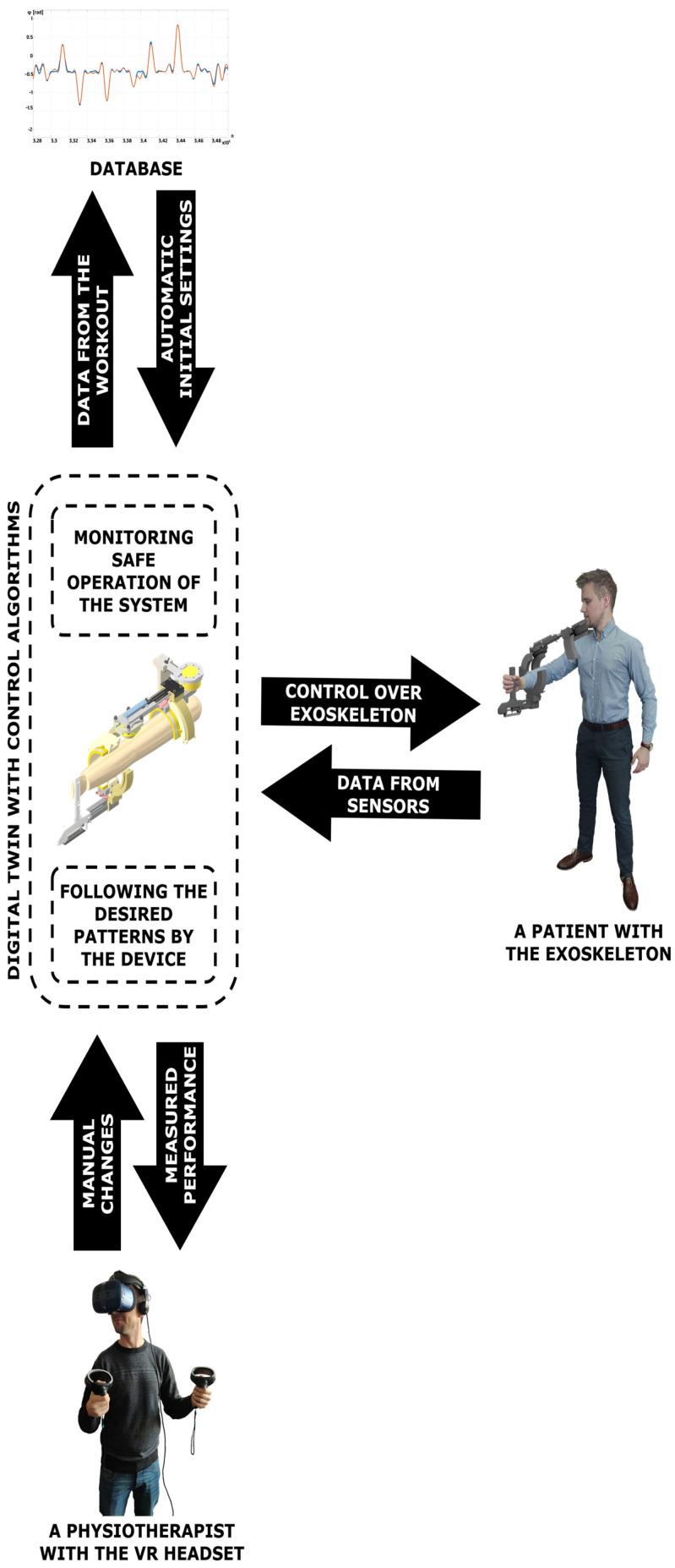
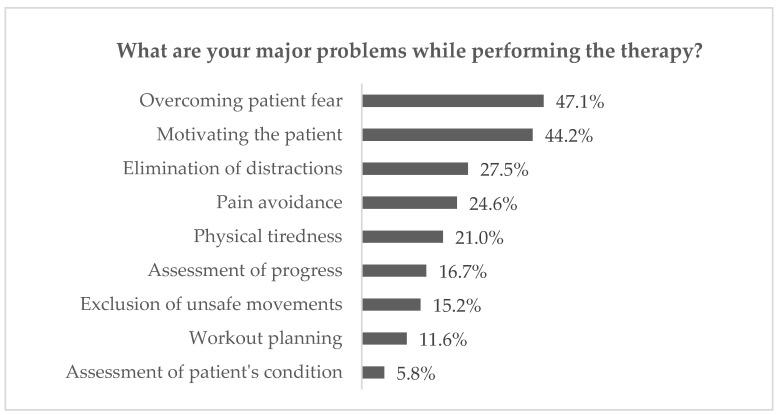
The COVID-19 pandemic created the need for telerehabilitation development, while Industry 4.0 brought the key technology. As motor therapy often requires the physical support of a patient's motion, combining robot-aided workouts with remote control is a promising solution. This may be realised with the use of the device's digital twin, so as to give it an immersive operation. This paper presents an extensive overview of this technology's applications within the fields of industry and health. It is followed by the in-depth analysis of needs in rehabilitation based on questionnaire research and bibliography review. As a result of these sections, the original concept of controlling a rehabilitation exoskeleton via its digital twin in the virtual reality is presented. The idea is assessed in terms of benefits and significant challenges regarding its application in real life. The presented aspects prove that it may be potentially used for manual remote kinesiotherapy, combined with the safety systems predicting potentially harmful situations. The concept is universally applicable to rehabilitation robots.
新冠疫情催生了远程康复的发展需求,而工业 4.0 则带来了关键技术。由于运动疗法通常需要患者运动的物理支撑,因此将机器人辅助锻炼与远程控制相结合是一种很有前途的解决方案。这可以通过使用设备的数字孪生来实现,从而使其具有沉浸式操作。本文广泛概述了该技术在工业和健康领域的应用。接下来,通过问卷调查研究和文献综述深入分析了康复需求。基于这些部分,提出了通过虚拟现实中的数字孪生来控制康复外骨骼的原始概念。从其在实际应用中的应用角度评估了该概念的好处和重大挑战。所呈现的方面证明,它可能被潜在地用于与预测潜在危险情况的安全系统相结合的手动远程运动疗法。该概念普遍适用于康复机器人。

 Zotero 插件