
草食动物负载对马铃薯中 VOC 介导的植物通讯的影响。
Effect of herbivore load on VOC-mediated plant communication in potato.
机构信息
Department of Ecology and Evolutionary Biology, University of California-Irvine, Irvine, CA, 92697, USA.
Misión Biológica de Galicia (MBG-CSIC), Apartado de Correos 28, 36080, Pontevedra, Galicia, Spain.
出版信息
Planta. 2023 Jan 23;257(2):42. doi: 10.1007/s00425-023-04075-6.
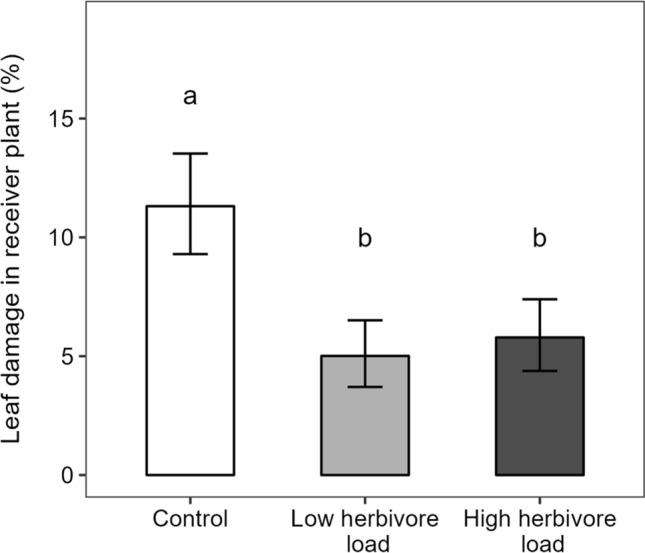
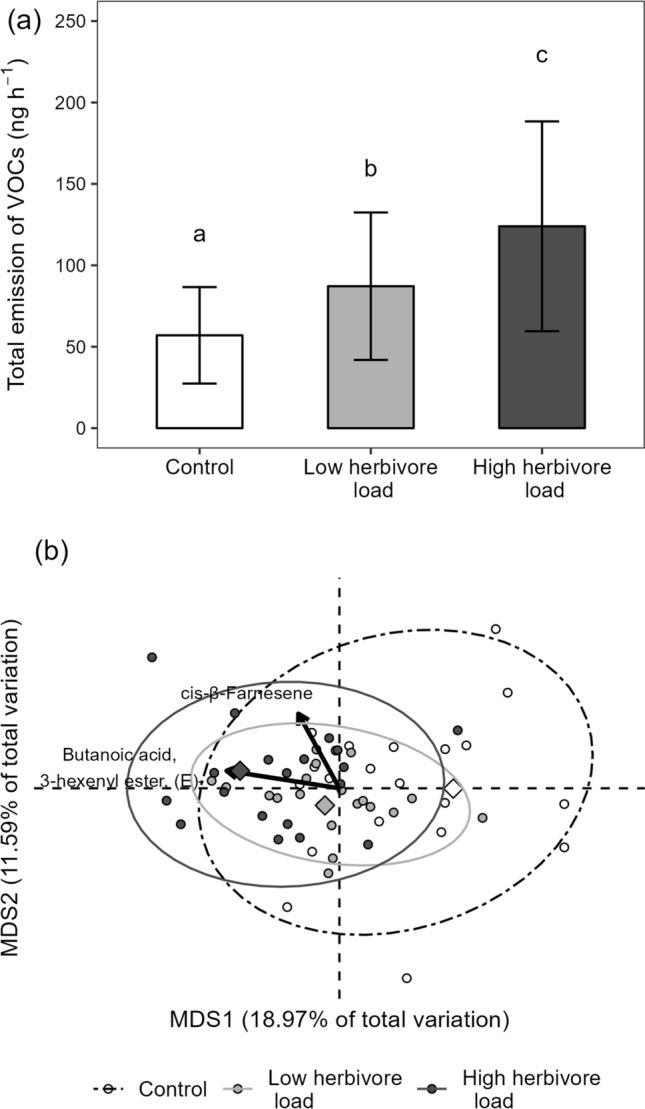
VOC emissions increased with herbivore load, but this did not result in concomitant increases in resistance in neighbouring plants, suggesting that communication occurred independently of herbivore load in emitter plants. Herbivore-damaged plants emit volatile organic compounds (VOCs) that can alert neighbours and boost their resistance. While VOC-mediated plant communication has been shown to be herbivore-specific, we know little about its contingency on variation in herbivore load. To address this knowledge gap, we tested herbivore load effects on VOC-mediated communication between potato plants (Solanum tuberosum) using the generalist herbivore Spodoptera exigua. First, we tested whether herbivore load (three levels: undamaged control, low, and high load) affected total VOC emissions and composition. Second, we matched emitter and receiver plants and subjected emitters to the same herbivore load treatments. Finally, we performed a bioassay with S. exigua on receivers to test for induced resistance due to VOC-mediated communication. We found that herbivory significantly increased total VOC emissions relative to control plants, and that such increase was greater under high herbivore load. In contrast, we found no detectable effect of herbivory, regardless of the load, on VOC composition. The communication experiment showed that VOCs released by herbivore-induced emitters boosted resistance in receivers (i.e., lower leaf damage than receivers exposed to VOCs released by control emitters), but the magnitude of such effect was similar for both levels of emitter herbivore load. These findings suggest that changes in VOCs due to variation in herbivore load do not modify the outcomes of plant communication.
VOC 排放随食草动物负载增加而增加,但这并没有导致相邻植物的抗性相应增加,这表明在发射植物中,通讯独立于食草动物负载发生。受食草动物损害的植物会释放挥发性有机化合物 (VOC),这些化合物可以提醒邻居并增强它们的抵抗力。虽然已经证明 VOC 介导的植物通讯是特定于食草动物的,但我们对其是否依赖于食草动物负载的变化知之甚少。为了解决这个知识空白,我们使用普通食草动物斜纹夜蛾 (Spodoptera exigua) 测试了食草动物负载对马铃薯植物 (Solanum tuberosum) 之间 VOC 介导通讯的影响。首先,我们测试了食草动物负载(三个水平:未受损对照、低负载和高负载)是否影响总 VOC 排放和组成。其次,我们匹配了发射器和接收器植物,并使发射器接受相同的食草动物负载处理。最后,我们在接收器上用 S. exigua 进行了生物测定,以测试由于 VOC 介导的通讯而引起的诱导抗性。我们发现,与对照植物相比,食草动物显著增加了总 VOC 排放,并且在高食草动物负载下增加更大。相比之下,我们发现无论负载如何,食草动物对 VOC 组成都没有可检测到的影响。通讯实验表明,食草动物诱导的发射器释放的 VOC 增强了接收器的抗性(即,比暴露于由对照发射器释放的 VOC 的接收器受到的叶片损伤更小),但这种效果的幅度对于发射器食草动物负载的两个水平相似。这些发现表明,由于食草动物负载的变化而导致的 VOC 变化不会改变植物通讯的结果。
 Zotero 插件