
单细胞计算机器学习方法在免疫介导的炎症性疾病中的应用:新工具揭示了新型成纤维细胞和巨噬细胞相互作用,推动疾病发生发展。
Single-cell computational machine learning approaches to immune-mediated inflammatory disease: New tools uncover novel fibroblast and macrophage interactions driving pathogenesis.
机构信息
Medical Scientist Training Program, University of Colorado School of Medicine, Aurora, CO, United States.
Division of Rheumatology, Department of Medicine, University of Colorado School of Medicine, Aurora, CO, United States.
出版信息
Front Immunol. 2023 Jan 4;13:1076700. doi: 10.3389/fimmu.2022.1076700. eCollection 2022.
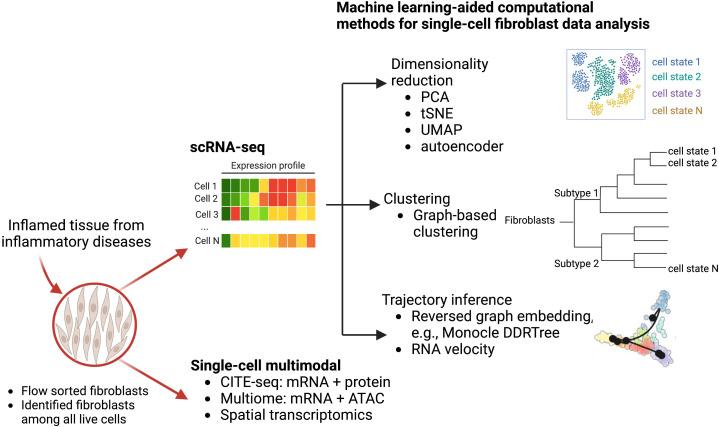
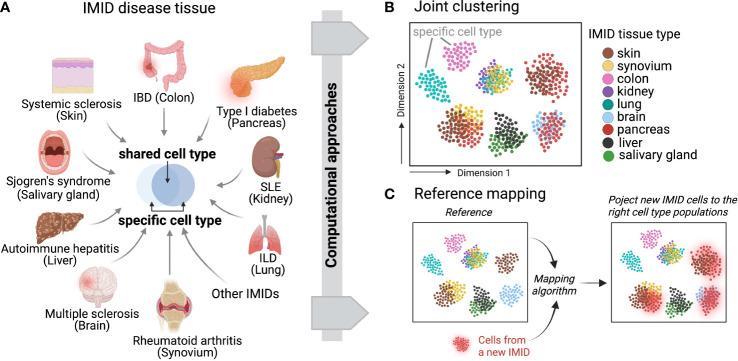
Recent advances in single-cell sequencing technologies call for greater computational scalability and sensitivity to analytically decompose diseased tissues and expose meaningful biological relevance in individual cells with high resolution. And while fibroblasts, one of the most abundant cell types in tissues, were long thought to display relative homogeneity, recent analytical and technical advances in single-cell sequencing have exposed wide variation and sub-phenotypes of fibroblasts of potential and apparent clinical significance to inflammatory diseases. Alongside anticipated improvements in single cell spatial sequencing resolution, new computational biology techniques have formed the technical backbone when exploring fibroblast heterogeneity. More robust models are required, however. This review will summarize the key advancements in computational techniques that are being deployed to categorize fibroblast heterogeneity and their interaction with the myeloid compartments in specific biological and clinical contexts. First, typical machine-learning-aided methods such as dimensionality reduction, clustering, and trajectory inference, have exposed the role of fibroblast subpopulations in inflammatory disease pathologies. Second, these techniques, coupled with single-cell predicted computational methods have raised novel interactomes between fibroblasts and macrophages of potential clinical significance to many immune-mediated inflammatory diseases such as rheumatoid arthritis, ulcerative colitis, lupus, systemic sclerosis, and others. Third, recently developed scalable integrative methods have the potential to map cross-cell-type spatial interactions at the single-cell level while cross-tissue analysis with these models reveals shared biological mechanisms between disease contexts. Finally, these advanced computational omics approaches have the potential to be leveraged toward therapeutic strategies that target fibroblast-macrophage interactions in a wide variety of inflammatory diseases.
单细胞测序技术的最新进展要求分析分解病变组织并以高分辨率在单个细胞中暴露有意义的生物学相关性的计算能力具有更大的可扩展性和灵敏度。虽然成纤维细胞是组织中最丰富的细胞类型之一,但长期以来,人们认为成纤维细胞表现出相对的均一性,但单细胞测序的最新分析和技术进步已经揭示了潜在和明显具有临床意义的炎症性疾病中成纤维细胞的广泛变异性和亚表型。随着单细胞空间测序分辨率的预期提高,新的计算生物学技术已经形成了探索成纤维细胞异质性及其与髓样细胞区室相互作用的技术骨干。然而,需要更强大的模型。这篇综述将总结正在部署的用于分类成纤维细胞异质性及其在特定生物学和临床背景下与髓样细胞区室相互作用的计算技术的关键进展。首先,典型的机器学习辅助方法,如降维、聚类和轨迹推断,已经揭示了成纤维细胞亚群在炎症性疾病病理学中的作用。其次,这些技术与单细胞预测计算方法相结合,提出了成纤维细胞和巨噬细胞之间具有潜在临床意义的新相互作用网络,这些相互作用网络对许多免疫介导的炎症性疾病(如类风湿关节炎、溃疡性结肠炎、狼疮、系统性硬化症等)具有潜在的临床意义。第三,最近开发的可扩展综合方法有可能在单细胞水平上绘制跨细胞类型的空间相互作用,而这些模型的跨组织分析揭示了不同疾病背景之间的共同生物学机制。最后,这些先进的计算组学方法有可能被利用来针对各种炎症性疾病中成纤维细胞-巨噬细胞相互作用的治疗策略。


 Zotero 插件