
重新审视逆转假说:一项基于全国人口的中国社会经济地位与非传染性疾病及风险因素之间关联的研究。
Re-examining the reversal hypothesis: A nationwide population-based study of the association between socioeconomic status, and NCDs and risk factors in China.
作者信息
Zhang Xuemei, Pan Tianxin, McPake Barbara
机构信息
Nossal Institute for Global Health, School of Population and Global Health, The University of Melbourne, Melbourne, VIC, Australia.
Health Economics Unit, Centre for Health Policy, School of Population and Global Health, The University of Melbourne, Melbourne, VIC, Australia.
出版信息
SSM Popul Health. 2023 Jan 7;21:101335. doi: 10.1016/j.ssmph.2022.101335. eCollection 2023 Mar.
BACKGROUND
According to the reversal hypothesis, as a country's economic and social development progresses, the burden of NCDs and risk factors shifts from rich to poor. The aim of this research is to examine the reversal hypothesis in the Chinese setting.
METHODS
Using data from the China Health and Retirement Longitudinal Study (CHARLS) in 2015, we explored whether the reversal hypothesis applies at the subnational level. Participants aged 45 years and older in 2015 were included. We examined five risk factors (smoking, heavy drinking, physical inactivity, overweight, and obesity) and three objectively measured NCDs (diabetes, hypertension, dyslipidemia). Binary logistic regressions were performed to examine outcomes across people of differing SES in provincial level, in urban and rural areas, and across generations.
RESULTS
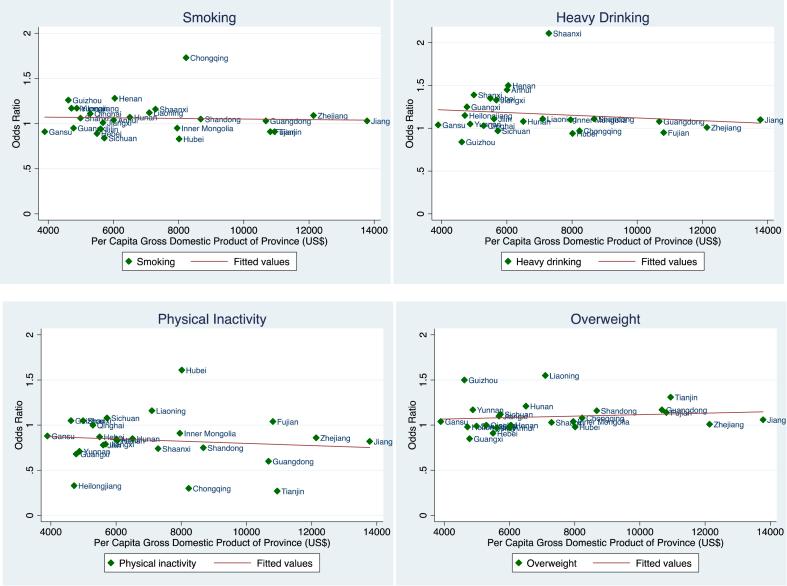
Nationally, SES is positively associated with heavy drinking, obesity, diabetes and dyslipidemia, whereas it is negatively associated with physical inactivity. The association between SES and smoking and hypertension was not statistically significant. Except in the cases of diabetes and dyslipidemia, we found that risk factors of all kinds were more concentrated among richer people in rural than in urban areas. Across provinces with increasing GDP per capita, a downward trend in risk factors among those with high SES compared to those with low SES could be interpreted, while the opposite trend could be interpreted with respect to the metabolic syndrome conditions. Obesity and overweight exhibited slight downward trends (in line with those for risk factors) and upward trends (in line with those for metabolic syndrome conditions), respectively.
CONCLUSION
We conclude that China is at a relatively early stage of 'reversal', visible with respect to risk factors. If these patterns persist over time, the trend will likely feed through to metabolic disorders which will increasingly become diseases of the poor.
背景
根据逆转假说,随着一个国家经济和社会的发展,非传染性疾病及风险因素的负担会从富裕人群向贫困人群转移。本研究旨在探讨中国背景下的逆转假说。
方法
利用2015年中国健康与养老追踪调查(CHARLS)的数据,我们探究逆转假说是否适用于国家以下层面。纳入了2015年年龄在45岁及以上的参与者。我们考察了五个风险因素(吸烟、酗酒、缺乏身体活动、超重和肥胖)以及三种客观测量的非传染性疾病(糖尿病、高血压、血脂异常)。进行二元逻辑回归以考察省级层面、城乡地区以及不同代际中不同社会经济地位人群的结果。
结果
在全国范围内,社会经济地位与酗酒、肥胖、糖尿病和血脂异常呈正相关,而与缺乏身体活动呈负相关。社会经济地位与吸烟和高血压之间的关联无统计学意义。除糖尿病和血脂异常外,我们发现农村地区各类风险因素在较富裕人群中比在城市地区更为集中。在人均GDP不断增长的省份中,可以观察到高社会经济地位人群的风险因素呈下降趋势,而低社会经济地位人群则相反;对于代谢综合征情况则呈现相反趋势。肥胖和超重分别呈现轻微下降趋势(与风险因素趋势一致)和上升趋势(与代谢综合征情况趋势一致)。
结论
我们得出结论,中国处于“逆转”的相对早期阶段,这在风险因素方面较为明显。如果这些模式随时间持续存在,这种趋势可能会导致代谢紊乱,而代谢紊乱将越来越多地成为穷人的疾病。
 Zotero 插件