
遗传风险和生活方式因素在成人发病炎症性肠病发展中的作用:一项前瞻性队列研究。
The Contribution of Genetic Risk and Lifestyle Factors in the Development of Adult-Onset Inflammatory Bowel Disease: A Prospective Cohort Study.
机构信息
Department of Big Data in Health Science, School of Public Health and The Second Affiliated Hospital, Zhejiang University School of Medicine, Hangzhou, China.
Centre for Global Health, School of Public Health, Zhejiang University School of Medicine, Hangzhou, China.
出版信息
Am J Gastroenterol. 2023 Mar 1;118(3):511-522. doi: 10.14309/ajg.0000000000002180. Epub 2023 Jan 9.
INTRODUCTION
The joint associations across genetic risk, modifiable lifestyle factors, and inflammatory bowel disease (IBD) remains unclear.
METHODS
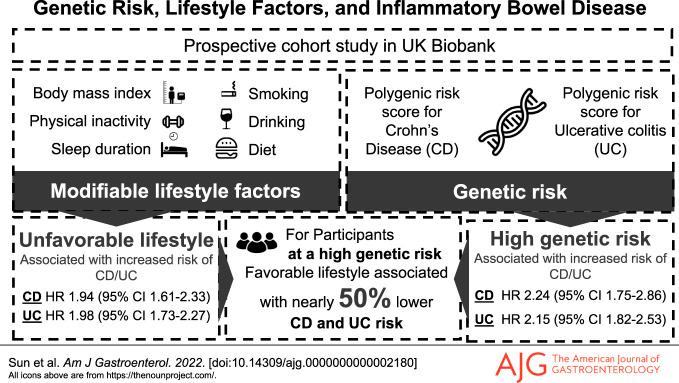
Genetic susceptibility to Crohn's disease (CD) and ulcerative colitis (UC) was estimated by polygenic risk scores and further categorized into high, intermediate, and low genetic risk categories. Weighted healthy lifestyle scores were constructed based on 5 common lifestyle factors and categorized into favorable (4 or 5 healthy lifestyle factors), intermediate (3 healthy lifestyle factors), and unfavorable (0-2 healthy lifestyle factors) groups. Cox proportional hazards regression model was used to estimate the hazard ratios (HR) and 95% confidence interval (CI) for their associations.
RESULTS
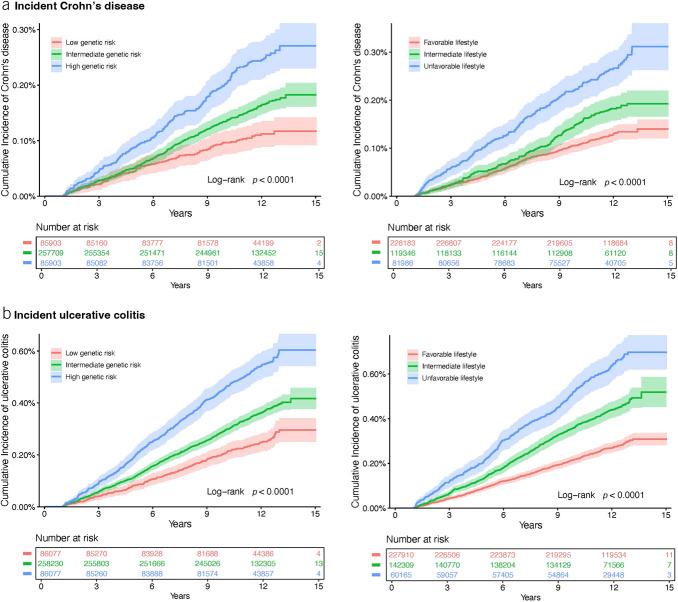
During the 12-year follow-up, 707 cases with CD and 1576 cases with UC were diagnosed in the UK Biobank cohort. Genetic risk and unhealthy lifestyle categories were monotonically associated with CD and UC risk with no multiplicative interaction between them. The HR of CD and UC were 2.24 (95% CI 1.75-2.86) and 2.15 (95% CI 1.82-2.53) for those with a high genetic risk, respectively. The HR of CD and UC for individuals with an unfavorable lifestyle were 1.94 (95% CI 1.61-2.33) and 1.98 (95% CI 1.73-2.27), respectively. The HR of individuals with a high genetic risk but a favorable lifestyle (2.33, 95% CI 1.58-3.44 for CD, and 2.05, 95% CI 1.58-2.66 for UC) were reduced nearly by half, compared with those with a high genetic risk but an unfavorable lifestyle (4.40, 95% CI 2.91-6.66 for CD and 4.44, 95% CI 3.34-5.91 for UC).
DISCUSSION
Genetic and lifestyle factors were independently associated with susceptibility to incident CD and UC. Adherence to a favorable lifestyle was associated with a nearly 50% lower risk of CD and UC among participants at a high genetic risk.
简介
遗传风险、可改变的生活方式因素与炎症性肠病(IBD)之间的联合关联仍不清楚。
方法
通过多基因风险评分估计克罗恩病(CD)和溃疡性结肠炎(UC)的遗传易感性,并进一步分为高、中、低遗传风险类别。根据 5 种常见的生活方式因素构建加权健康生活方式评分,并分为有利(4 或 5 种健康生活方式因素)、中等(3 种健康生活方式因素)和不利(0-2 种健康生活方式因素)组。使用 Cox 比例风险回归模型估计它们与关联的风险比(HR)和 95%置信区间(CI)。
结果
在 UK Biobank 队列的 12 年随访期间,诊断出 707 例 CD 和 1576 例 UC。遗传风险和不健康的生活方式类别与 CD 和 UC 的风险呈单调相关,且它们之间没有乘法交互作用。高遗传风险者 CD 和 UC 的 HR 分别为 2.24(95%CI 1.75-2.86)和 2.15(95%CI 1.82-2.53)。生活方式不利者 CD 和 UC 的 HR 分别为 1.94(95%CI 1.61-2.33)和 1.98(95%CI 1.73-2.27)。高遗传风险但生活方式有利者(CD 的 2.33,95%CI 1.58-3.44,UC 的 2.05,95%CI 1.58-2.66)的 HR 降低了近一半,与高遗传风险但生活方式不利者(CD 的 4.40,95%CI 2.91-6.66,UC 的 4.44,95%CI 3.34-5.91)相比。
讨论
遗传和生活方式因素独立与 CD 和 UC 的发病易感性相关。在高遗传风险的参与者中,坚持有利的生活方式与 CD 和 UC 的风险降低近 50%相关。



 Zotero 插件