
危险因素与炎症性肠病的病因机制:一项前瞻性队列研究。
Etiological mechanisms underlying the hazard factors and inflammatory bowel disease: a prospective cohort study.
作者信息
Tao Yi, Li Yongjia, Zhou Tianyi, Zhao Lei, Li Pan, Sun Minghong, Zhang Lijuan, Yang Lihong, Chen Ting, Lian Xuemei, Zhong Xiaoni
机构信息
Phase I clinical trial ward, The First Affiliated Hospital of Chongqing Medical University, Chongqing, 400016, China.
School of Public Health, Chongqing Medical University, Chongqing, 400016, China.
出版信息
Sci Rep. 2025 Jul 2;15(1):23517. doi: 10.1038/s41598-025-08744-2.
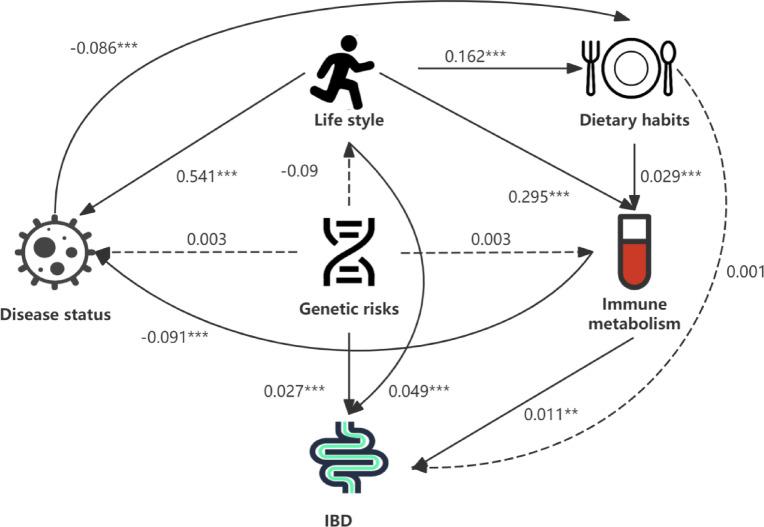
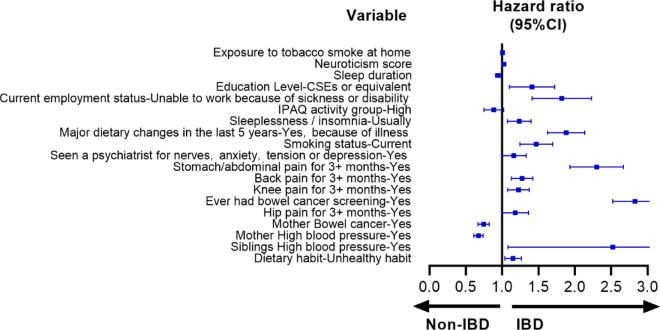
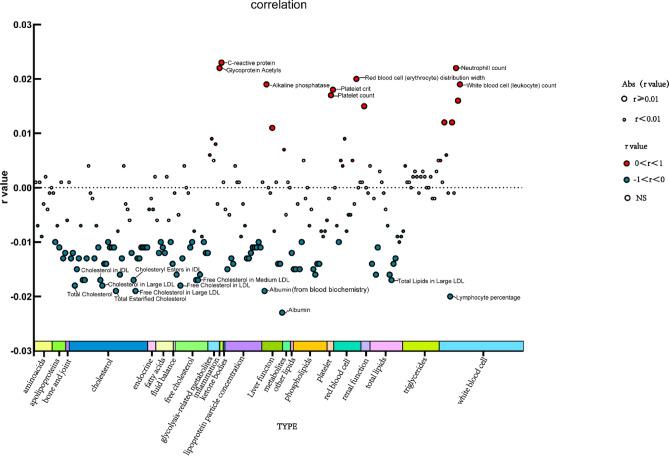
Inflammatory bowel disease (IBD) is a progressively advancing immune-mediated disorder characterized by intricate pathophysiological features. Despite extensive research, the mechanisms linking various risk factors to the development of IBD remain incompletely understood. We conducted analyses within a prospective cohort of unrelated European individuals, utilizing data from the UK Biobank. This cohort had over a decade of follow-up and included more than 500,000 participants aged between 37 and 73 years at recruitment, which took place between 2006 and 2010. A multivariate Cox proportional model was employed to investigate the impact of different risk factors on the incidence of IBD. Additionally, we examined the relationship between 220 peripheral biomarkers and the occurrence of IBD. Finally, we constructed a structural equation model to elucidate the complex pathogenic mechanisms and interactions among genetic risks, lifestyle factors, dietary habits, comorbidities, and immune metabolism in the progression of IBD. A total of 461,454 participants were included in the analysis, of whom 3,494 were newly diagnosed with IBD during the follow-up period. The multivariate Cox proportional model revealed the hazardous roles of polygenic risks, lifestyle factors, diet, immune metabolism, and pre-existing diseases. Specifically, insomnia, major illness-related dietary changes, and unhealthy dietary habits were associated with a 23%, 87%, and 15% increased risk of IBD, respectively. Smoking was found to increase the risk of IBD by 46% compared with never smoking. Comorbidities such as stomach pain, back pain, knee pain, and hip pain increased the risk of IBD by 128% , 27% , 22% and 17% respectively. Moreover, exposure to tobacco, lower educational degree, higher neuroticism score and seen a psychiatrist for nerves, anxiety, tension or depression before also identified as hazard risks. Among the 220 peripheral biomarkers analyzed, we found that cholesterol has the potential to become a new biomarker for predicting IBD. In terms of the pathways leading to IBD, a poor lifestyle contributed to a 5.2% increase in IBD risk, genetic risks accounted for a 2.7% increase, and immune metabolism was associated with a 1.1% increase. We developed an etiological model of IBD that elucidates the complex underlying mechanisms and highlights immune metabolism as the primary mediator in the emergence of IBD.
炎症性肠病(IBD)是一种渐进性的免疫介导疾病,具有复杂的病理生理特征。尽管进行了广泛研究,但将各种风险因素与IBD发生联系起来的机制仍未完全明确。我们利用英国生物银行的数据,在一个前瞻性队列中对无关的欧洲个体进行了分析。该队列有超过十年的随访时间,招募的参与者超过50万,年龄在37至73岁之间,招募时间为2006年至2010年。采用多变量Cox比例模型来研究不同风险因素对IBD发病率的影响。此外,我们还研究了220种外周生物标志物与IBD发生之间的关系。最后,我们构建了一个结构方程模型,以阐明IBD进展过程中遗传风险、生活方式因素、饮食习惯、合并症和免疫代谢之间复杂的致病机制及相互作用。共有461,454名参与者纳入分析,其中3494人在随访期间被新诊断为IBD。多变量Cox比例模型揭示了多基因风险、生活方式因素、饮食、免疫代谢和既往疾病的有害作用。具体而言,失眠、与重大疾病相关的饮食变化和不健康的饮食习惯分别使IBD风险增加23%、87%和15%。与从不吸烟相比,吸烟使IBD风险增加46%。胃痛、背痛、膝关节痛和髋关节痛等合并症分别使IBD风险增加128%、27%、22%和17%。此外,接触烟草、较低的教育程度、较高的神经质得分以及之前因神经、焦虑、紧张或抑郁看过精神科医生也被确定为危险因素。在分析的220种外周生物标志物中,我们发现胆固醇有可能成为预测IBD的新生物标志物。在导致IBD的途径方面,不良生活方式使IBD风险增加5.2%,遗传风险占2.7%的增加,免疫代谢与1.1%的增加有关。我们建立了一个IBD病因模型,阐明了复杂的潜在机制,并强调免疫代谢是IBD发生的主要介导因素。

 Zotero 插件