
不同治疗策略与常见标准治疗方案(CSA)在 60 岁以上新诊断 AML 患者中的比较:一项德国多中心组间随机研究。
Different treatment strategies versus a common standard arm (CSA) in patients with newly diagnosed AML over the age of 60 years: a randomized German inter-group study.
机构信息
University Leipzig, 04106, Leipzig, Germany.
Lithuanian University of Health Sciences, Kaunas, Lithuania.
出版信息
Ann Hematol. 2023 Mar;102(3):547-561. doi: 10.1007/s00277-023-05087-8. Epub 2023 Jan 25.
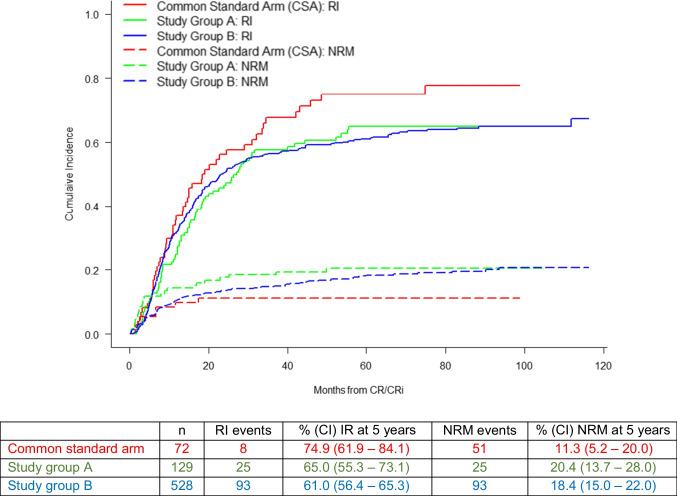
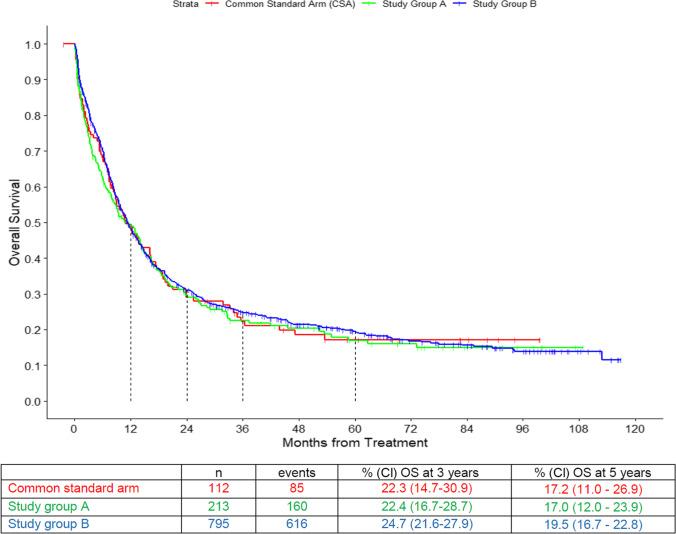
A randomized inter-group trial comparing more intensive treatment strategies to a common standard arm 3 + 7 (CSA) was conducted in patients with non-M3 AML. Untreated patients ≥ 60 years were allocated to the CSA (n = 132) or to the study group arms (n = 1154) of the AMLCG (TAD/HAM versus HAM/HAM ± G-CSF followed by TAD and maintenance) and the OSHO (intermediate-dose ara-C/mitoxantrone followed by ara-C/mitoxantrone). Median age of the 1147 eligible patients was 69 (range 60-87) years. CR/CRi status at 90 days was not significantly different between the CSA (54% (95%CI: 45-64)) and the study group arms (53% (95%CI: 47-60) and 59% (95%CI: 58-63)). The five-year event-free survival (EFS) probability (primary endpoint) was 6.2% (95%CI: 2.7-14.0) in the CSA, 7.6% (95%CI: 4.5-12.8) in study group A and 11.1% (95%CI: 9.0-13.7) in B. The 5-year OS was 17.2% (95%CI: 11.0-26.9), 17.0% (95%CI: 2.0-23.9), and 19.5% (95%CI: 16.7-22.8) in CSA, study group A and B, respectively. Neither study group differed significantly from the CSA regarding EFS, OS, or relapse-free survival. In multivariate analyses, allocation to the treatment strategy was not significantly associated with the time-to-event endpoints. The evaluation of more intensive treatment strategies did not show clinically relevant outcome differences when compared to CSA.
一项针对非 M3 急性髓系白血病患者的随机分组临床试验比较了更强化的治疗策略与常见标准治疗方案(CSA)。未接受治疗的年龄≥60 岁的患者被分配至 CSA(n=132)或 AMLCG 研究组(TAD/HAM 与 HAM/HAM±G-CSF 序贯 TAD 和维持治疗)和 OSHO 研究组(中剂量阿糖胞苷/米托蒽醌序贯阿糖胞苷/米托蒽醌)。1147 例符合条件患者的中位年龄为 69 岁(范围 60-87 岁)。90 天的完全缓解/完全缓解伴血细胞计数不完全恢复(CR/CRi)率在 CSA(54%(95%CI:45-64))和研究组(53%(95%CI:47-60)和 59%(95%CI:58-63))之间无显著差异。主要终点 5 年无事件生存(EFS)率(事件包括复发和死亡)在 CSA 组为 6.2%(95%CI:2.7-14.0),研究组 A 为 7.6%(95%CI:4.5-12.8),B 为 11.1%(95%CI:9.0-13.7)。5 年 OS 率在 CSA、研究组 A 和 B 分别为 17.2%(95%CI:11.0-26.9)、17.0%(95%CI:2.0-23.9)和 19.5%(95%CI:16.7-22.8)。在 EFS、OS 或无复发生存方面,两组均与 CSA 无显著差异。多变量分析显示,治疗策略的分配与时间相关终点无显著关联。与 CSA 相比,强化治疗策略的评估并未显示出具有临床意义的生存获益差异。



 Zotero 插件