
《西班牙语/拉丁裔成年人多病共存的 Mi Puente(我的桥梁)护理过渡计划:一项随机对照试验的结果》
Mi Puente (My Bridge) Care Transitions Program for Hispanic/Latino Adults with Multimorbidity: Results of a Randomized Controlled Trial.
机构信息
Department of Psychology, San Diego State University, San Diego, CA, USA.
South Bay Latino Research Center, San Diego State University, 780 Bay Blvd. Suite 200, Chula Vista, CA, 91910, USA.
出版信息
J Gen Intern Med. 2023 Jul;38(9):2098-2106. doi: 10.1007/s11606-022-08006-1. Epub 2023 Jan 25.
BACKGROUND
Multimorbidity frequently co-occurs with behavioral health concerns and leads to increased healthcare costs and reduced quality and quantity of life. Unplanned readmissions are a primary driver of high healthcare costs.
OBJECTIVE
We tested the effectiveness of a culturally appropriate care transitions program for Latino adults with multiple cardiometabolic conditions and behavioral health concerns in reducing hospital utilization and improving patient-reported outcomes.
DESIGN
Randomized, controlled, single-blind parallel-groups.
PARTICIPANTS
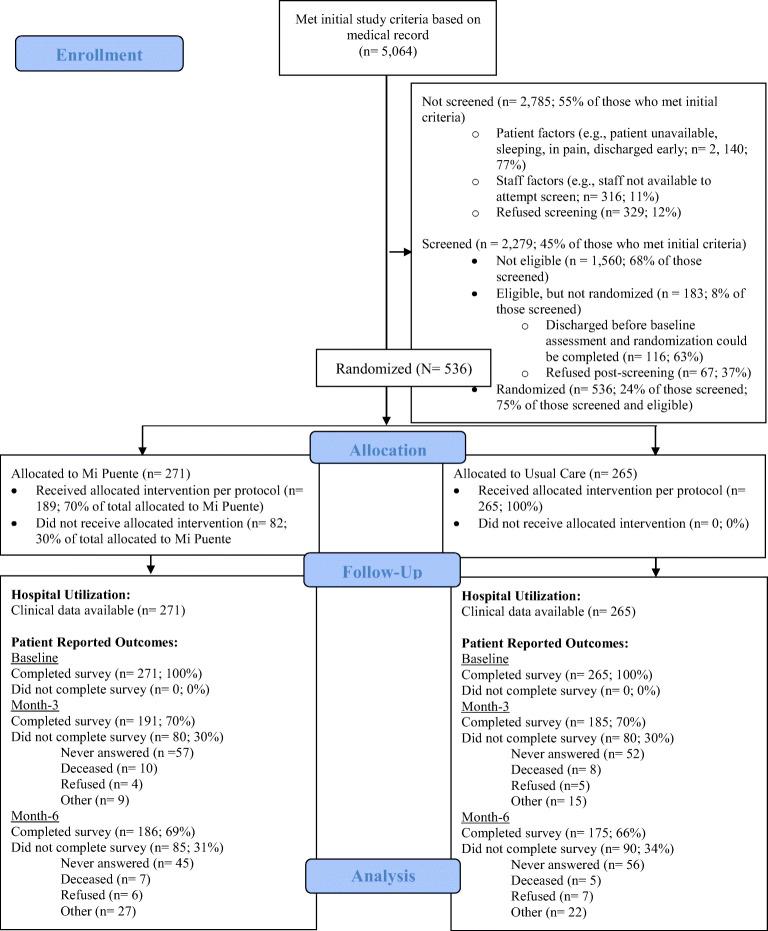
Hispanic/Latino adults (N=536; 75% of those screened and eligible; M=62.3 years (SD=13.9); 48% women; 73% born in Mexico) with multiple chronic cardiometabolic conditions and at least one behavioral health concern (e.g., depression symptoms, alcohol misuse) hospitalized at a hospital that serves a large, mostly Hispanic/Latino, low-income population.
INTERVENTIONS
Usual care (UC) involved best-practice discharge processes (e.g., discharge instructions, assistance with appointments). Mi Puente ("My Bridge"; MP) was a culturally appropriate program of UC plus inpatient and telephone encounters with a behavioral health nurse and community mentor team who addressed participants' social, medical, and behavioral health needs.
MAIN MEASURES
The primary outcome was 30- and 180-day readmissions (inpatient, emergency, and observation visits). Patient-reported outcomes (quality of life, patient activation) and healthcare use were also examined.
KEY RESULTS
In intention-to-treat models, the MP group evidenced a higher rate of recurrent hospitalization (15.9%) versus UC (9.4%) (OR=1.91 (95% CI 1.09, 3.33)), and a greater number of recurrent hospitalizations (M=0.20 (SD=0.49) MP versus 0.12 (SD=0.45) UC; P=0.02) at 30 days. Similar trends were observed at 180 days. Both groups showed improved patient-reported outcomes, with no advantage in the Mi Puente group. Results were similar in per protocol analyses.
CONCLUSIONS
In this at-risk population, the MP group experienced increased hospital utilization and did not demonstrate an advantage in improved patient-reported outcomes, relative to UC. Possible reasons for these unexpected findings are discussed.
TRIAL REGISTRATION
ClinicalTrials.gov Identifier: NCT02723019. Registered on 30 March 2016.
背景
多种疾病常伴有行为健康问题,这会导致医疗保健成本增加,生活质量和数量下降。非计划性再入院是医疗保健成本高的主要驱动因素。
目的
我们测试了一种针对有多种心血管代谢疾病和行为健康问题的拉丁裔成年人的文化上适宜的护理过渡计划,以减少住院利用率并改善患者报告的结果。
设计
随机、对照、单盲平行组。
参与者
有多种慢性心血管代谢疾病和至少一种行为健康问题(例如抑郁症状、酒精滥用)的西班牙裔/拉丁裔成年人(N=536;筛查和符合条件者的 75%;M=62.3 岁(SD=13.9);48%为女性;73%出生于墨西哥),在一家服务于大量主要为西班牙裔/拉丁裔、低收入人群的医院住院。
干预措施
常规护理(UC)包括最佳实践的出院流程(例如,出院指导,协助预约)。Mi Puente(“我的桥”)是一种文化上适宜的 UC 计划,包括住院期间和电话访谈,由行为健康护士和社区导师团队共同处理参与者的社会、医疗和行为健康需求。
主要措施
主要结果是 30 天和 180 天的再入院(住院、急诊和观察就诊)。还检查了患者报告的结果(生活质量、患者激活)和医疗保健使用情况。
主要结果
在意向治疗模型中,与 UC 组(9.4%)相比,MP 组的再入院率更高(15.9%)(OR=1.91(95%CI 1.09,3.33)),并且在 30 天时的再入院次数更多(MP 组 M=0.20(SD=0.49),UC 组 M=0.12(SD=0.45);P=0.02)。在 180 天的时间里也观察到了类似的趋势。两组患者报告的结果都有所改善,但 Mi Puente 组没有优势。在符合方案分析中结果相似。
结论
在这个高危人群中,与 UC 相比,MP 组经历了更多的住院治疗,并且在改善患者报告的结果方面没有优势。讨论了这些意外发现的可能原因。
试验注册
ClinicalTrials.gov 标识符:NCT02723019。于 2016 年 3 月 30 日注册。
 Zotero 插件