
医护人员和社交网络提供的情感支持的感知重要性:我们是否应该扩大支持性护理的关注焦点?
Perceived importance of emotional support provided by health care professionals and social networks: Should we broaden our focus for the delivery of supportive care?
机构信息
School of Medicine and Public health, University of Newcastle, Callaghan, New South Wales, Australia.
Priority Research Centre for Health Behaviour, University of Newcastle, Callaghan, New South Wales, Australia.
出版信息
Asia Pac J Clin Oncol. 2023 Dec;19(6):681-689. doi: 10.1111/ajco.13922. Epub 2023 Jan 25.
INTRODUCTION
Emotional support provided by health care professionals (HCPs) for people diagnosed with cancer is associated with improved outcomes. Support via social networks may also be important.
AIMS
To report among a sample of distressed patients and caregivers, (1) the importance attributed to different sources of emotional support (HCPs and social networks) by distressed cancer patients and caregivers; (2) the proportion who indicate they did not receive sufficient levels of emotional support; and (3) potential associations between respondents' demographic and clinical characteristics and reported lack of emotional support.
METHODS
This study utilised cross-sectional data from telephone interviews collected during the usual-care phase of the Structured Triage and Referral by Telephone (START) trial. Participants completed a telephone interview 6 months after their initial call to the Cancer Council Information and Support service and included recall of importance and sufficiency of emotional support.
RESULTS
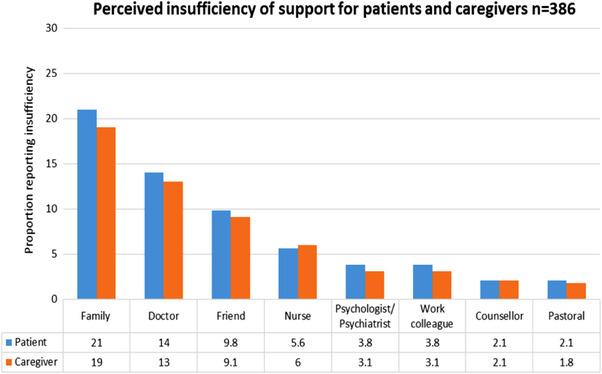
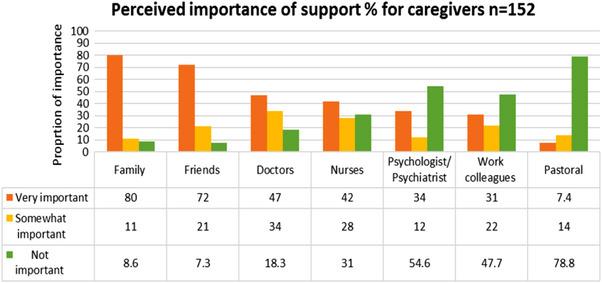
More than two-thirds of patients (n = 234) and caregivers (n = 152) reported that family and friends were very important sources of emotional support. Nurses (69% and 42%) and doctors (68% and 47%) were reported very important, while a lower proportion reported that psychologists and psychiatrists were very important (39%, and 43%). Insufficient levels of support were reported by 36% of participants. Perceptions of insufficient support were significantly associated with distress levels (p < .0001) and not having a partner (p = .0115).
CONCLUSION
Social networks, particularly family, are an important source of emotional support. Higher levels of distress, those without partners, and caregivers may require targeted interventions to increase their access to emotional support.
简介
医疗保健专业人员(HCPs)为癌症患者提供的情感支持与改善结果相关。通过社交网络提供的支持也可能很重要。
目的
在一组有困扰的患者和照顾者中报告:(1)有困扰的癌症患者和照顾者对 HCP 和社交网络等不同情感支持来源的重视程度;(2)表示未获得足够水平情感支持的比例;(3)受访者的人口统计学和临床特征与报告缺乏情感支持之间的潜在关联。
方法
本研究利用了结构分诊和电话转诊(START)试验常规护理阶段收集的电话访谈的横断面数据。参与者在首次致电癌症协会信息和支持服务 6 个月后完成电话访谈,包括对情感支持的重要性和充足性的回忆。
结果
超过三分之二的患者(n=234)和照顾者(n=152)报告说,家人和朋友是情感支持的非常重要来源。护士(69%和 42%)和医生(68%和 47%)被认为非常重要,而较少的人认为心理学家和精神科医生非常重要(39%和 43%)。36%的参与者报告说支持不足。支持不足的看法与困扰程度显著相关(p<0.0001),与没有伴侣相关(p=0.0115)。
结论
社交网络,特别是家庭,是情感支持的重要来源。较高水平的困扰、没有伴侣的人和照顾者可能需要有针对性的干预措施,以增加他们获得情感支持的机会。

 Zotero 插件