
皮肤型红斑狼疮的临床特征
Clinical aspects of cutaneous lupus erythematosus.
作者信息
Elmgren Julia, Nyberg Filippa
机构信息
Department of Medicine, Karolinska Institutet, Stockholm, Sweden.
Department of Dermatology, Karolinska University Hospital, Stockholm, Sweden.
出版信息
Front Med (Lausanne). 2023 Jan 9;9:984229. doi: 10.3389/fmed.2022.984229. eCollection 2022.
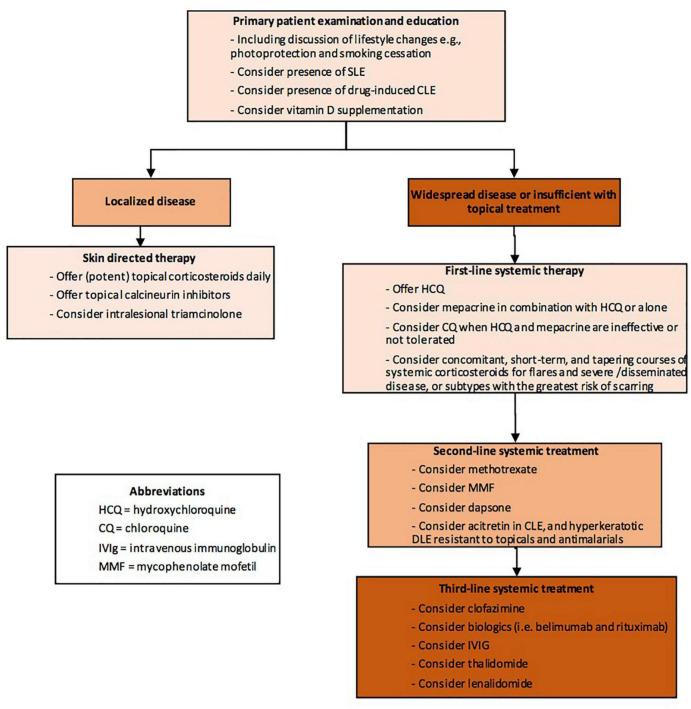
Lupus erythematosus (LE) is an autoimmune inflammatory disease with a wide clinical spectrum from life-threatening multi-organ inflammation in systemic lupus erythematosus (SLE) to limited skin disease in cutaneous LE (CLE). The etiology of CLE is still not fully understood but a multifactorial genesis with genetic predisposition and certain environmental factors as triggers for the development are generally accepted features. Lesions can be induced and aggravated by UV-irradiation and smoking is linked to more severe forms of skin disease and to co-morbidity. Drugs, including many common medicines like antihypertensives, are known to induce subacute CLE (SCLE). The mechanisms involved have recently been shown to be part of the IFN-I pathway and new, specific treatments are currently in clinical trials. CLE is currently classified in subtypes based on clinical presentation and duration into acute CLE (ACLE), SCLE, and chronic CLE (CCLE). Distinct subtypes can be seen in individual patients or coexist within the same patient. Because of the confluent and overlapping picture between these subsets, serology, and histopathology constitute an important role guiding towards correct diagnose and there is ongoing work to update the classification. The Cutaneous Lupus Area Severity Index (CLASI) is a validated tool to measure activity and damage both in clinical trials but also for the clinician to evaluate treatment and follow the course of the disease among patients. CLE is known to have substantial impact on the life of those affected. Several tools have been proposed to measure QoL in these patients, currently Skindex-29 is probably the most used. Patient education is an important part of prevention of flares, including UV-protection and smoking cessation. First-line treatment includes topical corticosteroids as well as topical calcineurin inhibitors with the addition of systemic treatment with antimalarials in more severe or therapy resistant cases. Treatment specifically targeting CLE has been lacking, however novel potential therapies are in later phase clinical trials. In this review we aim to describe the different subsets of the cutaneous form in LE with focus on clinical aspects.
红斑狼疮(LE)是一种自身免疫性炎症性疾病,临床谱广泛,从系统性红斑狼疮(SLE)中危及生命的多器官炎症到皮肤型红斑狼疮(CLE)中的局限性皮肤病。CLE的病因仍未完全明确,但遗传易感性和某些环境因素作为发病诱因的多因素发病机制已被普遍认可。紫外线照射可诱发和加重皮损,吸烟与更严重的皮肤病形式及合并症有关。已知包括许多常用药物如抗高血压药在内的药物可诱发亚急性CLE(SCLE)。最近已证明其涉及的机制是I型干扰素途径的一部分,目前新的特异性治疗正在临床试验中。CLE目前根据临床表现和病程分为急性CLE(ACLE)、SCLE和慢性CLE(CCLE)。不同亚型可在个体患者中出现或在同一患者中共存。由于这些亚组之间表现融合且相互重叠,血清学和组织病理学在正确诊断中起着重要作用,目前正在进行更新分类的工作。皮肤狼疮面积严重程度指数(CLASI)是一种经过验证的工具,可用于临床试验中测量疾病活动度和损伤情况,也可供临床医生评估治疗效果并跟踪患者的疾病进程。已知CLE对患者的生活有重大影响。已提出多种工具来测量这些患者的生活质量,目前Skindex-29可能是使用最广泛的。患者教育是预防病情发作的重要组成部分,包括紫外线防护和戒烟。一线治疗包括外用糖皮质激素以及外用钙调神经磷酸酶抑制剂,在病情更严重或治疗抵抗的情况下加用抗疟药进行全身治疗。然而,一直缺乏针对CLE的特异性治疗方法,不过新型潜在疗法正处于后期临床试验阶段。在本综述中,我们旨在描述LE皮肤型的不同亚组,重点关注临床方面。
 Zotero 插件