
高滴度抗干扰素-γ中和自身抗体与成人斯蒂尔病患者的机会性感染相关。
High-titer anti-interferon-γ neutralizing autoantibodies linked to opportunistic infections in patients with adult-onset still's disease.
作者信息
Chen Po-Ku, Liao Tsai-Ling, Chang Shih-Hsin, Yeo Kai-Jieh, Chou Chia-Hui, Chen Der-Yuan
机构信息
Rheumatology and Immunology Center, China Medical University Hospital, Taichung, Taiwan.
College of Medicine, China Medical University, Taichung, Taiwan.
出版信息
Front Med (Lausanne). 2023 Jan 9;9:1097514. doi: 10.3389/fmed.2022.1097514. eCollection 2022.
OBJECTIVE
Neutralizing anti-interferon (IFN)-γ autoantibodies are linked to opportunistic infections (OIs). To explore the association between anti-IFN-γ autoantibodies and OIs in patients with adult-onset Still's disease (AOSD), we aimed to examine the ability of these autoantibodies to blockade signal transducer and activator of transcription (STAT1)-phosphorylation and chemokines production.
METHODS
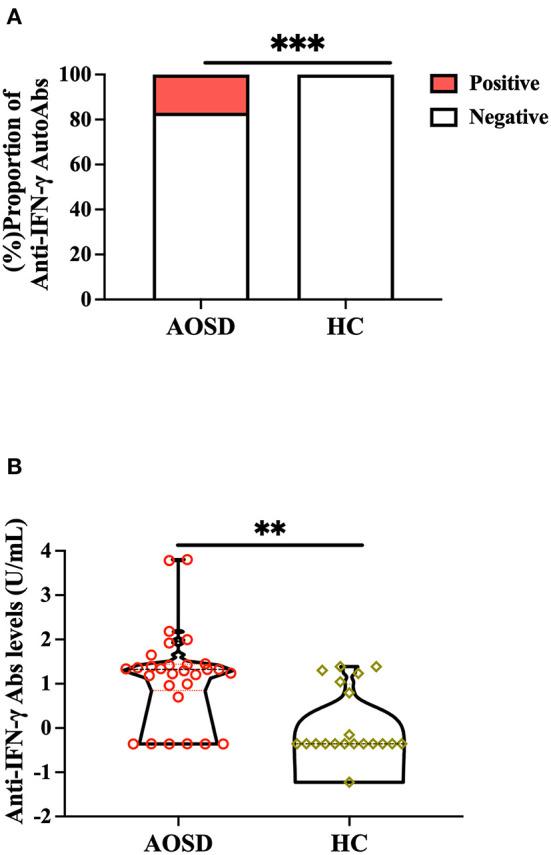
Serum titers of anti-IFN-γ autoantibodies were quantified using ELISA in 29 AOSD and 22 healthy controls (HC). The detectable autoantibodies were verified with immunoblotting assay, and their neutralizing capacity against IFN-γ-signaling was evaluated with flow-cytometry analysis and immunoblotting. IFN-γ-mediated production of supernatant chemokines, including monocyte chemoattractant protein-1 (MCP-1) and IFN-γ inducible protein-10 (IP-10), were measured by ELISA.
RESULTS
Among 29 AOSD patients, high titers of anti-IFN-γ neutralizing autoantibodies were detectable in two patients with OIs. Immunoblotting assay revealed more effective inhibition of STAT1-phosphorylation in THP-1 cells treated with sera from autoantibody-positive AOSD patients (56.7 ± 34.79%) compared with those from HC (104.3 ±29.51%), which was also demonstrated in flow-cytometry analysis (47.13 ± 40.99 vs. 97.92 ± 9.48%, < 0.05). Depleted serum IgG from anti-IFN-γ autoAbs-positive AOSD patients with OIs restored phosphorylated STAT-1 upon IFN-γ treatment. Sera from autoantibody-positive AOSD patients more effectively inhibited IFN-γ-mediated production of MCP-1 (45.65 pg/ml) and IP-10 (22.44 pg/ml) than sera from HC (263.1 pg/ml and 104.0 pg/ml, both < 0.05). Serum samples showing the strongest inhibition of IFN-γ-signaling were from two patients with high-titer autoantibodies and OIs.
CONCLUSION
AOSD patients have a high positive rate and titers of anti-IFN-γ autoantibodies. The remarkable blockade effect of high-titer autoantibodies on IFN-γ-mediated STAT1-phosphorylation and chemokines could make these patients susceptible to OIs.
目的
中和性抗干扰素(IFN)-γ自身抗体与机会性感染(OIs)相关。为探讨成人斯蒂尔病(AOSD)患者中抗IFN-γ自身抗体与OIs之间的关联,我们旨在检测这些自身抗体阻断信号转导和转录激活因子(STAT1)磷酸化及趋化因子产生的能力。
方法
采用酶联免疫吸附测定(ELISA)法对29例AOSD患者和22例健康对照(HC)的血清抗IFN-γ自身抗体滴度进行定量。通过免疫印迹法验证可检测到的自身抗体,并采用流式细胞术分析和免疫印迹法评估其对IFN-γ信号的中和能力。采用ELISA法检测IFN-γ介导的上清液趋化因子产生,包括单核细胞趋化蛋白-1(MCP-1)和IFN-γ诱导蛋白10(IP-10)。
结果
在29例AOSD患者中,2例发生OIs的患者可检测到高滴度的抗IFN-γ中和自身抗体。免疫印迹法显示,与HC血清处理的THP-1细胞(104.3±29.51%)相比,自身抗体阳性AOSD患者血清处理的THP-1细胞中STAT1磷酸化的抑制作用更有效(56.7±34.79%),流式细胞术分析也证实了这一点(47.13±40.99对97.92±9.48%,P<0.05)。用IFN-γ处理后,来自患有OIs的抗IFN-γ自身抗体阳性AOSD患者的血清IgG耗尽后恢复了磷酸化的STAT-1。与HC血清(263.1 pg/ml和104.0 pg/ml,均P<0.05)相比,自身抗体阳性AOSD患者的血清更有效地抑制了IFN-γ介导的MCP-1(45.65 pg/ml)和IP-10(22.44 pg/ml)的产生。显示对IFN-γ信号抑制作用最强的血清样本来自2例高滴度自身抗体和OIs患者。
结论
AOSD患者抗IFN-γ自身抗体的阳性率和滴度较高。高滴度自身抗体对IFN-γ介导的STAT1磷酸化和趋化因子具有显著的阻断作用,可能使这些患者易发生OIs。


 Zotero 插件