
巨噬细胞移动抑制因子通过低密度脂蛋白受体相关蛋白1-尿激酶型纤溶酶原激活物受体相互作用促进胰腺癌细胞的侵袭。
MIF promotes cell invasion by the LRP1-uPAR interaction in pancreatic cancer cells.
作者信息
Sun Huizhi, Cheng Runfen, Zhang Danfang, Guo Yuhong, Li Fan, Li Yanlei, Li Yue, Bai Xiaoyu, Mo Jing, Huang Chongbiao
机构信息
Tianjin Medical University Cancer Institute and Hospital, National Clinical Research Center for Cancer, Key Laboratory of Cancer Prevention and Therapy, Tianjin, China.
Department of Pathology, Tianjin Medical University, Tianjin, China.
出版信息
Front Oncol. 2023 Jan 10;12:1028070. doi: 10.3389/fonc.2022.1028070. eCollection 2022.
INTRODUCTION
Pancreatic ductal adenocarcinoma (PDAC) is characterized by high aggressiveness and a hypoxic tumour microenvironment. Macrophage migration inhibitory factor (MIF) is a hypoxia-related pleiotropic cytokine that plays important roles in cancer. However, its role in PDAC progression has not been fully elucidated.
METHODS
The clinical significance of MIF and hypoxia inducible factor 1 subunit alpha (HIF1A) in PDAC was analysed using immunohistochemical staining on PDAC tissues and data from KM-Plotter database. Spatial distribution of MIF and HIF1A gene expression was visualized by spatial transcriptomics in PDAC cell xenografts. To monitor the role of MIF in PDAC cell malignancy, immunostaining, lentivirus shRNA, migration assays, flow cytometry, transcriptomics and in vivo tumorigenicity were performed.
RESULTS
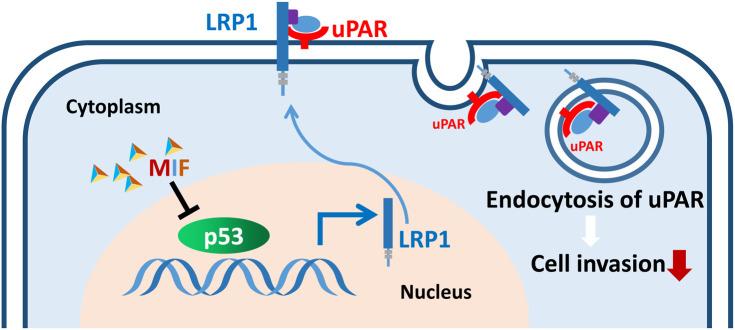
The spatial distribution of MIF and HIF1A was highly correlated and that high MIF expression was associated with poor prognosis of PDAC patients. MIF knockdown impaired cell invasion, with a decrease in the expression of urokinase-type plasminogen activator receptor (uPAR). Although PLAUR transcript was not reduced, a uPAR endocytic receptor, low-density lipoprotein receptor-related protein 1 (LRP1), was upregulated at both the mRNA and protein levels after MIF knockdown. The LRP1 antagonist RAP restored uPAR expression and invasiveness. MIF attenuated the nuclear translocation of p53, a transcriptional regulator of LRP1. Furthermore, MIF downregulation blunted the growth of PDAC cell xenografts and inhibited cell proliferation under normoxia and hypoxia. Transcriptome analysis also provided evidence for the role of MIF in cancer-associated pathways.
DISCUSSION
We demonstrate a novel link between the two pro-invasive agents MIF and uPAR and explain how MIF increases PDAC cell invasion capability. This finding provides a basis for therapeutic intervention of MIF in PDAC progression.
引言
胰腺导管腺癌(PDAC)具有高侵袭性和缺氧的肿瘤微环境。巨噬细胞迁移抑制因子(MIF)是一种与缺氧相关的多效细胞因子,在癌症中发挥重要作用。然而,其在PDAC进展中的作用尚未完全阐明。
方法
通过对PDAC组织进行免疫组织化学染色以及利用KM-Plotter数据库的数据,分析MIF和缺氧诱导因子1α亚基(HIF1A)在PDAC中的临床意义。通过空间转录组学观察PDAC细胞异种移植中MIF和HIF1A基因表达的空间分布。为监测MIF在PDAC细胞恶性肿瘤中的作用,进行了免疫染色、慢病毒短发夹RNA、迁移试验、流式细胞术、转录组学和体内致瘤性实验。
结果
MIF和HIF1A的空间分布高度相关,且MIF高表达与PDAC患者的不良预后相关。MIF敲低损害细胞侵袭,尿激酶型纤溶酶原激活物受体(uPAR)表达降低。尽管PLAUR转录本未减少,但MIF敲低后,uPAR内吞受体低密度脂蛋白受体相关蛋白1(LRP1)在mRNA和蛋白质水平均上调。LRP1拮抗剂RAP恢复了uPAR表达和侵袭性。MIF减弱了p53的核转位,p53是LRP1的转录调节因子。此外,MIF下调减弱了PDAC细胞异种移植的生长,并在常氧和缺氧条件下抑制细胞增殖。转录组分析也为MIF在癌症相关通路中的作用提供了证据。
讨论
我们证明了两种促侵袭因子MIF和uPAR之间的新联系,并解释了MIF如何增加PDAC细胞的侵袭能力。这一发现为MIF在PDAC进展中的治疗干预提供了基础。


 Zotero 插件