
基质辅助激光解吸电离飞行时间质谱法鉴定高生物膜产生菌株能力的测定
Determination of the ability of matrix-assisted laser desorption ionization time-of-flight mass spectrometry to identify high-biofilm-producing strains.
作者信息
Rodríguez-Temporal David, Díez Rafael, Díaz-Navarro Marta, Escribano Pilar, Guinea Jesús, Muñoz Patricia, Rodríguez-Sánchez Belén, Guembe María
机构信息
Department of Clinical Microbiology and Infectious Diseases, Hospital General Universitario Gregorio Marañón, Madrid, Spain.
Instituto de Investigación Sanitaria Gregorio Marañón, Madrid, Spain.
出版信息
Front Microbiol. 2023 Jan 10;13:1104405. doi: 10.3389/fmicb.2022.1104405. eCollection 2022.
BACKGROUND
The traditional method for assessing the capacity of a microorganism to produce biofilm is generally a static model in a multi-well plate using the crystal violet (CV) binding assay, which takes 96 h. Furthermore, while the method is simple to perform, its reproducibility is poor.
OBJECTIVE
We evaluated whether matrix-assisted laser desorption ionization time-of-flight mass spectrometry (MALDI-TOF MS) could make it possible to differentiate between high-and low-biofilm-producing microorganisms on 24-h cultures of and .
METHODS
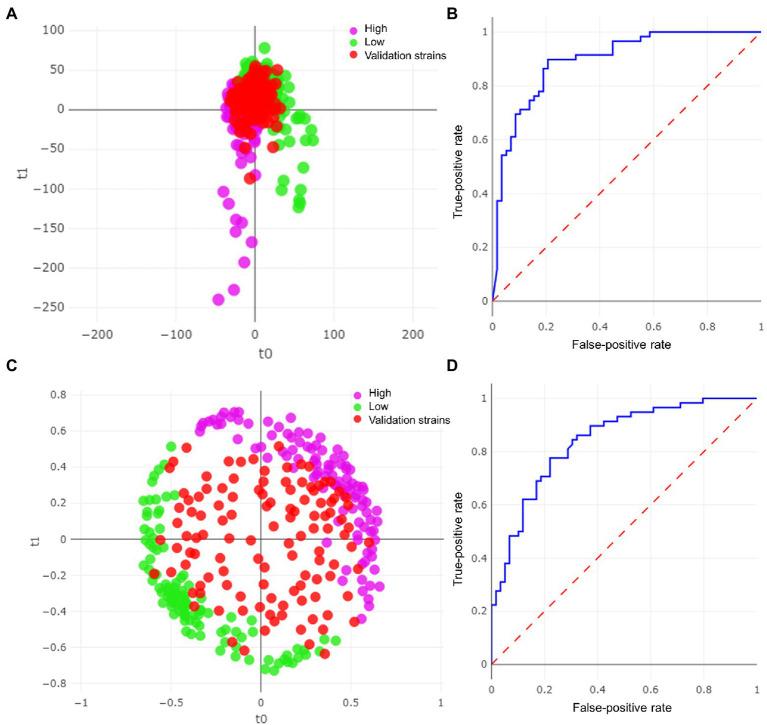
We included 157 strains of . and 91 strains of . obtained from the blood cultures of patients with bacteremia/candidemia. We tested biofilm production using the CV binding assay as the gold standard to classify strains as low or high biofilm producers. We then applied MALDI-TOF MS to create a machine learning-based predictive model using 40 strains of . and . , each with extreme absorbance values, and validated this approach with the remaining 117 and 51 strains using the random forest algorithm and the support vector machine algorithm, respectively.
RESULTS
Overall, 81.2% of the . strains (95/117) and 74.5% of the . strains (38/51) used for validation were correctly categorized, respectively, as low and high-biofilm-producing.
CONCLUSION
Classification based on MALDI-TOF MS protein spectra enables us to predict acceptable information about the capacity of 24-h cultures of . and . to form biofilm.
背景
评估微生物产生生物膜能力的传统方法通常是在多孔板中使用结晶紫(CV)结合试验的静态模型,该方法需要96小时。此外,虽然该方法操作简单,但其可重复性较差。
目的
我们评估了基质辅助激光解吸电离飞行时间质谱(MALDI-TOF MS)是否能够在24小时培养的[具体微生物1]和[具体微生物2]中区分高生物膜产生菌和低生物膜产生菌。
方法
我们纳入了157株[具体微生物1]和91株[具体微生物2],这些菌株来自菌血症/念珠菌血症患者的血培养。我们以CV结合试验作为金标准检测生物膜的产生,将菌株分类为低生物膜产生菌或高生物膜产生菌。然后,我们应用MALDI-TOF MS,使用40株[具体微生物1]和[具体微生物2](每种微生物各20株,具有极端吸光度值)创建基于机器学习的预测模型,并分别使用随机森林算法和支持向量机算法,用其余117株[具体微生物1]和51株[具体微生物2]验证该方法。
结果
总体而言,用于验证的[具体微生物1]菌株中81.2%(95/117)和[具体微生物2]菌株中74.5%(38/51)分别被正确分类为低生物膜产生菌和高生物膜产生菌。
结论
基于MALDI-TOF MS蛋白质谱的分类使我们能够预测关于24小时培养的[具体微生物1]和[具体微生物2]形成生物膜能力的可接受信息。


 Zotero 插件