
病毒性肺炎患者真菌感染的危险因素分析:系统评价和荟萃分析。
Analysis of risk factors of fungal superinfections in viral pneumonia patients: A systematic review and meta-analysis.
机构信息
Department of Respiratory & Critical Medicine, Renmin Hospital of Wuhan University, Wuhan, Hubei, China.
Department of infectious disease, Ezhou Central Hospital, Ezhou, Hubei, China.
出版信息
Immun Inflamm Dis. 2023 Jan;11(1):e760. doi: 10.1002/iid3.760.
BACKGROUND
Infections with fungi, such as Aspergillus species, have been found as common complications of viral pneumonia. This study aims to determine the risk factors of fungal superinfections in viral pneumonia patients using meta-analysis.
OBJECTIVE
This study aims to determine the risk factors of fungal infection s in viral pneumonia patients using meta-analysis.
METHODS
We reviewed primary literature about fungal infection in viral pneumonia patients published between January 1, 2010 and September 30, 2020, in the Chinese Biomedical Literature, Chinese National Knowledge Infrastructure, Wanfang (China), Cochrane Central Library, Embase, PubMed, and Web of Science databases. These studies were subjected to an array of statistical analyses, including risk of bias and sensitivity analyses.
RESULTS
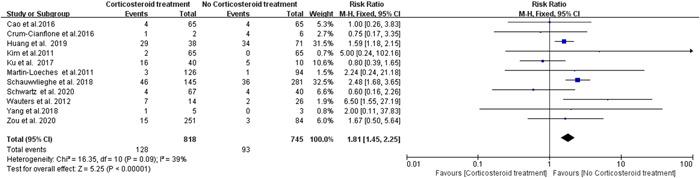
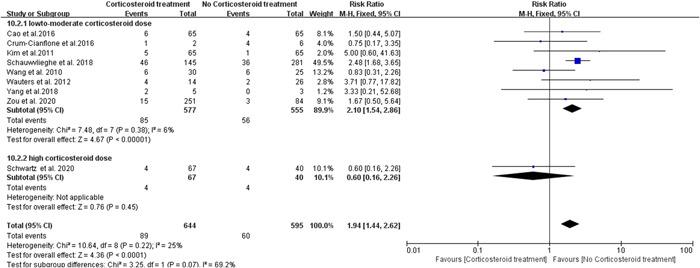
In this study, we found a statistically significant difference in the incidence of fungal infections in viral pneumonia patients that received corticosteroid treatment as compared to those without corticosteroid treatment (p < .00001). Additionally, regarding the severity of fungal infections, we observed significant higher incidence of invasive pulmonary aspergillosis (IPA) in patients with high Acute Physiology and Chronic Health Evaluation (APACHE) II scores (p < .001), tumors (p = .005), or immunocompromised patients (p < .0001).
CONCLUSIONS
Our research shows that corticosteroid treatment was an important risk factor for the development of fungal infection in patients with viral pneumonia. High APACHE II scores, tumors, and immunocompromised condition are also important risk factors of developing IPA. The diagnosis of fungal infection in viral pneumonia patients can be facilitated by early serum galactomannan (GM) testing, bronchoalveolar lavage fluid Aspergillus antigen testing, culture, and biopsy.
背景
真菌感染,如曲霉菌属,已被发现是病毒性肺炎的常见并发症。本研究旨在通过荟萃分析确定病毒性肺炎患者真菌感染的危险因素。
目的
本研究旨在通过荟萃分析确定病毒性肺炎患者真菌感染的危险因素。
方法
我们检索了 2010 年 1 月 1 日至 2020 年 9 月 30 日期间在中国生物医学文献、中国知网、万方(中国)、考克兰图书馆、Embase、PubMed 和 Web of Science 数据库中发表的关于病毒性肺炎患者真菌感染的原始文献。这些研究进行了一系列的统计分析,包括风险偏倚和敏感性分析。
结果
在这项研究中,我们发现接受皮质类固醇治疗的病毒性肺炎患者与未接受皮质类固醇治疗的患者相比,真菌感染的发生率存在统计学显著差异(p<0.00001)。此外,关于真菌感染的严重程度,我们观察到急性生理与慢性健康状况评分系统(APACHE)Ⅱ评分较高(p<0.001)、肿瘤(p=0.005)或免疫功能低下的患者(p<0.0001)中侵袭性肺曲霉病(IPA)的发生率显著较高。
结论
我们的研究表明,皮质类固醇治疗是病毒性肺炎患者真菌感染发展的一个重要危险因素。高 APACHE Ⅱ评分、肿瘤和免疫功能低下也是发生 IPA 的重要危险因素。早期血清半乳甘露聚糖(GM)检测、支气管肺泡灌洗液曲霉抗原检测、培养和活检有助于诊断病毒性肺炎患者的真菌感染。


 Zotero 插件