
医疗保健中的人工智能技术与人文关怀:一项系统综述。
Artificial intelligence technologies and compassion in healthcare: A systematic scoping review.
作者信息
Morrow Elizabeth, Zidaru Teodor, Ross Fiona, Mason Cindy, Patel Kunal D, Ream Melissa, Stockley Rich
机构信息
Research Support Northern Ireland, Downpatrick, United Kingdom.
Department of Anthropology, London School of Economics and Political Sciences, London, United Kingdom.
出版信息
Front Psychol. 2023 Jan 17;13:971044. doi: 10.3389/fpsyg.2022.971044. eCollection 2022.
BACKGROUND
Advances in artificial intelligence (AI) technologies, together with the availability of big data in society, creates uncertainties about how these developments will affect healthcare systems worldwide. Compassion is essential for high-quality healthcare and research shows how prosocial caring behaviors benefit human health and societies. However, the possible association between AI technologies and compassion is under conceptualized and underexplored.
OBJECTIVES
The aim of this scoping review is to provide a comprehensive depth and a balanced perspective of the emerging topic of AI technologies and compassion, to inform future research and practice. The review questions were: How is compassion discussed in relation to AI technologies in healthcare? How are AI technologies being used to enhance compassion in healthcare? What are the gaps in current knowledge and unexplored potential? What are the key areas where AI technologies could support compassion in healthcare?
MATERIALS AND METHODS
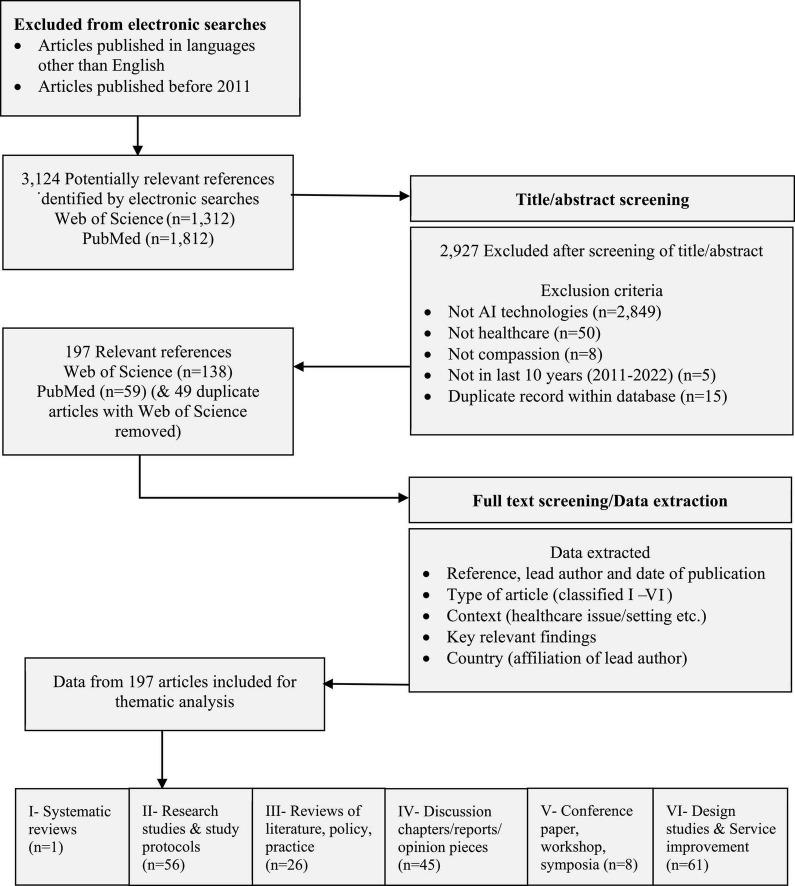
A systematic scoping review following five steps of Joanna Briggs Institute methodology. Presentation of the scoping review conforms with PRISMA-ScR (Preferred Reporting Items for Systematic reviews and Meta-Analyses extension for Scoping Reviews). Eligibility criteria were defined according to 3 concept constructs (AI technologies, compassion, healthcare) developed from the literature and informed by medical subject headings (MeSH) and key words for the electronic searches. Sources of evidence were Web of Science and PubMed databases, articles published in English language 2011-2022. Articles were screened by title/abstract using inclusion/exclusion criteria. Data extracted (author, date of publication, type of article, aim/context of healthcare, key relevant findings, country) was charted using data tables. Thematic analysis used an inductive-deductive approach to generate code categories from the review questions and the data. A multidisciplinary team assessed themes for resonance and relevance to research and practice.
RESULTS
Searches identified 3,124 articles. A total of 197 were included after screening. The number of articles has increased over 10 years (2011, = 1 to 2021, = 47 and from Jan-Aug 2022 = 35 articles). Overarching themes related to the review questions were: (1) (7 themes) Concerns about AI ethics, healthcare jobs, and loss of empathy; Human-centered design of AI technologies for healthcare; Optimistic speculation AI technologies will address care gaps; Interrogation of what it means to be human and to care; Recognition of future potential for patient monitoring, virtual proximity, and access to healthcare; Calls for curricula development and healthcare professional education; Implementation of AI applications to enhance health and wellbeing of the healthcare workforce. (2) (10 themes) Empathetic awareness; Empathetic response and relational behavior; Communication skills; Health coaching; Therapeutic interventions; Moral development learning; Clinical knowledge and clinical assessment; Healthcare quality assessment; Therapeutic bond and therapeutic alliance; Providing health information and advice. (3) (4 themes) Educational effectiveness of AI-assisted learning; Patient diversity and AI technologies; Implementation of AI technologies in education and practice settings; Safety and clinical effectiveness of AI technologies. (4) (3 themes) Enriching education, learning and clinical practice; Extending healing spaces; Enhancing healing relationships.
CONCLUSION
There is an association between AI technologies and compassion in healthcare and interest in this association has grown internationally over the last decade. In a range of healthcare contexts, AI technologies are being used to enhance empathetic awareness; empathetic response and relational behavior; communication skills; health coaching; therapeutic interventions; moral development learning; clinical knowledge and clinical assessment; healthcare quality assessment; therapeutic bond and therapeutic alliance; and to provide health information and advice. The findings inform a reconceptualization of compassion as a comprising six elements: (1) Awareness of suffering (e.g., pain, distress, risk, disadvantage); (2) Understanding the suffering (significance, context, rights, responsibilities etc.); (3) Connecting with the suffering (e.g., verbal, physical, signs and symbols); (4) Making a judgment about the suffering (the need to act); (5) Responding with an intention to alleviate the suffering; (6) Attention to the effect and outcomes of the response. These elements can operate at an individual (human or machine) and collective systems level (healthcare organizations or systems) as a cyclical system to alleviate different types of suffering. New and novel approaches to human-AI intelligent caring could enrich education, learning, and clinical practice; extend healing spaces; and enhance healing relationships.
IMPLICATIONS
In a complex adaptive system such as healthcare, human-AI intelligent caring will need to be implemented, not as an ideology, but through strategic choices, incentives, regulation, professional education, and training, as well as through joined up thinking about human-AI intelligent caring. Research funders can encourage research and development into the topic of AI technologies and compassion as a system of human-AI intelligent caring. Educators, technologists, and health professionals can inform themselves about the system of human-AI intelligent caring.
背景
人工智能(AI)技术的进步,加上社会中大数据的可得性,使得这些发展将如何影响全球医疗保健系统变得不确定。同情心对于高质量医疗保健至关重要,研究表明亲社会关怀行为如何有益于人类健康和社会。然而,人工智能技术与同情心之间可能的关联在概念上尚未得到充分阐述,也未得到充分探索。
目的
本范围综述的目的是对人工智能技术与同情心这一新兴主题提供全面的深度和平衡的视角,为未来的研究和实践提供参考。综述问题如下:在医疗保健中,同情心与人工智能技术是如何相关讨论的?人工智能技术如何被用于增强医疗保健中的同情心?当前知识存在哪些差距以及未被探索的潜力是什么?人工智能技术在哪些关键领域可以支持医疗保健中的同情心?
材料与方法
遵循乔安娜·布里格斯研究所方法的五个步骤进行系统的范围综述。范围综述的呈现符合PRISMA-ScR(系统评价和Meta分析扩展的范围综述的首选报告项目)。根据从文献中发展而来并由医学主题词(MeSH)和电子搜索关键词提供信息的3个概念结构(人工智能技术、同情心、医疗保健)定义纳入标准。证据来源为科学网和PubMed数据库,2011 - 2022年以英文发表的文章。使用纳入/排除标准通过标题/摘要筛选文章。提取的数据(作者、发表日期、文章类型、医疗保健的目的/背景、关键相关发现、国家)使用数据表进行图表化。主题分析采用归纳 - 演绎方法,从综述问题和数据中生成代码类别。一个多学科团队评估主题与研究和实践的共鸣及相关性。
结果
检索到3124篇文章。筛选后共纳入197篇。文章数量在10年期间有所增加(2011年为1篇至2021年为47篇,2022年1月至8月为35篇)。与综述问题相关的总体主题包括:(1)(7个主题)对人工智能伦理、医疗保健工作岗位和同理心丧失的担忧;以人类为中心的医疗保健人工智能技术设计;对人工智能技术将解决护理差距的乐观推测;对人性和关怀含义的审视;认识到患者监测、虚拟亲近和医疗保健可及性的未来潜力;呼吁开展课程开发和医疗保健专业教育;实施人工智能应用以增进医疗保健工作者的健康和福祉。(2)(10个主题)同理心意识;同理心反应和关系行为;沟通技巧;健康指导;治疗干预;道德发展学习;临床知识和临床评估;医疗保健质量评估;治疗关系和治疗联盟;提供健康信息和建议。(3)(4个主题)人工智能辅助学习的教育效果;患者多样性与人工智能技术;人工智能技术在教育和实践环境中的实施;人工智能技术的安全性和临床有效性。(4)(3个主题)丰富教育、学习和临床实践;扩展治愈空间;增强治愈关系。
结论
在医疗保健中,人工智能技术与同情心之间存在关联,并且在过去十年中,国际上对这种关联的兴趣有所增加。在一系列医疗保健背景下,人工智能技术正被用于增强同理心意识;同理心反应和关系行为;沟通技巧;健康指导;治疗干预;道德发展学习;临床知识和临床评估;医疗保健质量评估;治疗关系和治疗联盟;以及提供健康信息和建议。这些发现促使将同情心重新概念化为一个包含六个要素的系统:(1)对痛苦的意识(例如疼痛、困扰、风险、劣势);(2)理解痛苦(重要性、背景、权利、责任等);(3)与痛苦建立联系(例如言语、身体、符号和象征);(4)对痛苦做出判断(采取行动的必要性);(5)以减轻痛苦的意图做出回应;(6)关注回应的效果和结果。这些要素可以在个体(人类或机器)和集体系统层面(医疗保健组织或系统)作为一个循环系统运作,以减轻不同类型的痛苦。新的和新颖的人机智能关怀方法可以丰富教育、学习和临床实践;扩展治愈空间;并增强治愈关系。
启示
在像医疗保健这样的复杂适应系统中,人机智能关怀需要通过战略选择、激励措施、监管、专业教育和培训,以及通过对人机智能关怀的联合思考来实施,而不是作为一种意识形态。研究资助者可以鼓励对人工智能技术与同情心作为人机智能关怀系统这一主题的研究和开发。教育工作者、技术专家和卫生专业人员可以了解人机智能关怀系统。

 Zotero 插件