
肿瘤坏死因子α:麻醉对癌症的影响
Tumor Necrosis Factor Alpha: Implications of Anesthesia on Cancers.
作者信息
Tseng Wei-Cheng, Lai Hou-Chuan, Huang Yi-Hsuan, Chan Shun-Ming, Wu Zhi-Fu
机构信息
Department of Anesthesiology, Tri-Service General Hospital, National Defense Medical Center, Taipei 114, Taiwan.
Department of Anesthesiology, Kaohsiung Medical University Hospital, Kaohsiung Medical University, Kaohsiung 807, Taiwan.
出版信息
Cancers (Basel). 2023 Jan 25;15(3):739. doi: 10.3390/cancers15030739.
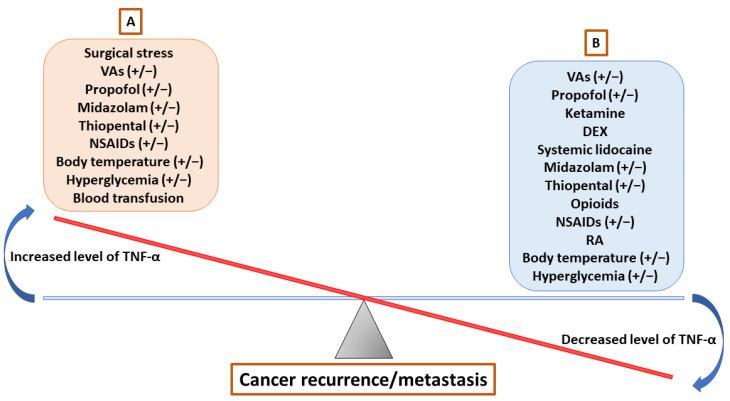
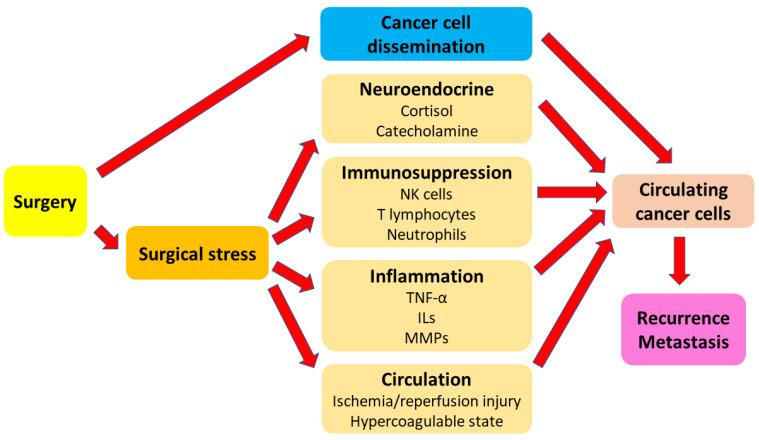
Cancer remains a major public health issue and a leading cause of death worldwide. Despite advancements in chemotherapy, radiation therapy, and immunotherapy, surgery is the mainstay of cancer treatment for solid tumors. However, tumor cells are known to disseminate into the vascular and lymphatic systems during surgical manipulation. Additionally, surgery-induced stress responses can produce an immunosuppressive environment that is favorable for cancer relapse. Up to 90% of cancer-related deaths are the result of metastatic disease after surgical resection. Emerging evidence shows that the interactions between tumor cells and the tumor microenvironment (TME) not only play decisive roles in tumor initiation, progression, and metastasis but also have profound effects on therapeutic efficacy. Tumor necrosis factor alpha (TNF-α), a pleiotropic cytokine contributing to both physiological and pathological processes, is one of the main mediators of inflammation-associated carcinogenesis in the TME. Because TNF-α signaling may modulate the course of cancer, it can be therapeutically targeted to ameliorate clinical outcomes. As the incidence of cancer continues to grow, approximately 80% of cancer patients require anesthesia during cancer care for diagnostic, therapeutic, or palliative procedures, and over 60% of cancer patients receive anesthesia for primary surgical resection. Numerous studies have demonstrated that perioperative management, including surgical manipulation, anesthetics/analgesics, and other supportive care, may alter the TME and cancer progression by affecting inflammatory or immune responses during cancer surgery, but the literature about the impact of anesthesia on the TNF-α production and cancer progression is limited. Therefore, this review summarizes the current knowledge of the implications of anesthesia on cancers from the insights of TNF-α release and provides future anesthetic strategies for improving oncological survival.
癌症仍然是一个重大的公共卫生问题,也是全球主要的死亡原因。尽管化疗、放疗和免疫疗法取得了进展,但手术仍是实体瘤癌症治疗的主要手段。然而,已知肿瘤细胞在手术操作过程中会扩散到血管和淋巴系统中。此外,手术引起的应激反应会产生有利于癌症复发的免疫抑制环境。高达90%的癌症相关死亡是手术切除后转移性疾病的结果。新出现的证据表明,肿瘤细胞与肿瘤微环境(TME)之间的相互作用不仅在肿瘤的发生、发展和转移中起决定性作用,而且对治疗效果也有深远影响。肿瘤坏死因子α(TNF-α)是一种参与生理和病理过程的多效性细胞因子,是TME中炎症相关致癌作用的主要介质之一。由于TNF-α信号可能调节癌症进程,因此可以将其作为治疗靶点以改善临床结果。随着癌症发病率的持续上升,约80%的癌症患者在癌症治疗期间需要进行麻醉以进行诊断、治疗或姑息手术,超过60%的癌症患者因初次手术切除而接受麻醉。大量研究表明,围手术期管理,包括手术操作、麻醉剂/镇痛药和其他支持性护理,可能通过影响癌症手术期间的炎症或免疫反应来改变TME和癌症进展,但关于麻醉对TNF-α产生和癌症进展影响的文献有限。因此,本综述从TNF-α释放的角度总结了目前关于麻醉对癌症影响的知识,并提出了改善肿瘤患者生存率的未来麻醉策略。
 Zotero 插件