
瑞典龙讷比受污染饮用水中全氟烷基物质高暴露后学龄前儿童的发育性语言障碍
Developmental language disorders in preschool children after high exposure to perfluoroalkyl substances from contaminated drinking water in Ronneby, Sweden.
作者信息
Stübner Charlotte, Ebel Matilda, Jakobsson Kristina, Gillberg Christopher, Nielsen Christel, Miniscalco Carmela
机构信息
Gillberg Neuropsychiatry Centre, Institute of Neuroscience and Physiology, Sahlgrenska Academy, University of Gothenburg, Gothenburg, Sweden.
Department of Pediatric Speech and Language Pathology, Queen Silvia Childrens´ Hospital, Sahlgrenska University Hospital, Gothenburg, Sweden.
出版信息
Environ Epidemiol. 2022 Dec 14;7(1):e233. doi: 10.1097/EE9.0000000000000233. eCollection 2023 Feb.
UNLABELLED
There are indications that early-life exposure to perfluoroalkyl substances (PFAS) can impact neurodevelopment, but results are inconclusive. The objective was to investigate if high early-life exposure to primarily perfluorohexanesulfonic acid (PFHxS) and perfluorooctanesulfonic acid (PFOS) increases the risk of developmental language disorder in children up to seven years of age.
METHODS
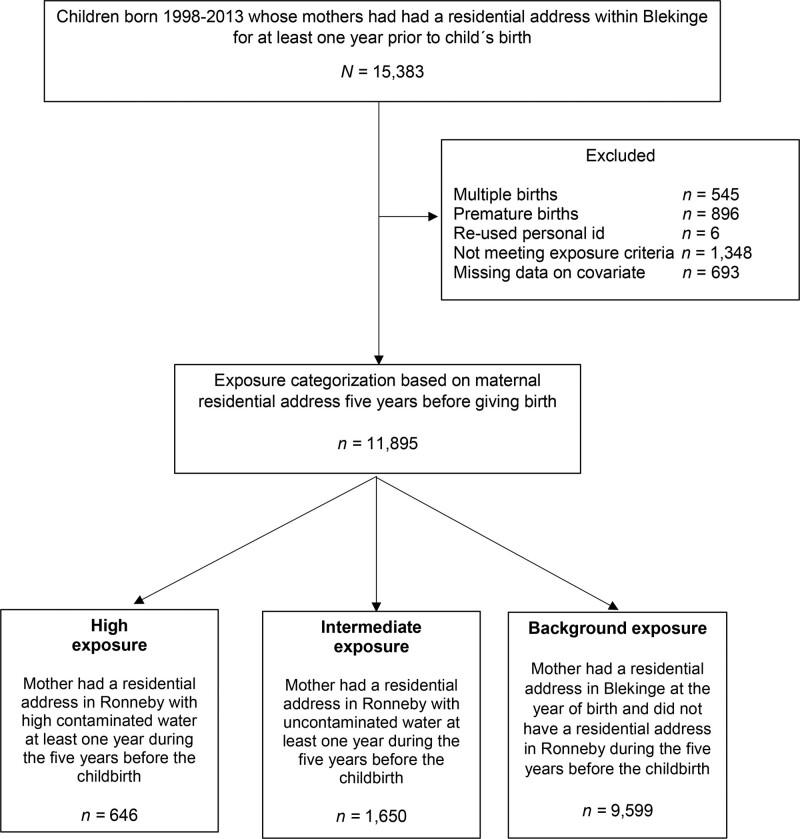
A register-based cohort of all children born 1998-2013 in Blekinge county, Sweden, was studied. Maternal residential history, that is, with or without highly PFAS-contaminated drinking water, during the 5-year period before childbirth was used as a proxy for early-life exposure. Exposure was categorized as high (n = 646), intermediate (n = 1,650), or background (n = 9,599). We used Cox proportional hazards regression to estimate hazard ratios (HR) for (1) referral to a speech- and language pathologist after routine screening at Child Health Services, and (2) subsequent language disorder diagnosis after clinical assessment. Models were adjusted for parity, maternal age, education level, and smoking, and explored effect modification by sex.
RESULTS
In children from the high-exposed area, the adjusted HR for referral was 1.23 (95% CI = 1.03, 1.47) and 1.13 (95% CI = 0.97, 1.56) for subsequent diagnosis. There was no increased risk in the intermediate exposure category.
CONCLUSION
Children, particularly girls, with high exposure had an increased risk of both referral and confirmed developmental language disorder. Further research is needed on PFAS in the context of general neurodevelopment, for which language development is a proxy.
未标注
有迹象表明,生命早期接触全氟烷基物质(PFAS)会影响神经发育,但结果尚无定论。目的是调查生命早期主要接触全氟己烷磺酸(PFHxS)和全氟辛烷磺酸(PFOS)是否会增加7岁以下儿童患发育性语言障碍的风险。
方法
对瑞典布莱金厄省1998年至2013年出生的所有儿童进行基于登记的队列研究。分娩前5年的母亲居住史,即是否饮用受PFAS高度污染的饮用水,被用作生命早期接触的替代指标。接触分为高暴露组(n = 646)、中暴露组(n = 1,650)或背景组(n = 9,599)。我们使用Cox比例风险回归来估计(1)儿童健康服务常规筛查后转诊至言语和语言病理学家的风险比(HR),以及(2)临床评估后随后的语言障碍诊断的风险比。模型对产次、母亲年龄、教育水平和吸烟进行了调整,并探讨了性别对效应的修饰作用。
结果
在高暴露地区的儿童中,转诊的调整后HR为1.23(95%CI = 1.03, 1.47),随后诊断的调整后HR为1.13(95%CI = 0.97, 1.56)。中暴露组没有增加的风险。
结论
高暴露的儿童,尤其是女孩,转诊和确诊发育性语言障碍的风险增加。在一般神经发育的背景下,需要对PFAS进行进一步研究,语言发育是其替代指标。
 Zotero 插件