
螺环罗丹明B苯并异噻唑衍生物:一种表现出乙醇响应性、光响应性和酸致变色的多刺激荧光开关。
Spirocyclic rhodamine B benzoisothiazole derivative: a multi-stimuli fluorescent switch manifesting ethanol-responsiveness, photo responsiveness, and acidochromism.
作者信息
Battula Himabindu, Nath Moromi, Mishra Sabyashachi, Jayanty Subbalakshmi
机构信息
Department of Chemistry, Birla Institute of Technology and Science Pilani-Hyderabad Campus, Jawaharnagar, Shameerpet, Kapra Mandal, Medchal Dist. Hyderabad-500078 Telangana State India
Department of Chemistry, Indian Institute of Technology Kharagpur-721302 India.
出版信息
RSC Adv. 2023 Feb 9;13(8):5134-5148. doi: 10.1039/d2ra08022b. eCollection 2023 Feb 6.
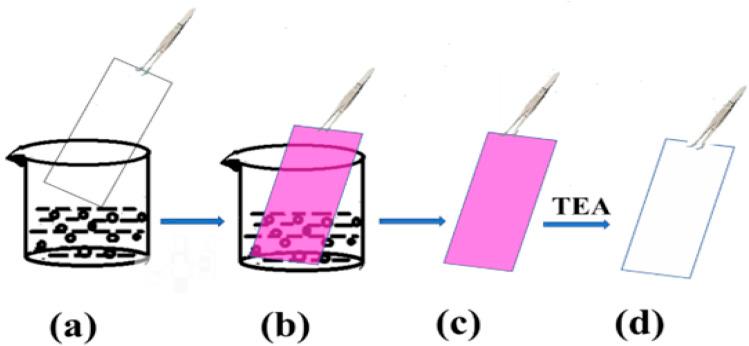
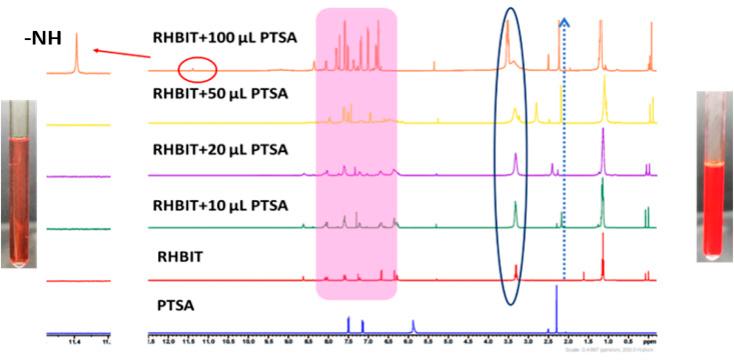
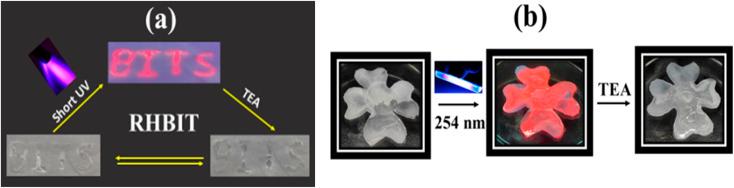
Multi-stimuli fluorescent switching materials have been extensively employed in chemistry, biochemistry, physics, and materials science. Although rhodamine-based spirolactams have been specifically considered for metal ion sensing by photoluminescence, only some of them manifest photochromic behavior, and further development of rhodamine B (RHB)-based photochromic materials is required. RHB and its cyclic amides are advantageous in various sensing applications owing to their colorimetric responses to external stimulation. Hence, the current work reports a novel multifunctional active molecular material (3',6'-bis(diethylamino))-2-(5-nitrobenzo[]isothiazol-3-yl)spiro[isoindoline-1,9'-xanthen]-3-one (RHBIT) by linking rhodamine B with 3-amino,5-nitro[2,1]benzoisothiazole (ANB) in a facile synthetic pathway; that perceives both emission color change and switching between off-on states. RHBIT shows acidochromism, photochromism, and pH sensitivity accompanied by unique ethanol responsiveness, with potential applications in anti-counterfeiting and drug delivery. Notably, RHBIT is highly acid sensitive and reverts to the ring-closed form on treatment with triethylamine (base), visible with the naked eye amidst colorless-pink-colorless transformations. On short UV irradiation, RHBIT provides a two-fold rise in the lifetime for the ring-open form in CHCl and DCM compared to the spirolactam (closed form). DFT and TDDFT studies provide electronic characterization for the absorption spectra of the open and closed forms. Using the photoresponsive feature of RHBIT, an information protection application has been enacted a rewritable platform.
多刺激荧光开关材料已广泛应用于化学、生物化学、物理学和材料科学领域。尽管基于罗丹明的螺内酰胺已被专门用于通过光致发光检测金属离子,但其中只有一些表现出光致变色行为,因此需要进一步开发基于罗丹明B(RHB)的光致变色材料。RHB及其环状酰胺由于其对外部刺激的比色响应,在各种传感应用中具有优势。因此,目前的工作报道了一种新型多功能活性分子材料(3',6'-双(二乙氨基))-2-(5-硝基苯并[]异噻唑-3-基)螺[异吲哚啉-1,9'-呫吨]-3-酮(RHBIT),它通过一种简便的合成途径将罗丹明B与3-氨基-5-硝基[2,1]苯并异噻唑(ANB)连接起来;该材料既能感知发射颜色变化,又能在关闭-开启状态之间切换。RHBIT表现出酸致变色、光致变色和pH敏感性,并伴有独特的乙醇响应性,在防伪和药物递送方面具有潜在应用。值得注意的是,RHBIT对酸高度敏感,用三乙胺(碱)处理后会恢复到闭环形式,在无色-粉红色-无色的转变中肉眼可见。与螺内酰胺(闭环形式)相比,在短时间紫外线照射下,RHBIT在CHCl₃和DCM中开环形式的寿命提高了两倍。DFT和TDDFT研究为开环和闭环形式的吸收光谱提供了电子表征。利用RHBIT的光响应特性,已经实现了一种信息保护应用——一个可重写平台。




 Zotero 插件